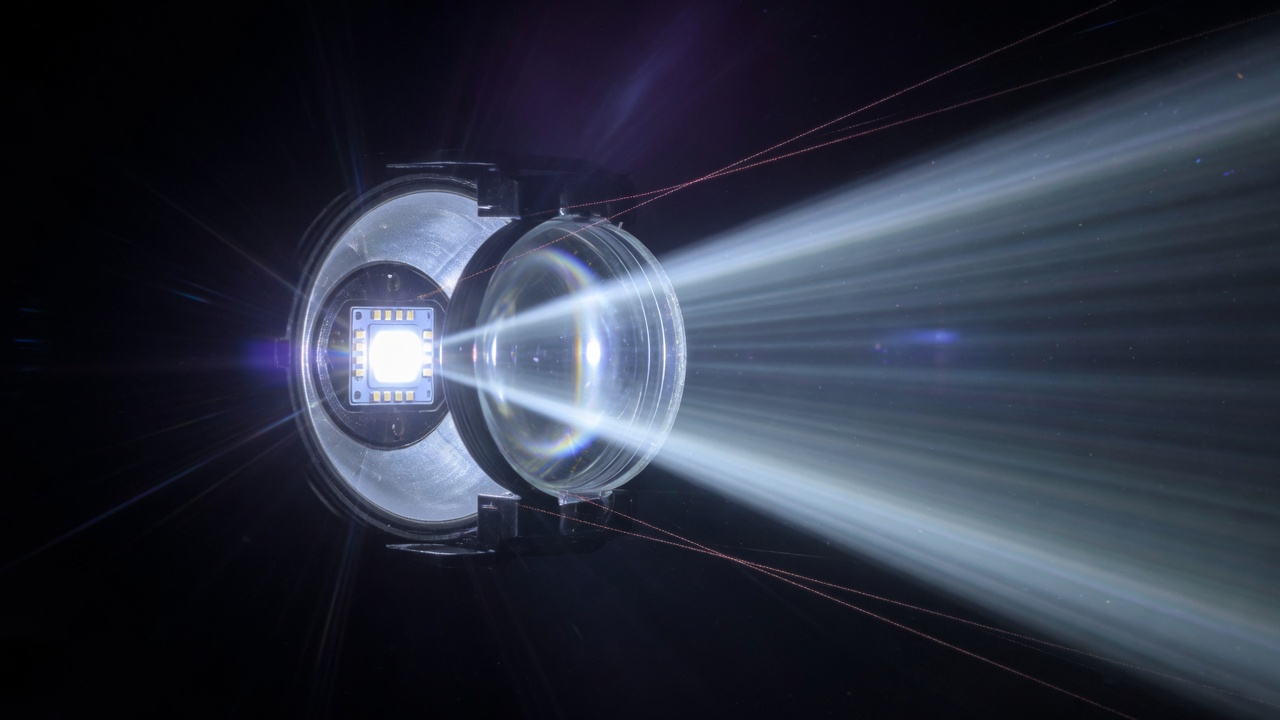
Light leaving an LED die scatters in every direction unless it is guided. Optics—lenses, reflection, diffusion—decide where that light ultimately goes, how wide it spreads, and how tightly it focuses. And all of it can be described precisely in a standard format called an IES photometric file, letting designers simulate real light on a computer. This article is about LED optics and light distribution.
Light leaving an LED die scatters in every direction unless it is guided. Optics—lenses, reflection, diffusion—decide where that light ultimately goes, how wide it spreads, and how tightly it focuses.
And all of it can be described precisely in a standard format, letting designers simulate real light on a computer. This article is about LED optics and light distribution—a dimension decorative lighting often overlooks, yet one that determines viewing quality.
Beam angle: how much the light spreads
Beam angle describes how much an LED’s light spreads, and it is the single most central parameter of light distribution:
- Narrow beam (say 15°)—focused, throws far, ideal for accent lighting and long-distance projection.
- Wide beam (say 120°)—spread out, wide coverage, ideal for uniform illumination or large-scale decoration.
Beam angle is set by the LED’s lens and optical design. In decorative and display applications, a pixel’s emission angle (the range of angles from which it can be seen) matters just as much—it governs how uniform the light looks to viewers standing at different angles.
Intensity distribution curves and IES photometric files
To describe precisely where the light goes, you need an intensity distribution curve—which describes a source’s luminous intensity (in candela) in every direction.
The standard format that carries this curve is IES LM-63—the standard photometric file format (.ies file) defined by the Illuminating Engineering Society (IES)[1]. It records, in text, a luminaire’s candela values at each vertical and horizontal angle, along with total lumens, wattage, beam angle, luminaire dimensions, and more. ANSI/IES LM-63-19 is the current version, and it will be complemented in future by the XML-based TM-33 format[1].
Why design relies on photometric files: making light predictable
The value of an IES photometric file lies in making lighting design predictable.
With a real luminaire’s IES file, a designer can accurately simulate illuminance distribution, uniformity, and glare in software such as DIALux, Relux, and AGi32—without trial and error on site. For planning, sign-off, and communication on large projects, this is an indispensable tool. A luminaire without an IES file effectively asks the designer to work blind.
The optics of decorative lighting: designed for viewing
Here lies a crucial distinction. General lighting cares about illuminance distribution and uniformity—lighting a space comfortably; addressable decorative and display work cares more about each pixel’s emission angle and consistency—so viewers see uniform color and brightness from every angle.
Too narrow an emission angle and the sides dim out with uneven color; too wide and brightness disperses, losing its punch. The optics of decorative applications are designed for viewing, not for illuminating—and that is the fundamental difference from functional lighting in optical terms.
Optics are part of pixel selection too
A pixel’s optics (emission angle, diffusion) are determined mainly by its package and lamp body design. PowerMOS offers point-control chips and addressable pixels that can be paired with different packages and diffusion designs for different applications—dense displays need uniform viewing angles, while outline decoration needs appropriate focus. See the full lineup at the product center.
Further reading: for the color side of display quality, see Grayscale, Color, and Flicker-Free Dimming in Addressable LEDs; for visual comfort, see Glare and Visual Comfort.
References and standards
- ANSI/IES LM-63-19, Standard File Format for the Electronic Transfer of Photometric Data and Related Information. Illuminating Engineering Society.
- ANSI/IES TM-33, Standard Format for the Electronic Transfer of Luminaire Optical Data. Illuminating Engineering Society — the next-generation XML optical data format.
This article is an educational overview of optical engineering. The names and numbers of the cited standards can be verified in the official catalog of the Illuminating Engineering Society (IES). PowerMOS point-control chips use a proprietary carrier protocol optimized specifically for LED point control; pixel optics are determined by package and lamp body design.
FAQ
What is beam angle?
Beam angle describes how much an LED's light spreads. A narrow beam (say 15°) is focused and throws far, ideal for accent lighting; a wide beam (say 120°) spreads out and covers a large area, ideal for uniform illumination or large-scale decoration. Beam angle is set by the LED's lens and optical design and is the core parameter of light distribution. In decorative and display applications, a pixel's viewing angle (its emission angle) also affects how uniform it looks.
What are intensity distribution curves and IES photometric files?
An intensity distribution curve describes a source's luminous intensity (in candela) in every direction. IES LM-63 is the standard photometric file format (.ies file) defined by the Illuminating Engineering Society (IES); it records a luminaire's candela values at each vertical and horizontal angle in text form, along with total lumens, wattage, beam angle, and more. Designers use it in software such as DIALux, Relux, and AGi32 to simulate the lighting effect of a real luminaire.
Why does lighting design rely on IES photometric files?
Because they make design predictable. With a real luminaire's IES file, a designer can accurately simulate illuminance distribution, uniformity, and glare on a computer, without trial and error on site. This is essential for planning, sign-off, and communication on large projects. ANSI/IES LM-63-19 is the current version, and it will be complemented in future by the XML-based TM-33 format.
How do the optical considerations for addressable decorative lighting differ from general lighting?
General lighting cares about illuminance distribution and uniformity (lighting a space comfortably); addressable decorative and display work cares more about each pixel's emission angle and consistency (so viewers see uniform color and brightness from different angles). Too narrow an emission angle and the sides dim out; too wide and brightness disperses. The optics of decorative applications are designed for viewing, not for illuminating.
How does PowerMOS approach pixel selection from an optical standpoint?
A pixel's optics (emission angle, diffusion) are determined mainly by its package and lamp body design. PowerMOS offers point-control chips and addressable pixels that can be paired with different packages and diffusion designs for different applications—dense displays need uniform viewing angles, while outline decoration needs appropriate focus. You are welcome to discuss pixel and packaging options with PowerMOS based on your application's viewing requirements.
Upgrading your string lights to full pixel control?
Power MOS Electronics delivers the complete stack — driver ICs, addressing equipment, controllers and apps. Tell us about your product and our engineering team will spec it with you.
Contact PowerMOS Browse products