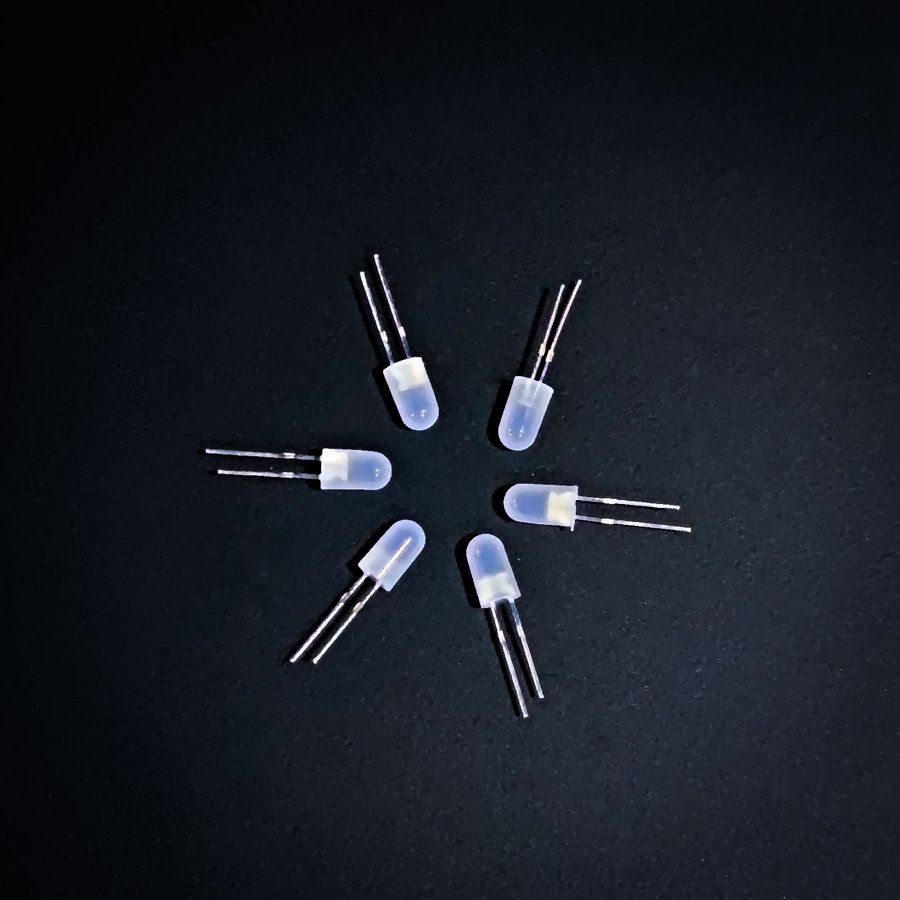
P9866 series
Third-generation anti-interference architecture: fuse-region surge protection and interference-resistant decoding. 256+ beads per channel, working at both high-voltage AC 110/220V and low-voltage DC — our current workhorse part.
Products
The full range of power-line carrier driver ICs, backed by DC/AC controllers, carrier converters and an app ecosystem — covering retail, professional installation, signage and copper-wire lights.
Pixel IC · Full-Pixel Series
Every bead gets its own address, with live (on-line) and pre-stored (off-line) data — full-gamut control across points, lines, planes and 3D.
Third-generation anti-interference architecture: fuse-region surge protection and interference-resistant decoding. 256+ beads per channel, working at both high-voltage AC 110/220V and low-voltage DC — our current workhorse part.
Four-channel output; an independent white channel lets warm-white scenes and full-color motion coexist, meeting the color-quality demands of premium retail and professional installations.
Purpose-built for copper-wire and PVC-wire lights. The P9871's two-layer address (18-bit laser fuse + 8-bit poly fuse) lets a single feed reel complete both assembly and addressing on an automated SMD line; the parallel structure supports automatic detection of faulty beads and re-addressing after replacement.
Patented two-section address design (10 bits split into 6+4), so one chip recognizes two sets of information at once. Laser-trim grading of functions — synchronized/random blink, 1–32 fixed codes, and fixed-plus-random sectioned combinations — covers high-volume full-color tree lights across price points.
A new high-speed carrier protocol (core patent US 11,152,972 B1) that raises refresh rate and LED count on the same two wires and decodes reliably even with voltage drop at the far end of long strings.
Single-level power-line carrier: the supply line is pulled straight to 0 V to send data while built-in charge storage keeps the chip running — so the controller needs just one MOSFET. 256-step PWM, field-burnable 8-bit address, RGBW zone compensation and a Low Vds design save power in series strings; P9165AH/A add 8-step current gain for battery and solar strings. Bead operating current is about 70% below the benchmark part.
Built for year-round eave lighting: five constant-current outputs R/G/B/CW/WW (up to 60 mA each), with independent cool- and warm-white channels for direct color-temperature control; 16-bit grayscale (65,536 steps) and 25 kHz PWM — no flicker on phone video. VDD 4.5–38V for long 36V runs; sleep current <100 µA when off with no data. Single-wire RZ cascade protocol.
Two-wire power-line carrier with four constant-current R/G/B/W outputs (up to 19.5 mA each, 256-step PWM) for standard two-pin bases such as E27 / GU10 / MR16. Each chip ships with a laser-trimmed 24-bit unique address, so users replace failed bulbs themselves — the controller detects the new bulb by its power draw and learns its address automatically (US 12,452,984), no addressing tool needed.
Selection Guide
| Series | Channels | Address mode | Typical application | Voltage |
|---|---|---|---|---|
| P9864 / P9866 series | RGB × 3 | Programmable 8–9 bits | Pixel string, net & curtain lights, architectural lighting | DC / AC 110/220V |
| P9865 / P9873 | RGBW × 4 | Programmable 9 bits | Premium strings, warm-white + full-color scenes | DC / AC |
| P9871 | RGB × 3 | Two-layer address (18b laser + 8b poly fuse) | Copper-wire lights, 2D curtains, 3D sculptures, replaceable screw-base lamps | DC |
| P9874 / P9875 | RGB × 3 / RGBW × 4 | Parallel, programmable | PVC-wire lights, shoelace-light automated lines, repairable applications | DC |
| P9863 / P9867 / P9868 | RGB / RGBW | Fixed address (10–18 bits) | Full-color tree lights, high-volume retail strings | DC / AC |
| P9831 / P9832 / P9835 high-refresh series | RGB × 3 / RGBW × 4 | 9-bit programmable (511 LEDs), reads both high and low levels | Smart strings, curtains and trees needing smooth per-bead animation; ~41.5 Hz at 200 LEDs | DC (6 series groups at 24V) |
| P9825 permanent lighting | RGB + CW + WW × 5 | Single-wire RZ cascade | Permanent, architectural outline and linear lights; 16-bit · 25 kHz PWM | DC 4.5–38V (36V systems) |
| P9779 | RGBW × 4 | Factory 24-bit unique address, auto-learned after a swap | Replaceable bulb strings (E27 / GU10 / MR16) | DC 5–40V |
| P9165 series | RGB × 3 / RGB + WW × 4 | Field-programmable 8 bits | DC 5V / 24–31V strings, bulbs, rectified-AC high voltage, battery strings | DC / rectified AC |
| Parameter | Options | Notes |
|---|---|---|
| Regulated voltage | 6V across the range | Built-in voltage regulator |
| Drive current | Indoor: 3.5 / 4.7 / 7 mA per channel · Outdoor: 7 / 10 / 12 / 20 mA per channel | Chosen by the brightness needs of the environment |
| ESD protection | Human-body model 6KV · Latch-up ±200mA @ 8.25V | Built-in over-voltage protection with strong anti-interference |
The chips are produced on a mature 8-inch process line in Taiwan and fully tested at our own wafer-probe facility. The connection structure supports two topologies: all-parallel (simple process, PWM-adjustable total power) and serial-parallel (more lamps per supply, longer signal reach).
P9165 Series · Constant-Current Carrier
Data rides on the power line as pull-low pulses, so two wires carry both power and control. Field-programmable addresses, 256-level PWM grayscale and constant-current drive; four parts cover high-speed RGB, rectified-AC high voltage, bulbs and low-voltage DC strings.
| Parameter | P9165D | P9165B | P9165AH | P9165A |
|---|---|---|---|---|
| Overview | ||||
| Channels | 3 (R / G / B) | 4 (R / G / B / WW) | ||
| PWM grayscale | 256 levels / ch (8 bit) | |||
| Communication | Single-supply carrier (power-line pull-low encoding) | |||
| Field-programmable address | Yes, up to 256 (0–255) | Yes, up to 255 | ||
| Current gain | None | None (fixed) | 8 steps (3 bit) | |
| Typical application | 3–5V all-parallel | Rectified AC 120V / 220V high-voltage supply | Bulbs; DC 24–31V, DC 5V | DC 24–31V, DC 5V |
| Drive current (VDD = 3.6V, Typ) | ||||
| Per-channel current | 2 mA (fixed) | 14 mA (fixed) | 2.31–14.96 mA (8 steps) | 8-step adjustable * |
| Gain 0 / 1 | — | — | 2.31 / 3.81 mA | Not listed |
| Gain 2 / 3 | — | — | 5.56 / 7.44 mA | Not listed |
| Gain 4 / 5 | — | — | 9.36 / 11.29 mA | Not listed |
| Gain 6 / 7 | — | — | 13.13 / 14.96 mA | Not listed |
| All-channel total (max.) | 3 × 2 = 6 mA | 4 × 14 = 56 mA | ≈ 59.8 mA | Not listed |
| Drive mode | Constant current, LED cathode to driver pin | |||
| Electrical & hardware | ||||
| Operating voltage VCC | 3–5V (Typ 3.6V) | 2.6–5V (Typ 3.6V) | 2.6–5V (Typ 3.6V) | Not in datasheet * |
| VCC absolute max. | 0 – +5.5V | |||
| Operating temp. | -20℃ – 85℃ | |||
| Storage temp. | -50℃ – 125℃ | |||
| ESD (HBM) | 4000V | |||
| Pads | 5 Pad: VDD, B, R, G, VSS | 6 Pad: VDD, WW, B, R, G, VSS | ||
| Reference circuit | 5V supply; MCU pulls the power line low via a low-side MOSFET (IR receiver) | 165V HV supply; MCU syncs to AC zero-cross, modulates via HV low-side MOSFET | DC 24–31V and DC 5V circuits (low-side MOSFET modulation, IR receiver) | |
* The P9165A operating-voltage range and per-step gain currents are not in the current datasheet — please request full data from sales before designing. Values are typical — design to the datasheet.
Classic Beads · Two-pin
Our mainstay two-pin pixel beads, grouped by address capacity. Power and signal share the same line (our patented technology, granted in China, the US, the EU and elsewhere), with 256-level grayscale per channel.
| Model | Channels | Output | Current (mA/ch) | Topology | Notes |
|---|---|---|---|---|---|
| 512-address RGB512 addresses | |||||
| 9866J | RGB | Constant current | 4.7 | Series-parallel | Designed for Christmas lights |
| 9866E | RGB | Constant current | 7 | Series-parallel | Designed for Christmas lights |
| 9866B | RGB | Linear | 7 | Series-parallel | For mains high-voltage use |
| 9874A | RGB | Constant current | 7 | Fully parallel | Parallel use, supports in-line bulb replacement |
| 512-address RGBW512 addresses | |||||
| 9865C | RGBW | Constant current | 7 | Series-parallel | Designed for Christmas lights |
| 9865E | RGBW | Constant current | 4.7 | Series-parallel | Designed for Christmas lights |
| 9873A | RGBW | Constant current | 10 | Fully parallel | Parallel use, supports in-line bulb replacement |
| 256-address RGB256 addresses | |||||
| 9864T | RGB | Constant current | 7 | Series-parallel | Address-code writing |
| 9864S | RGB | Constant current | 4.7 | Series-parallel | Address-code writing |
| 15-address RGB / RGBW (fixed code)15 addresses (fixed code) | |||||
| 9867A | RGB | — | 12 | Series-parallel | Designed for Christmas lights |
| 9867B | RGB | — | 4.7 | Series-parallel | Designed for Christmas lights |
| 9868B | RGBW | — | 4.7 | Series-parallel | Fixed + random code |
Full parameters (connection, output current, clamp voltage) are in the complete lineup table below →
PLC Carriers
A PLC carrier uses a modulation circuit to merge power and control signal onto one pair of wires: plug an existing SPI or DMX512 controller into a carrier and it drives two-wire pixel strings directly.
A modulation circuit merges power with the controller signal and outputs a carrier signal; two wires (+/−) go to the string with no separate signal line.
The signal side maps to 8 controller ports; outputs 1–8 each provide a two-wire carrier output for one controller port.
Merges power with a DMX512 signal into a carrier the beads understand; two wires to the string, connecting straight into stage and project control systems.
Multiple outputs extend how many beads each controller port can drive — one set of lights per output — cutting controller cost on projects.
A two-in-one controller for two-wire parallel beads: no separate programmer needed — beads are addressed one by one in-line as bulbs are installed, and effects play right away. Supports the 9874A, 9873A and similar.
Features
Full Lineup · Complete Parameter Table
The complete parameter table, grouped by series — connection, constant-current architecture, output current and clamp voltage. Values shown are typical; for full datasheets and samples, contact sales.
The flagship full-pixel series: beads assembled at random, addressed in-line on the production line. The P9866 is a third-generation anti-interference architecture, with versions for both high- and low-voltage applications.
Channels: RGB × 3 · Address: Programmable address (P9864: 8 bits · P9866: 9 bits / 512 codes)
| Model | Connection | CC | Output current (mA/ch) | Clamp voltage (V) | Notes |
|---|---|---|---|---|---|
| P9864S | Serial | ✓ | 4.7 | 6 | |
| P9864T | Serial | ✓ | 7 | 6 | |
| P9866A | Serial | ✓ | 7 | 6 | |
| P9866B | Serial | — | 7 | 6 | High-voltage |
| P9866D | Serial | — | 12 | 6 | High-voltage |
| P9866E | Serial | ✓ | 7 | 6 | |
| P9866F | Serial | — | 20 | 6 | Outdoor high-brightness |
| P9866G | Serial | — | 7 | 6 | |
| P9866J | Serial | ✓ | 4.7 | 6 | |
| P9866K | Serial | ✓ | 3 | 6 |
A fully parallel structure that detects faulty beads and rewrites the address after replacement — ideal for copper-wire lights and repairable applications.
Channels: RGB × 3 · Address: Programmable address (9 bits)
| Model | Connection | CC | Output current (mA/ch) | Clamp voltage (V) | Notes |
|---|---|---|---|---|---|
| P9874A | Parallel | ✓ | 7 | — | |
| P9874B | Parallel | ✓ | 4.7 | — | Battery-powered |
| P9874T | Parallel | — | 7 | — | |
| P9874N | Parallel | ✓ | 12 | — |
An independent white channel lets warm-white scenes and full-color motion coexist, serving premium retail and professional installation markets.
Channels: RGBW × 4 · Address: Programmable address (9 bits)
| Model | Connection | CC | Output current (mA/ch) | Clamp voltage (V) | Notes |
|---|---|---|---|---|---|
| P9865A | — | — | 4.7 | 6 | 3-channel version |
| P9865B | — | — | 7 | 6 | |
| P9865C | Parallel | ✓ | 7 | 6 | |
| P9865E | — | ✓ | 4.7 | 6 | |
| P9865F | — | — | 12 | 6 | High-voltage |
| P9865G | — | ✓ | — | — | Specs on request |
| P9873A | Parallel | — | 10 | — | Parallel structure |
A patented two-section address design with laser-trim function grading, serving the high-volume full-color tree-light market at exceptional value.
Channels: RGB × 3 · Address: Fixed two-section address (10 bits)
| Model | Connection | CC | Output current (mA/ch) | Clamp voltage (V) | Notes |
|---|---|---|---|---|---|
| P9867A | Serial | — | 12 | 6 | High-voltage |
| P9867B | Serial | — | 4.7 | 6 | |
| P9867C | Serial | — | 12 | 6 | High-voltage |
| P9867D | Serial | — | 4.7 | 6 | High-voltage |
| P9867E | Serial | — | 3 | 4 | Battery-powered |
| P9867F | Serial | — | 20 | 6 | Outdoor high-brightness |
| P9867G | Serial | — | 12 | 6 | |
| P9867H | Serial | ✓ | 3 | 6 | |
| P9869H | Serial | — | 3 | 6 | 3mA current version of the P9867B |
A four-channel fixed-code series; the P9875 is a parallel, programmable variant, covering four-color needs across copper-wire and tree lights.
Channels: RGBW × 4 · Address: Fixed address (10 bits)
| Model | Connection | CC | Output current (mA/ch) | Clamp voltage (V) | Notes |
|---|---|---|---|---|---|
| P9868A | Serial | — | 12 | 6 | High-voltage |
| P9868B | Serial | ✓ | 4.7 | 6 | |
| P9868D | Serial | — | 4.7 | 6 | High-voltage |
| P9868I | Serial | — | — | — | Specs on request |
| P9875A | Parallel | ✓ | 7 | — | Parallel · programmable address |
A copper-wire-light solution where a single feed reel completes both assembly and addressing; low-voltage parallel, with built-in power-to-ground reverse protection.
Channels: RGB × 3 · Address: 18-bit laser fuse + 8-bit poly fuse two-layer address
| Model | Connection | CC | Output current (mA/ch) | Clamp voltage (V) | Notes |
|---|---|---|---|---|---|
| P9871A | Parallel | — | 12 | — | |
| P9871B | Parallel | — | 7 | — | |
| P9871C | Parallel | — | 7 | — |
A fixed-code series with a serial constant-current architecture; multiple voltage and current versions cover both high- and low-voltage applications.
Channels: RGB × 3 · Address: Fixed address (18 bits)
| Model | Connection | CC | Output current (mA/ch) | Clamp voltage (V) | Notes |
|---|---|---|---|---|---|
| P9863A | Serial | ✓ | 7 | 7 | |
| P9863B | Serial | ✓ | 7 | 7 | |
| P9863C/D | Serial | ✓ | 7 | 7 | High-voltage |
| P9863E | Serial | ✓ | 7 | 5 | |
| P9863F | Serial | ✓ | 5 | 5 | |
| P9863G | Serial | ✓ | 7 | 5.2 | |
| P9863H | Serial | ✓ | 4.7 | 5.2 |
The new high-speed carrier protocol (US 11,152,972 B1) — ~41.5 Hz at 200 LEDs, 511 LEDs per channel.
Channels: P9831: RGB × 3 · P9832 / P9032: RGBW × 4 · P9835: RGB / RGBW · Address: Programmable address (9 bits)
| Model | Connection | CC | Output current (mA/ch) | Clamp voltage (V) | Notes |
|---|---|---|---|---|---|
| P9831A | Serial | ✓ | 4.7 | 6 | |
| P9831B | Serial | ✓ | 3 | 6 | |
| P9831C | Serial | ✓ | 3 | 6 | |
| P9831D | Serial | — | 7 | 6 | |
| P9831E | Serial | — | 3 | 5.5 | |
| P9835 | Serial | — | — | — | High-speed protocol · RGB / RGBW versions |
| P9832A | Serial | ✓ | 3 | 6 | |
| P9832B | Parallel | ✓ | 7 | — | |
| P962A | — | — | 4.7 | 6 | |
| P9032A | Serial | ✓ | — | — | Specs on request |
A serial constant-current programmable series with a 5.5V clamp-voltage design.
Channels: P9964 / P9966: RGB × 3 · P9965: RGBW × 4 · Address: Programmable address (P9964: 8 bits · others 9 bits)
| Model | Connection | CC | Output current (mA/ch) | Clamp voltage (V) | Notes |
|---|---|---|---|---|---|
| P9964T | Serial | ✓ | 7 | 5.5 | |
| P9965C | Serial | ✓ | 7 | 5.5 | |
| P9965E | Serial | ✓ | 4.7 | 5.5 | |
| P9966J | Serial | ✓ | 4.7 | 5.5 |
A two-wire, constant-current carrier series that encodes data by pulling the power line low, with 256-level PWM; P9165B / AH / A share one protocol, so a single controller firmware drives them all. See the P9165 comparison above for full specs.
Channels: P9165D: RGB × 3 · P9165B / AH / A: RGB + WW × 4 · Address: Field-programmable address (8 bits)
| Model | Connection | CC | Output current (mA/ch) | Clamp voltage (V) | Notes |
|---|---|---|---|---|---|
| P9165D | Parallel | ✓ | 2 | — | High-speed · 3-channel |
| P9165B | — | ✓ | 14 | — | Rectified-AC high voltage |
| P9165AH | — | ✓ | 2.31–14.96 | — | 8-step gain · bulbs |
| P9165A | — | ✓ | — | — | 8-step gain · standard |
16-bit grayscale, 25 kHz PWM, 60 mA per channel, VDD 4.5–38V and <100 µA sleep — built for year-round permanent eave lighting.
Channels: RGB + CW + WW × 5 · Address: Single-wire RZ cascade (no address code)
| Model | Connection | CC | Output current (mA/ch) | Clamp voltage (V) | Notes |
|---|---|---|---|---|---|
| P9825 | — | ✓ | 60 | — | 5-channel · 16-bit · 25 kHz PWM |
Two-wire power-line carrier, all chips in parallel; after a bulb swap the controller finds the new bulb by power detection and learns its address (US 12,452,984).
Channels: RGBW × 4 · Address: Factory 24-bit laser-trimmed unique address + 10-bit sequence address
| Model | Connection | CC | Output current (mA/ch) | Clamp voltage (V) | Notes |
|---|---|---|---|---|---|
| P9779 | Parallel | ✓ | 19.5 | — | Replaceable bulbs |
A three-wire shift-register product line serving the existing LED-strip and signage ecosystem.
Channels: RGB × 3 · Address: Serial shift register (no address code)
| Model | Connection | CC | Output current (mA/ch) | Clamp voltage (V) | Notes |
|---|---|---|---|---|---|
| P9828x | Parallel | — | 4.3 | — | 3-channel all-parallel |
Controllers & Converters
A complete chip + controller + software delivery, so customers receive a solution ready for volume production — not an isolated IC.
A full range of DC 5V/12V/24V and AC 110/220V control boards with a built-in effect library, supporting button, IR and RF remote — ready out of the box.
Four Ethernet groups, eight ports, driving 32 channels per board; at 200 beads/channel that's 6,400 beads per board, scaling in multiples through board cascading and video splitting.
Compatible with off-the-shelf host software: SPI video is converted to the carrier protocol in one step, and graphics (mapping) and video (AVI) files play back offline once composed — a direct route into the signage and city-lighting ecosystem.
Email us your application (string / net / copper-wire / installation), target bead count and input voltage, and we'll reply with a complete selection recommendation and sample arrangements.
Request samples / a quote sales-02@powermos.com