Core Technology

Modulate data onto the power line,
and every bead knows its own name

Power-line carrier pixel control is the complete answer PowerMOS built for one stubborn physical limit: a traditional string has only two wires.

The Problem

Why does it have to be two wires?

Mainstream shift-register architectures (the WS2811 family, for instance) need at least three lines — signal, VCC and GND; DMX512 needs five ports. But a traditional decorative bulb has only two legs. To bring full pixel control without changing the string's construction, tooling or production habits, carrying the signal on the power line is the only option.

One hard problem remains: how to assign and identify each bead's position address effectively, in the shortest possible time. That determines whether a product can move to automated production — and it's the real barrier to entry in this field.

ArchitectureWires neededWhat it means
Early display driving5 wires (clock / data / latch + power)Only suits routing on a single PCB
Three-wire shift register3 wires (signal + power)Mainstream for strips and through-hole lights
DMX5125 portsStage and professional installations
Power-line carrier2 wiresCompatible with traditional string construction

How It Works

How power and signal share a single pair of wires

01 · Modulation

A raised logic level

Once signal and power share the same port, you can no longer tell logic apart by 0V versus 5V. The carrier architecture sets a low level that always stays above the chip's reset voltage, encoding "0" and "1" by pulse width (PWM), which each bead's on-chip demodulation circuit restores to data.

02 · Decoding

Code timing measured from the falling edge

The resistance and parasitic inductance of a long wire distort the waveform. PowerMOS decodes each symbol from the signal's falling edge and ignores any pulse narrower than 1µs as noise — so even multi-strand net lights and curtain lights read reliably.

03 · Protection

Surge-protection circuitry

The logic gates of a 5V CMOS process are vulnerable to grid surges. The chip builds anti-interference protection into the critical fuse regions, and paired with surge absorption on the controller side, high-voltage AC 110/220V applications no longer suffer address drift, missing colors or dead beads.

Operating parameters Today's mainstream operating frequencies are around 330K (T0L 3µs) and 200K (T0L 5µs). Frame rate (FPS) depends on the bead count per channel — for example, driving 200 beads on a single string at 3µs reaches 16 FPS; larger net lights and lighting installations scale linearly through multi-channel output.
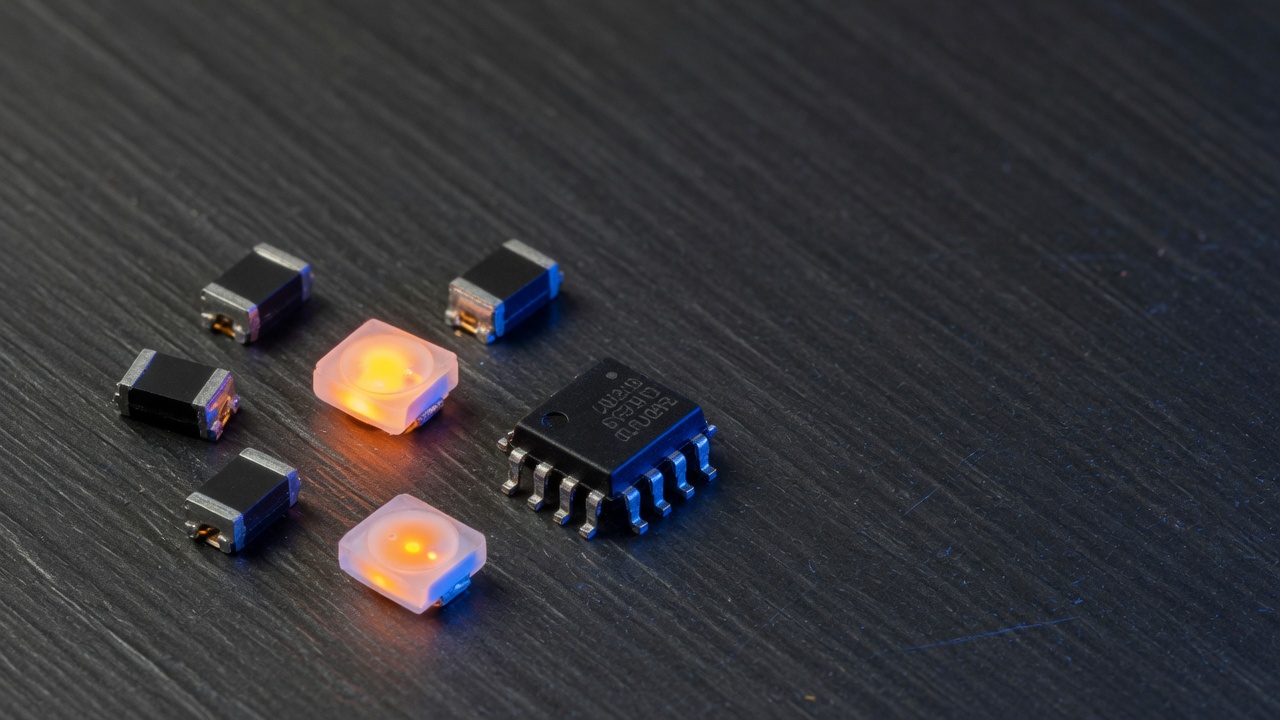
Close-up of SMD pixel beads and driver ICs

Signature · Two-Layer Address Architecture

The address: one layer set at the factory, one written on the line

The proprietary PowerMOS two-layer address design integrates two kinds of fuse on a single driver chip:

  • Metal fuse — laser-trimmed before wafer probe to set an 18-bit factory address (256K unique addresses), managed by lot number to avoid duplicates.
  • Poly fuse — after beads are randomly assembled into a string, an address writer performs a second in-line write so the address code matches each bead's real position exactly, with a checksum guarding against rewrites and drift.

The result: every string shares a consistent address scheme — interchangeable and repairable. A faulty string in a curtain light or 3D sculptural assembly can be swapped on the spot without being tied to a specific controller. Once addressing is folded into the automated string machine, throughput reaches 2,400 beads per hour — bringing string lights into the era of full-pixel volume production.

Evolution

Five generations in five years: the carrier technology roadmap

2015 – 2016

Architecture takes shape

The fundamental architecture — PWM modulation mixed into power delivery, demodulated at the bead — was established. The first generation used 20 trim-position combinations for addresses, launching parallel (P9860), serial (P9861) and high-voltage mains (P9862) parts, and completed volume validation.

2017

Laser trimming + two-layer address

Laser-trimmed metal fuses solved reliability issues, and integrating metal fuse + poly fuse on the same die — an industry first — made "assemble randomly, address afterward" possible. The P9871 remains a workhorse for 2D/3D copper-wire applications to this day.

2018

Automated in-line addressing at volume

The checksum mechanism eliminated address rewrites and drift; the address writer and the automated string machine were integrated for 2,400 beads/hour of in-line addressing. The P9864 series passed 50KK cumulative shipments in the low-voltage market with zero large-scale customer complaints over two years.

2019

The high-voltage, anti-interference generation

Fuse-region surge protection, falling-edge decoding and narrow-pulse noise filtering worked in concert: per-channel connections passed 256 beads and address depth expanded to 9 bits (512 codes). The P9866 became the new high-and-low-voltage workhorse, alongside the P9867/P9868 two-section fixed-code series for the mass market.

2020 →

Faster addressing, higher frame rates

Faster addressing (a single 9-bit burn, throughput heading toward 4,000/hour), edge-spacing encoding for 30% higher transmission efficiency, and 350 lamps per channel at 20 FPS — all validated across multiple foundry MPW runs in pursuit of the best cost and stability.

Control Ecosystem

A complete ecosystem, from controller to mobile app

The chip is only the start. To make pixel strings genuinely usable, you also need the controller, the host software and the mobile app — the full package.

Dedicated controllers

Retail solutions, ready out of the box

A full range of DC 5V/12V/24V and AC 110/220V control boards, mixing linear and switching supplies freely, with built-in effect programs switched by button or wireless remote — covering retail products at every price point.

Universal controller + converter

Bridging the professional ecosystem

The converter turns the video signal (SPI) authored in off-the-shelf host software into the carrier protocol; multi-port sub-control boards scale to thousands of beads and compose graphics and video files in a single step — a direct route into city lighting and light-show markets.

Mobile app

Handing editing over to the user

Two-way control over Wi-Fi and Bluetooth Mesh: custom string sizes, color-from-image sampling, music sync and synchronized multi-node networking. Buyers can design their own effects at home — the single biggest difference between pixel strings and traditional Christmas lights.

Not sure which generation fits your application?

Share your bead count, voltage, indoor/outdoor environment and control needs, and we'll help you spec the chip and controller.

Talk to our engineers See the products