Whether a space feels comfortable or harsh depends not only on how bright it is, but on whether it glares. Glare is the leading cause of visual discomfort—a light source that is too bright against a background that is too dark makes the eyes work hard. Lighting design has a quantitative method for glare called UGR, and standards that cap glare for different spaces. This article is about the engineering of visual comfort.
Whether a space feels comfortable or harsh depends not only on how bright it is, but on whether it glares.
Glare is the leading cause of visual discomfort—a light source that is too bright against a background that is too dark makes the eyes work hard. Lighting design has a quantitative method for glare, and standards that cap glare for different spaces. This article is about the engineering of visual comfort, and how addressable lighting strikes a balance between effect and comfort.
Bright ≠ comfortable: where glare comes from
A common intuitive fallacy is “brighter is better.” But visual comfort depends on the distribution of luminance, not on absolute brightness.
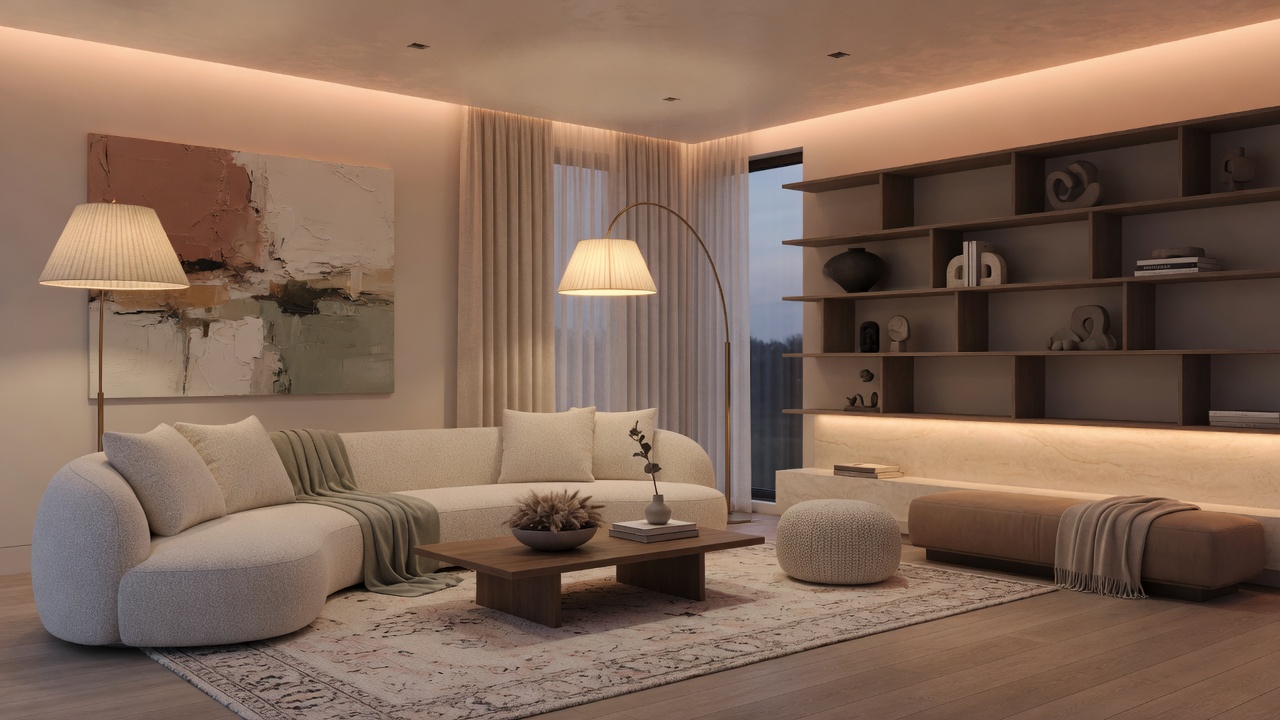
When a light source is far brighter than its surroundings, the eyes suffer from the sharp contrast between light and dark—that is glare. A bare bulb in a dark room is harsh; the same bulb in a bright room is not, and the difference is contrast. Good lighting is therefore not about making a space as bright as possible, but about controlling the contrast between source and background so that luminance is distributed evenly and comfortably.
UGR: turning glare into a measurable number
To manage glare, you first have to quantify it. UGR (Unified Glare Rating) is a method for assessing glare from interior lighting, developed by the International Commission on Illumination (CIE) to unify glare assessment[1].
UGR describes glare on a scale from 10 to 40—the higher the number, the harsher the glare—in steps of 3 (<13, <16, <19, <22…, corresponding to the smallest difference in glare the human eye can perceive)[1]. It does not look at a single luminaire alone, but takes into account luminaire luminance, background luminance, and the layout of the luminaires within the space—it assesses the glare of the whole lighting installation.
EN 12464: the glare red line for different spaces
With a way to quantify glare, you still need target values. EN 12464-1 is the standard for lighting of indoor workplaces, and it defines UGR upper limits for different visual tasks[2]:
- Offices, meeting rooms: UGR ≤ 19
- Precision work: UGR ≤ 16
- Industrial spaces: UGR ≤ 22
- Corridors, passageways: UGR ≤ 25
The pattern is clear: the finer the task, the lower the tolerance for glare. These figures give lighting designers an objective basis for assessing comfort.
The comfort advantage of addressable lighting
Addressable lighting has one distinctive advantage for visual comfort: per-pixel brightness control.
This lets it create dynamic effects while avoiding the glare of local hot spots—for example, softening the pixels facing viewers and dimming those in the background to actively control contrast. Combined with flicker-free dimming (following the dimming-frequency recommendations of IEEE 1789[3]), addressable lighting can be “effective and comfortable” at once.
Comfort is a quality detail of commercial and display lighting
For commercial spaces, displays, and hospitality—environments where people linger for long periods—visual comfort is part of the quality of the experience. PowerMOS addressable control ICs offer high grayscale depth and a constant-current architecture, so the brightness of every pixel can be adjusted finely and stably—the foundation for controlling glare and shaping a comfortable luminance distribution. Combined with flicker-free dimming, they suit spaces with demanding visual-comfort requirements. See the product center for the full model list.
Further reading: for flicker-free dimming, see Grayscale, Color, and Flicker-Free Dimming Engineering for Addressable LEDs; for commercial-space applications, see Festive Street Décor and Retail Window Lighting.
Reference standards and literature
- CIE (International Commission on Illumination), Unified Glare Rating (UGR) method. Glare assessment method.
- EN 12464-1, Light and lighting — Lighting of work places — Part 1: Indoor work places. European Committee for Standardization (CEN).
- IEEE Std 1789-2015, IEEE Recommended Practices for Modulating Current in High-Brightness LEDs for Mitigating Health Risks to Viewers. IEEE Standards Association.
This article is an educational piece on lighting quality. The names of the standards cited can be verified in the official catalogs of the CIE, CEN, and IEEE. PowerMOS addressable control ICs use a proprietary carrier protocol optimized for LED pixel control.
FAQ
What is UGR (the Unified Glare Rating)?
UGR (Unified Glare Rating) is a method for assessing glare from interior lighting. Developed by the International Commission on Illumination (CIE), it was intended to unify glare assessment across Europe. UGR describes glare on a scale from 10 to 40—the higher the number, the harsher the glare—in steps of 3 (<13, <16, <19, <22…). It takes into account luminaire luminance, background luminance, and the layout of the luminaires within the space.
What does EN 12464-1 specify about glare?
EN 12464-1 is the standard for lighting of indoor workplaces, and it defines UGR upper limits for different visual tasks and spaces. For example, it recommends UGR ≤ 19 for offices and meeting rooms, ≤ 16 for precision work, ≤ 22 for industrial spaces, and ≤ 25 for corridors. The finer the task, the lower the tolerance for glare. These figures give lighting designers an objective basis for assessing comfort.
Why is 'bright' not the same as 'comfortable'?
Visual comfort depends on the distribution of luminance, not on absolute brightness. When a light source is far brighter than its surroundings, the eyes suffer from the sharp contrast between light and dark—that is glare. Good lighting is therefore not about making a space as bright as possible, but about controlling the contrast between source and background so that luminance is distributed evenly and comfortably. The per-pixel brightness control of addressable lighting provides exactly this kind of fine control.
How does addressable lighting balance effect with visual comfort?
Addressable pixels can be tuned individually, so you can create dynamic effects while avoiding the glare of local hot spots—for example, softening the pixels facing viewers and dimming those in the background to control contrast. Flicker-free dimming (see IEEE 1789) is part of comfort too. Balancing effect with comfort is a mark of quality in decorative and commercial lighting.
How does PowerMOS's addressable solution support comfort control?
PowerMOS addressable control ICs offer high grayscale depth and a constant-current architecture, so the brightness of every pixel can be adjusted finely and stably—the foundation for controlling glare and shaping a comfortable luminance distribution. Combined with a flicker-free dimming design, they suit commercial and display spaces with demanding visual-comfort requirements. See the product center for the full model list.
Upgrading your string lights to full pixel control?
Power MOS Electronics delivers the complete stack — driver ICs, addressing equipment, controllers and apps. Tell us about your product and our engineering team will spec it with you.
Contact PowerMOS Browse products