Selling a string of lights into Europe used to be about 'how to make the lights well and pass certification.' But now there is a new question: what happens to that string once it is scrapped? Who is responsible for recycling it? Who pays for that? The EU's WEEE Directive and the new Battery Regulation have turned a product's 'afterlife' into a producer's legal responsibility. This is not just a compliance burden—it is quietly changing how products are designed. A string that is 'easy to fix and easy to replace' is turning from an environmental issue into a competitive selling point. This article discusses the circular-economy obligations of decorative lighting.
- WEEE: making ‘recycling’ the producer’s responsibility
- The new Battery Regulation: for battery-containing products, the bar rises a notch
- From ‘toss the whole string’ to ‘replace one bead’: the circular economy rewrites design
- Repairable is turning into a product selling point
- PowerMOS: a bead-replaceable architecture, naturally matched to circular design
- References and standards
- FAQ
Selling a string of lights into Europe used to be about ‘how to make the lights well and pass certification.’ But now there is a new question: what happens to that string once it is scrapped? Who is responsible for recycling it? Who pays for that?
The EU’s WEEE Directive and the new Battery Regulation have turned a product’s ‘afterlife’ into a producer’s legal responsibility. This is not just a compliance burden—it is quietly changing how products are designed. A string that is ‘easy to fix and easy to replace’ is turning from an environmental issue into a competitive selling point. This article discusses the circular-economy obligations of decorative lighting, and how they in turn shape a product’s design choices.
WEEE: making ‘recycling’ the producer’s responsibility
The EU’s core law for handling electronic and electrical waste is the WEEE Directive (Directive 2012/19/EU, on waste electrical and electronic equipment)[1]. Its spirit can be distilled into one term: Extended Producer Responsibility (EPR)—whoever places a product on the market is responsible for its disposal after it is scrapped.
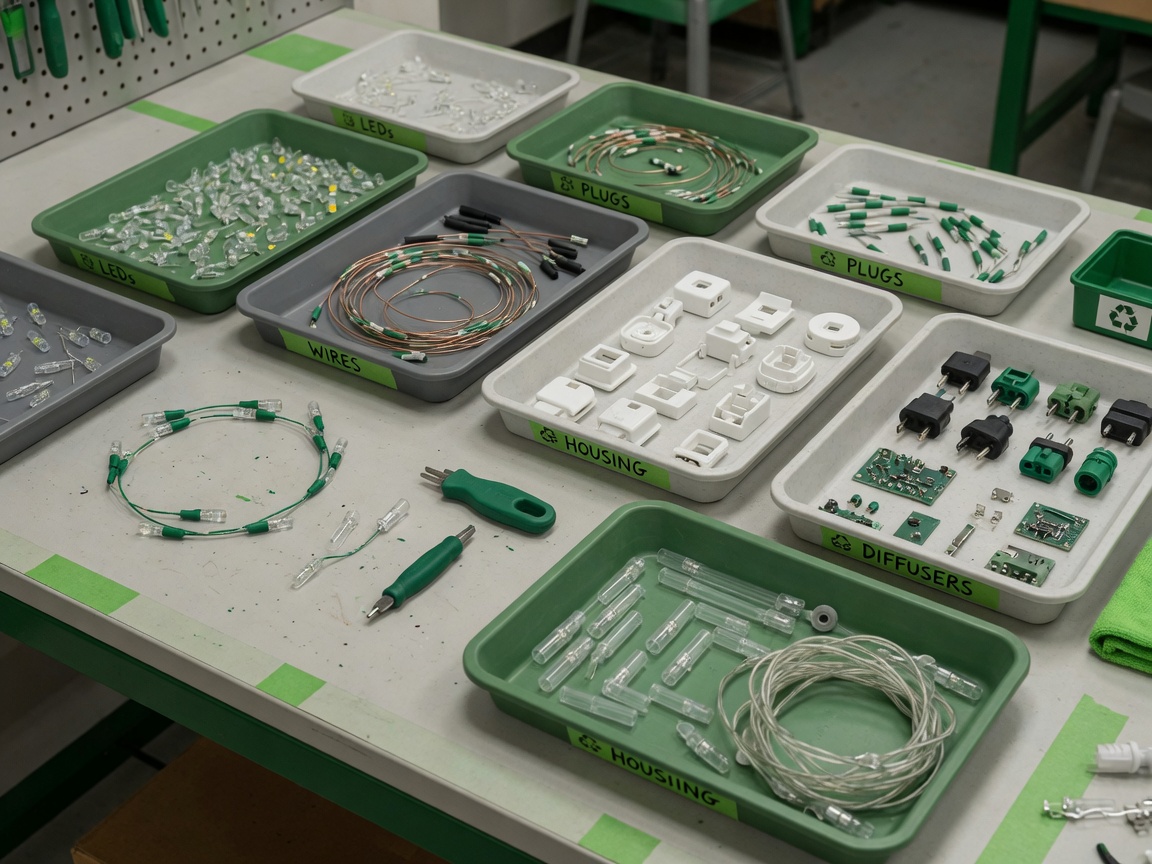
For producers or importers of electronic products such as light strings and light decorations, WEEE brings three specific obligations:
- Registration: register as a producer with the competent authority in each EU member state where it is placed on the market
- Marking: mark the product with the ‘crossed-out wheelie bin’ symbol, telling consumers it must not be discarded as ordinary waste and must be separately collected
- Recycling costs: bear the collection and recycling costs after the product is scrapped, usually met by joining and paying into each country’s recycling scheme (compliance scheme)
Lighting equipment falls explicitly within WEEE’s scope[1]. In other words, getting a light string into the EU does not end with passing safety and EMC certification—you also have to arrange the ‘recycling’ part, or it is non-compliant on the market.
The new Battery Regulation: for battery-containing products, the bar rises a notch
If a decorative light contains a battery—think of battery-powered copper-wire and wearable lights—then it faces another set of rules. In 2023 the EU introduced the new Batteries and Waste Batteries Regulation, Regulation (EU) 2023/1542, replacing the long-standing old Battery Directive[2].
This regulation raises the requirements a notch, spanning a product’s whole life cycle:
- Sustainability and safety: requirements on battery performance, durability and safety
- Marking and information: requiring battery-related information so that both users and the recycling end can identify and handle it correctly
- Collection and treatment of waste batteries: reinforcing producer responsibility for waste-battery recycling
The most notable point for a product team is a direction the regulation pushes: removability and replaceability—letting end users remove and replace built-in batteries more easily[2]. For a battery-powered decorative light this directly affects design: the battery cannot be permanently sealed inside, but has to allow for user replacement.
From ‘toss the whole string’ to ‘replace one bead’: the circular economy rewrites design
Looking at WEEE and the Battery Regulation together, you find they point the same way: make products more durable, easier to repair and easier to recycle, rather than scrapping the whole set when it breaks.
Traditional light strings have an annoying structural problem—one failed bead can drag down the whole string. In a series-wired circuit, a single point of failure often kills everything downstream; you cannot find which bead failed and cannot replace it, so the whole run ends up in the bin. This is exactly the waste that circular-economy law wants to change.
So the goal of product design turns toward repairability:
- Single-point failure does not propagate: one bead fails, the rest stay lit, making it easy to locate
- Bead-replaceable: the failed bead can be replaced on its own, without scrapping the whole string
- Modular: repair can be done at the user end or a service point
Once these designs are in place, the recycling burden drops and the product’s life extends—matching exactly what WEEE and the Battery Regulation require.
Repairable is turning into a product selling point
Interestingly, ‘repairable’ started as a passive obligation driven by law, but it is flipping into an active selling point.
The logic is not hard to follow. When a string lets you replace only the failed bead instead of scrapping the whole run, it satisfies three things at once: lowering the recycling burden (environmental), extending the service life (saving money), and improving customer experience (no need to buy a whole new string for one bad bead). For European consumers and buyers increasingly focused on sustainability, ‘this string is easy to fix and easy to replace’ is itself a persuasive reason to buy.
So durability and repairability shift from a cost item into a value item. A brand willing to build repairability into its product is not only more easily compliant, but also better able to tell a good story on the shelf.
PowerMOS: a bead-replaceable architecture, naturally matched to circular design
The circular economy’s demand for ‘repairability’ is exactly the strong suit of the PowerMOS pixel-control IC architecture. It supports bead-replaceable repair—a single-point failure does not propagate down the line, the rest keep working when one bead fails, making it easy to locate; and with an on-line rewritable two-tier address design, a replacement bead can be re-written with the correct address, so after repair the whole string keeps addressing normally without scrapping the whole run.
This ‘break one, replace one’ repairability answers the durability and repairability that WEEE and the Battery Regulation expect, giving the product a value beyond compliance that you can tell a customer. See the full model range and technical architecture at the product center.
Further reading: for the market overview of decorative lighting, see A Guide to the Decorative Lighting Market; for the durability engineering of bead lifetime and light decay, see LED Lifetime and Lumen Maintenance.
References and standards
- Directive 2012/19/EU of the European Parliament and of the Council of 4 July 2012 on waste electrical and electronic equipment (WEEE). European Parliament and Council of the European Union.
- Regulation (EU) 2023/1542 of the European Parliament and of the Council of 12 July 2023 concerning batteries and waste batteries, amending Directive 2008/98/EC and Regulation (EU) 2019/1020 and repealing Directive 2006/66/EC. European Parliament and Council of the European Union.
This article is an educational piece on the circular economy and compliance. The names of the cited regulations can be verified in the official catalog of the EU’s EUR-Lex. PowerMOS pixel-control ICs use a proprietary carrier protocol optimized for LED pixel control.
FAQ
What is the WEEE Directive, and what obligations does it place on light-string makers?
The WEEE Directive (Directive 2012/19/EU, on waste electrical and electronic equipment) is the EU's law governing electronic and electrical waste, built on Extended Producer Responsibility (EPR). A producer or importer placing light strings and other electronics on the EU market must register in each member state, mark the product with the 'crossed-out wheelie bin' symbol, and bear the collection and recycling costs after the product is scrapped. Lighting equipment is explicitly within WEEE's scope.
What does the 'crossed-out wheelie bin' symbol mean?
It is the separate-collection marking required by the WEEE Directive, signifying that the product must not be discarded as ordinary household waste but must be collected separately and sent through a dedicated electronic-waste recycling channel. It reminds consumers to dispose of it correctly and shows that the manufacturer has met WEEE's registration and recycling obligations. For products like light strings that contain electronic components and batteries, correct marking is one of the prerequisites for entering the EU market.
What effect does the new EU Battery Regulation have on battery-containing lights?
Regulation (EU) 2023/1542 (the Batteries and Waste Batteries Regulation) replaces the old Battery Directive and imposes stricter requirements on battery-containing products, covering sustainability, safety, marking and information, and reinforcing producer responsibility for the collection and treatment of waste batteries. One much-watched direction is 'removability and replaceability'—the regulation pushes for end users to be able to remove and replace built-in batteries more easily, which directly affects the design of battery-powered decorative lights.
Why does 'repairable' turn from an environmental duty into a selling point?
The core spirit of circular-economy law is to make products more durable, easier to repair and easier to recycle, rather than tossing the whole string when it breaks. When a string lets you replace only the failed bead instead of scrapping the whole run, it satisfies three things at once: lowering the recycling burden, extending the service life and improving customer experience. So 'bead-replaceable repair' shifts from passive environmental compliance to active product differentiation—durability and repairability are value in themselves.
How does the PowerMOS solution support repairable and circular design?
The PowerMOS pixel-control IC architecture supports 'bead-replaceable repair'—a single-point failure does not propagate down the line, and with an on-line rewritable address design, a damaged bead can be replaced without affecting the whole string's operation. This 'break one, replace one' repairability answers the circular economy's demand for durability and repairability, giving the product a layer of value beyond compliance. See the product center for the full model range and technology.
Upgrading your string lights to full pixel control?
Power MOS Electronics delivers the complete stack — driver ICs, addressing equipment, controllers and apps. Tell us about your product and our engineering team will spec it with you.
Contact PowerMOS Browse products