The same string of glowing lights sold into a US big-box store, hung across a city light show, built into a signboard, or wrapped around a champagne bottle is four completely different businesses. Different seasonal rhythms, different certification thresholds, different control ecosystems, different cost structures. This article unpacks the four segments of the decorative lighting market all at once.
- The retail market: a seasonal business shipping before August
- The professional market: secondary installation and control-system ecosystems
- The signage market: a three-wire scheme pushed to its cost limit
- The copper-wire light market: the automation turning point
- A field guide to string structures and control methods
- The app era: handing editing rights to the consumer
The retail market: a seasonal business shipping before August
Retail Christmas lights are a strongly seasonal business: the year’s production is concentrated to ship before August, with September through the following February the off-season for production; new-product showcases cluster from November to the following February, anchored by three key dates, the Frankfurt Christmasworld fair, the Hong Kong Autumn Lighting Fair, and the Atlanta lighting show in the US. Miss the shipping window and you miss a whole year.
The regional structure is clear too. The US market has historically been led by a handful of large importers with concentrated purchasing; Europe purchases in a more dispersed way, with each country’s own importers working with processing plants in East and South China, small in individual volume but long-standing in supply-chain ties. In product form, the US market favors a replaceable-bulb copper-bracket structure, while the European market favors welded iron-bracket construction.
Two hard thresholds
- Safety and EMC certification: going on shelves officially requires passing the safety and EMC certifications of the target region, with long application cycles. Note in particular: power-line-carrier products need a filter capacitor added to each LED to pass certification, a necessary cost for pixel-control strings entering retail channels.
- Complete packaged delivery: a retail product is a self-contained working set of power supply, controller, light string, and pattern software. Control methods have evolved from button switching and IR/RF remotes all the way to Bluetooth and Wi-Fi, and in recent years have paired with smart speakers for voice control and audio-reactive rhythm.
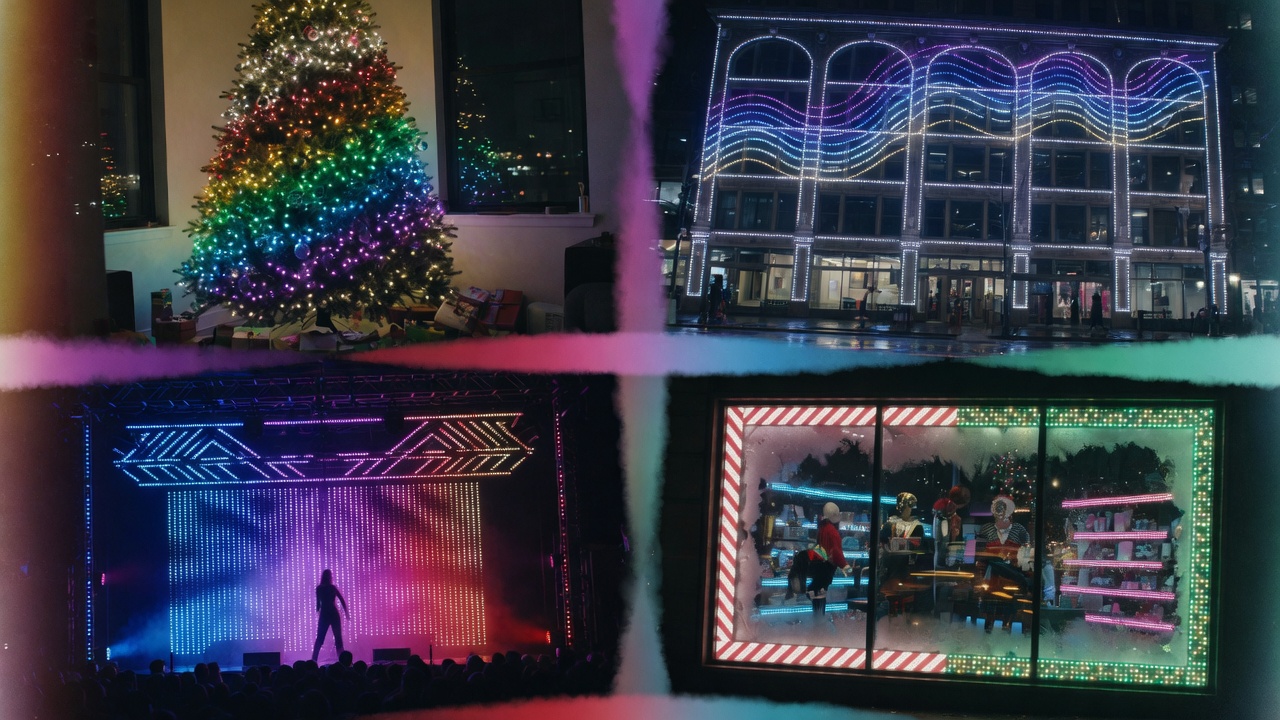
The professional market: secondary installation and control-system ecosystems
The professional market refers to products requiring secondary installation: indoor decor for commercial and entertainment venues, large outdoor spaces, urban illumination projects, and dedicated light-show venues. Its rules of the game differ completely from retail:
- Customization is the mainstream — low volume, high variety; you only know what product to build once you have the client;
- Milder seasonal swings — festivals fall at different times across countries, though the second half of the year remains the focus;
- Compatibility is the entry ticket — large projects need multiple subsystems managing huge numbers of graphic points under one control system, so a light string must be compatible with the market’s common host software and controllers to have a chance of being chosen.
The mainstream control ecosystem of the professional market today still rests on shift registers and the DMX512 protocol, with hardware using fully parallel, fixed-value low-voltage DC supply, which means thick, highly conductive wire is needed to fight attenuation. On this point, the carrier architecture offers a different answer: AC110/220V high-voltage input, series-parallel combinations, high voltage and low current, meaning thinner wire and lower total cost. Through a protocol-conversion controller, carrier strings can likewise plug into the ecosystem of common host software, as covered in the control-system chapter of Core Technology.
The signage market: a three-wire scheme pushed to its cost limit
The signage market, made up of exposed-pixel lights, backlight modules, and various light bars, has long been dominated by the shift-register architecture, with the three-wire scheme (one signal plus two power) the absolute mainstream. But the cost structure of this market has reached a tipping point:
- Existing shift-register modules need one SOP8-packaged IC, one separate four-pin RGB LED, a PCB, plus resistors and capacitors — the assembly process is complex, and every raw material has been squeezed to the edge of cost, with almost no room to fall further;
- The old problem of a broken point taking out the rest is especially expensive on outdoor signboards — the labor cost of a single repair can exceed the material itself.
The opportunity for carrier LEDs lies right here: an automated production process, non-propagating breakpoints, and a PCB-free integrated package give them the makings of the next-generation signage solution. Paired with a multi-output controller supporting standard host software, end users may eventually be able to do the wiring, address reading, and image editing for perforated-character signboards themselves.
The copper-wire light market: the automation turning point
Copper-wire lights have long relied mostly on fixed-color LEDs, and in recent years have used fixed address codes to achieve synchronized, chasing, and flowing effects. But fixed addressing has a structural pain point: it requires stocking multiple feed reels in different address sequences, which is error-prone to manage, hard to repair in the finished product, and costly, which is also why pixel control has spread slowly through copper-wire lights, with applications mostly stuck at shoe lights, battery light strings, and motif lights under 50 pixels.
The turning point is “dual-layer addressing”: a factory address plus in-line rewriting lets a single feed reel handle assembly and address reset for every LED within the valid address range, so the SMD placement line no longer needs to manage dozens of reels. Combined with the integration of a PVC-wire automatic production machine and address-writing equipment, automated production of 2D curtain lights and 3D dimensional lights is already running; strings with a parallel structure can further detect faulty LED positions automatically and rewrite addresses after replacement, closing the last gap in the reputation of pixel-control LEDs for being “hard to repair.” For related parts, see the copper-wire light solutions in the Product Center.
A field guide to string structures and control methods
Three structure types
| Type | Representative products | Characteristics |
|---|---|---|
| String | Straight strings, tube lights | Fully parallel or series-parallel, the most widely used |
| Grid | Net lights, curtain lights, tunnel lights | Multiple strings wired together, demanding address consistency and replaceability |
| Motif | Glowing flower trees, Santa, snowmen, reindeer, snowflakes, bells, Christmas trees, stake lights | Custom shapes, dominated by festive mascots |
The spectrum of control methods
- Mechanical buttons: a switch built into the controller manually cycles patterns, the most basic form;
- Infrared (IR): suited to indoor or short-range outdoor use, directional;
- RF remote (27 MHz / 49 MHz / 2.4 GHz): limited bandwidth, able only to send commands that wake built-in patterns;
- Bluetooth and Wi-Fi: the only two channels able to send large volumes of external data for real-time control. Bluetooth Mesh (4.2/5.0) supports bidirectional transmission, with many nodes forming a honeycomb local network, suited to long-range, multi-node scenarios such as street-tree illumination.
The app era: handing editing rights to the consumer
The biggest functional divide between fully pixel-controlled strings and traditional Christmas lights is that the consumer can keep creating after bringing it home: choosing colors on a phone, drawing patterns, syncing to music, customizing the string size and the net’s width and height, even using camera-based address reading to automatically locate each LED’s spatial position.
For brands and makers, this changes the product’s value curve: the hardware is merely the carrier, while the app experience and content ecosystem are the source of premium. The highest-end smart light-string product lines on the market were built along exactly this path. For the supply chain, it also means the chip supplier’s role is upgraded from “selling ICs” to “delivering a complete solution of chip, controller, and app.”
Upgrading your string lights to full pixel control?
Power MOS Electronics delivers the complete stack — driver ICs, addressing equipment, controllers and apps. Tell us about your product and our engineering team will spec it with you.
Contact PowerMOS Browse products