What does it mean for an LED pixel to be rated at '50,000 hours of life'? An LED almost never burns out suddenly like a bulb; instead it dims slowly. So an LED's lifetime is not 'lit until dark' but 'brightness decaying to a certain threshold'—which requires a rigorous test-and-projection method to define. This article is about lumen maintenance, LM-80, and L70, and how temperature and current determine how long a pixel really lasts.
What does it mean for an LED pixel to be rated at “50,000 hours of life”?
The question is subtler than it seems. An LED almost never burns out suddenly like a traditional bulb; instead it dims slowly. So an LED’s lifetime is not “lit until dark” but “brightness decaying to a certain threshold”—which requires a rigorous test-and-projection method to define. This article unpacks LED lifetime engineering, and how it affects addressable lighting running outdoors over the long term.
Lumen maintenance: the right definition of LED lifetime
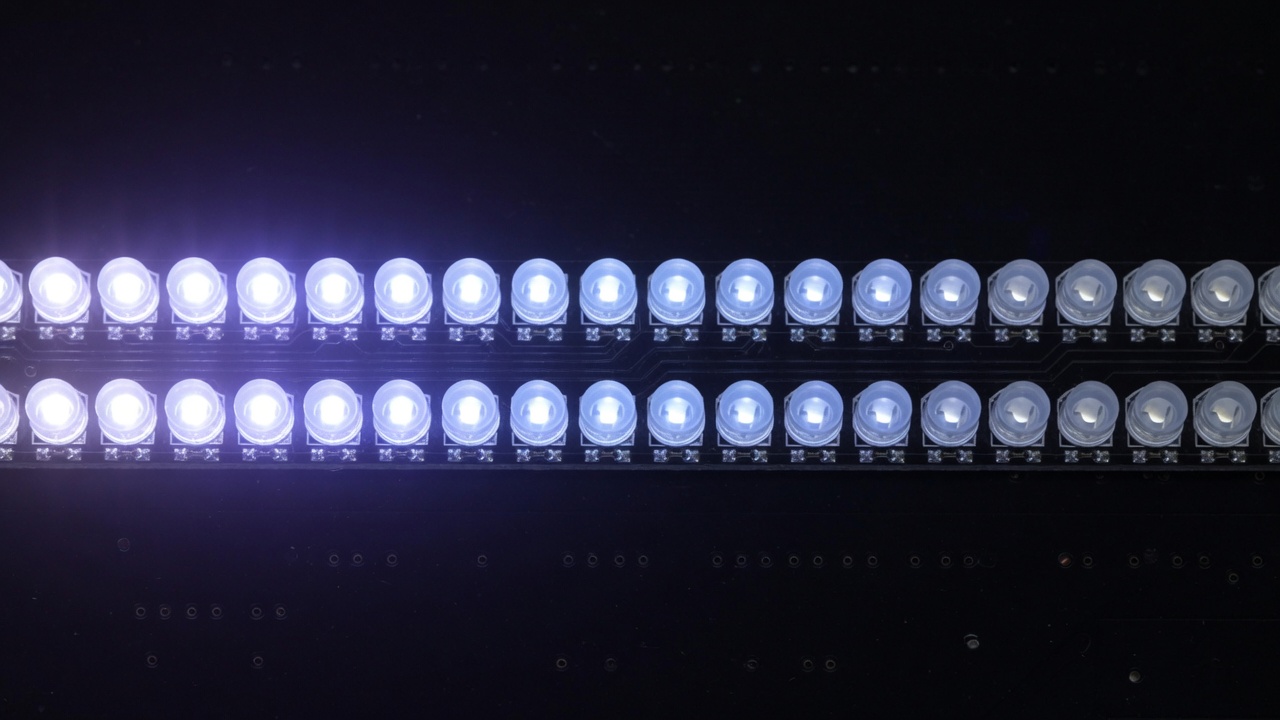
A traditional bulb’s lifetime is “lit until it burns out”; an LED is different—it undergoes lumen depreciation, its light output falling slowly over time. LED lifetime is therefore defined by lumen maintenance: the time it takes for light output to decay to a certain percentage of its initial value.
The most common benchmark is L70—the time to decay to 70% of initial output. When a pixel is rated at “50,000 hours,” it usually means an L70 of 50,000 hours, not “goes completely dark after 50,000 hours.”
LM-80 and TM-21: the division of labor between test and projection
The credibility of LED lifetime rests on two IES (Illuminating Engineering Society) standards with a clear division of labor.
IES LM-80 is the standard test method for measuring LED lumen depreciation[1]. It requires operating the LED at a specific operating temperature for at least 6,000 hours while recording lumen-maintenance data. LM-80 handles only “measurement”—it makes no prediction beyond the test duration.
IES TM-21 takes over the prediction[2]. It extrapolates LM-80’s measured data mathematically to calculate L70 lifetime. There is an important limit here: TM-21’s extrapolation cap is 6 times the test duration—a 10,000-hour test supports at most a 60,000-hour L70 claim, no more. This rule prevents overly optimistic lifetime marketing.
Temperature and current: the two true variables of lifetime
The L70 figure looks objective, but it depends heavily on test conditions. The two true variables determining the rate of LED lumen depreciation are:
- Junction temperature—the higher the temperature, the faster the depreciation and the shorter the lifetime. This is exactly why LM-80 tests at a specific temperature, and why good thermal design is vital to LED lifetime.
- Drive current—higher current means more heat and usually a shorter lifetime. Constant-current drive and sensible current design help control heat and extend lifetime.
So rated lifetime and actual service life can differ: if the actual application has higher temperature, larger current, or worse heat dissipation, lumen depreciation is faster than rated.
Lifetime is also a matter of selection and environment
Understanding the definition of lifetime makes selection clearer. PowerMOS addressable control ICs offer constant-current / non-constant-current architectures and selectable drive current (indoor 3.5–7 mA, outdoor 7–20 mA per channel); constant current and sensible current design help control heat and extend lifetime. Combined with good thermal structures, they suit the long-term outdoor operation of city illumination and architectural lighting—applications whose maintenance costs are tied directly to pixel lifetime. See the product center for full model parameters.
Further reading: for the other side of outdoor reliability (surge and EMC), see EMC, ESD, and Surge Reliability Engineering for Addressable LEDs; for display quality, see Grayscale, Color, and Flicker-Free Dimming Engineering for Addressable LEDs.
Reference standards and literature
- IES LM-80, Approved Method: Measuring Luminous Flux and Color Maintenance of LED Packages, Arrays and Modules. Illuminating Engineering Society.
- IES TM-21, Projecting Long-Term Luminous, Photon, and Radiant Flux Maintenance of LED Light Sources. Illuminating Engineering Society.
- IES PS-10-18, IES Position on LED Product Lifetime Prediction. Illuminating Engineering Society.
This article is an educational piece on lifetime engineering. The names of the standards cited can be verified in the official catalog of the Illuminating Engineering Society (IES). PowerMOS addressable control ICs use a proprietary carrier protocol optimized for LED pixel control.
FAQ
How is LED 'lifetime' defined?
Unlike a traditional bulb that stays 'lit until it burns out,' an LED usually dims slowly (lumen depreciation). LED lifetime is therefore defined by 'lumen maintenance'—the time it takes for light output to decay to a certain percentage of its initial value. The most common is L70, the time to decay to 70% of initial output. L70 is the most common benchmark for rating LED lifetime in the industry.
What are LM-80 and TM-21, and how are they related?
IES LM-80 is the standard test method for measuring LED lumen depreciation, requiring operation of the LED at a specific temperature for at least 6,000 hours while recording lumen-maintenance data. TM-21 is the method for extrapolating LM-80's measured data mathematically to project L70 lifetime. The two work together: LM-80 provides measured data, and TM-21 projects lifetime from it. An important limit is that TM-21's extrapolation cap is 6 times the test duration.
Why does temperature affect LED lifetime so much?
Junction temperature is the key factor determining the rate of LED lumen depreciation. The higher the temperature, the faster the depreciation and the shorter the lifetime. This is why LM-80 tests at a specific temperature, and why good thermal design is vital to LED lifetime. Drive current matters too—higher current means more heat, and usually a shorter lifetime. Constant-current drive and sensible current design help extend lifetime.
Why might rated lifetime and actual service life differ?
Rated lifetime (such as L70) is based on specific test conditions (temperature, current). If the actual application has higher temperature, larger current, or worse heat dissipation, lumen depreciation is faster than rated. The IES also clearly states that TM-21's LED lumen-depreciation lifetime should not be the sole indicator for judging whole-luminaire lifetime—which also depends on the driver power supply and other components. When selecting, understand the test premises of the rated lifetime.
What choices does PowerMOS offer for pixel lifetime?
PowerMOS addressable control ICs offer constant-current / non-constant-current architectures and selectable drive current (indoor 3.5–7 mA, outdoor 7–20 mA per channel); constant current and sensible current design help control heat and extend lifetime. Combined with good thermal structures, they suit the long-term outdoor operation of city illumination and architectural lighting. See the product center for full model parameters.
Upgrading your string lights to full pixel control?
Power MOS Electronics delivers the complete stack — driver ICs, addressing equipment, controllers and apps. Tell us about your product and our engineering team will spec it with you.
Contact PowerMOS Browse products