In contemporary art, light is no longer merely a tool to illuminate the exhibit—light itself is the exhibit. teamLab-style immersive spaces, suspended light sculptures, breathing walls: the medium of these works is 'light that can be controlled point by point.' Addressable LEDs let artists treat light as paint and paint in three-dimensional space. This article is about the engineering of light-art installations, written for those who make light the work.
In contemporary art, light is no longer merely a tool to illuminate the exhibit—light itself is the exhibit.
Immersive spaces of light, suspended light sculptures, breathing walls: the medium of these works is “light that can be controlled point by point.” Addressable LEDs let artists treat light as paint and paint in three-dimensional space. This article is about the engineering of light-art installations, written for those who make light the work.
Light as medium: the creative freedom of point-by-point control
The fundamental difference between light art and general lighting is that light is the object being created, not the means of illumination.
This requires light to have paint-like controllability—which addressable LEDs provide exactly: each pixel can independently display color and brightness, so an artist can “paint with light” on a 2D wall or in a 3D space. Flowing colors, breathing rhythms, waves of light spreading through space—this creative freedom is something fixed lighting or whole-strip color-changing cannot offer.
PowerMOS’s power-line carrier point-control chip provides precisely this foundation: giving every pixel its own address, making it one controllable point of light on the artist’s palette.
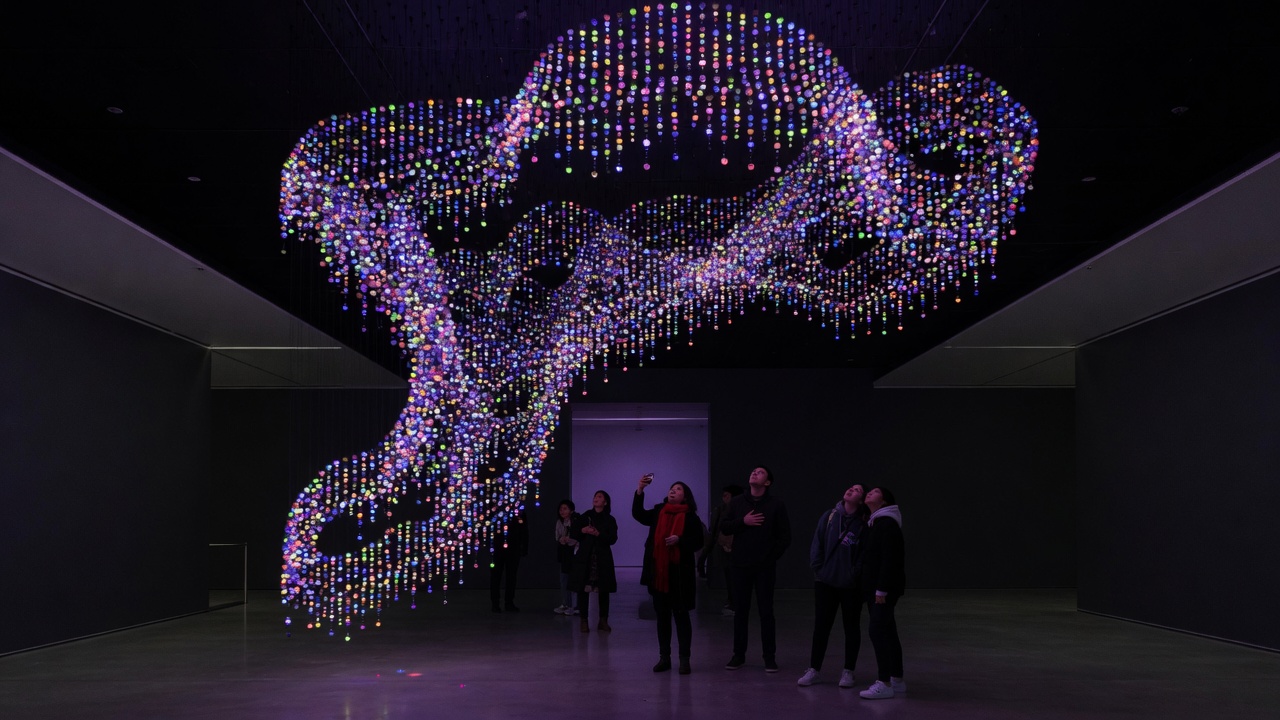
Free-form shapes: keeping wiring from shackling the imagination
Art installations are often oddly shaped—suspended, entangled, irregularly arranged. This is a major challenge for wiring: traditional multi-wire control quickly becomes a wiring nightmare on free-form shapes.
The two-wire power-plus-signal of addressable point-control pixels greatly simplifies this: each pixel needs only two wires to be independently addressed, suiting any shaped structure. This keeps an artist’s imagination for form from being shackled by wiring complexity—a structural advantage this series has repeatedly stressed when discussing 3D light sculptures in Theme Parks and Immersive Spaces.
Responding to the audience: bringing the work to life
The higher form of immersive light art is letting the work respond to the audience—light changing with a person’s movement, sound, or position.
In engineering terms, sensor or motion-capture signals are fed into the visual engine via protocols such as OSC (Open Sound Control)[1], and the engine maps the interaction to each pixel’s parameters in real time. Per-pixel control is the physical prerequisite for interactive light art—the same technical lineage as Motion-Capture Interactive Lighting Engineering.
Curatorial-grade reliability: the work must last the whole run
Art installations have a harsh requirement that commercial events do not: long-term display. Exhibitions often run long hours every day for weeks or months, and a mid-run failure hurts the visitor experience and the integrity of the work.
An architecture with independent address codes keeps a single pixel’s failure from breaking the whole string the way shift registers do, confining the fault to a single point and easing repair; consistent addresses also let a faulty string be swapped without scrambling. This is crucial for curatorial-grade installations that need long-term stability—the integrity of the art cannot be defeated by one dead pixel.
Selecting for your creation
PowerMOS provides addressable pixels, controllers, and carrier-conversion solutions; two-wire wiring suits free-form shapes, and it plugs into the standard show-signal ecosystem so artists can create with familiar tools. See the full lineup at the product center. To feel a 3D light sculpture directly, try the “3D light screen” scene in the Christmas Town 3D World. Museums, curatorial teams, and light artists are welcome to get in touch with PowerMOS with a creative concept in hand.
References and standards
- Wright, M. (2005). Open Sound Control: an enabling technology for musical networking. Organised Sound, 10(3). CNMAT, University of California, Berkeley.
- ANSI E1.31-2018 (sACN), Lightweight streaming protocol for transport of DMX512 using ACN. ESTA — content-distribution reference for large-scale installations.
This article is an educational overview of an application scenario. PowerMOS point-control chips use a proprietary carrier protocol optimized specifically for LED point control, connecting to the standard show-signal ecosystem through controllers.
FAQ
Why does contemporary art installation favor addressable LEDs?
Because addressable LEDs turn 'light' into a medium that can be controlled point by point in real time. Each pixel can independently display color and brightness, so an artist can 'paint with light' on a 2D wall or in a 3D space—flowing colors, breathing rhythms, interaction that responds to the audience. This creative freedom is something fixed lighting or whole-strip color-changing cannot offer.
What does an art installation's free-form shape require of pixel wiring?
Art installations are often oddly shaped—suspended, entangled, irregularly arranged—so wiring is a major challenge. The two-wire power-plus-signal of addressable point-control pixels greatly simplifies wiring: each pixel needs only two wires to be independently addressed, suiting any shaped structure. This keeps an artist's imagination for form from being shackled by wiring complexity.
How does immersive light art respond to the audience (interaction)?
Immersive installations often let light respond to the audience's movement, sound, or position. Sensor or motion-capture signals are fed into the visual engine via protocols such as OSC, and the engine maps the interaction to each pixel's parameters in real time. Per-pixel control is the physical prerequisite for interactive light art—the same lineage as immersive spaces and motion-capture interactive lighting.
What does a museum-grade exhibition require of lighting reliability?
Exhibitions are often on display long-term, running long hours every day, and a mid-run failure hurts the visitor experience and the integrity of the work. An architecture with independent address codes keeps a single pixel's failure from breaking the whole string, confining the fault to a single point and easing repair. Consistent addresses also let a faulty string be swapped without scrambling—crucial for curatorial-grade installations that need long-term stability.
How can a light artist or curatorial team obtain a solution?
PowerMOS provides addressable pixels, controllers, and carrier-conversion solutions; two-wire wiring suits free-form shapes, and it plugs into the standard show-signal ecosystem so artists can create with familiar tools. To feel a 3D light sculpture directly, try the '3D light screen' scene in the Christmas Town 3D World. Museums, curatorial teams, and light artists are welcome to get in touch with a creative concept in hand.
Upgrading your string lights to full pixel control?
Power MOS Electronics delivers the complete stack — driver ICs, addressing equipment, controllers and apps. Tell us about your product and our engineering team will spec it with you.
Contact PowerMOS Browse products