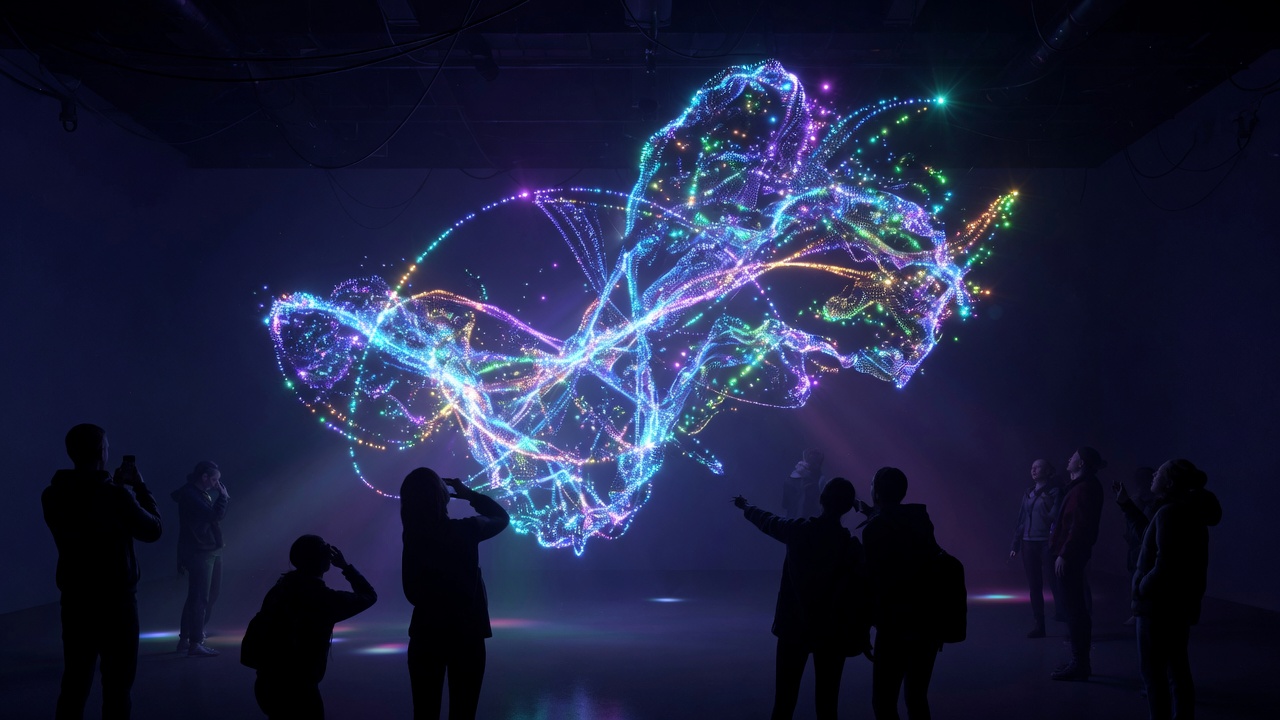
You walk into a room and light flows through the three-dimensional space all around you—not a flat picture on a wall, but light suspended in the air, with depth. Theme parks and immersive experiences push addressable LED from the 2D plane into 3D volume. That takes three things at once: enough scale, precise synchronization, and beads that can be controlled point by point in space.
You walk into a room and light flows through the three-dimensional space all around you—not a flat picture on a wall, but light suspended in the air, with depth.
Theme parks and immersive experiences push addressable LED from the 2D plane into 3D volume. It is the most imaginative application of addressable beads, and the one that tests system integration hardest. It takes three things at once: enough scale, precise synchronization, and beads that can be controlled point by point in space.
From plane to volume: 3D light sculpture
An ordinary LED wall is a 2D flat display; 3D volumetric lighting places addressable beads in a matrix through three-dimensional space, giving light depth and letting it flow within a volume—a rotating plane of light, a spiral wave, a rain of particles falling inside a cube.
This requires every bead to have a three-dimensional coordinate and an independent address, so that volumetric content can be mapped onto each physical bead in space. To feel it directly, the Volumetric Light Screen scene in the Christmas Town 3D world demonstrates volumetric light flowing through a bead matrix.
And volumetric installations have free-form shapes and constrained wiring—which is exactly the structural advantage of two-wire carrier: each bead needs only two wires to be addressed independently, suiting suspended, wrapped, or freely arranged three-dimensional structures, without pulling multiple control lines to every bead.
Scale and sync: coordinating multiple subsystems
A large immersive scene is often made of multiple subsystems that must coordinate an enormous number of beads under one control regime while staying synchronized across systems—the core challenge of theme-park-scale applications.
The professional approach distributes content through the synchronization mechanism of network lighting-control standards such as sACN (ANSI E1.31-2018). The current version of sACN includes enhancements for synchronization and discovery[1], designed precisely for this kind of large-scale, multi-node installation. PowerMOS carrier-conversion controllers connect into these standard signal ecosystems and, through multi-board cascading and video splitting, scale to multiples of thousands of beads.
Real-time interaction: letting the space respond to people
The advanced move in an immersive experience is letting the space respond to people in real time—a visitor’s movement, sound, or trigger instantly changes how the light behaves. Signals from motion capture or sensors are fed into a visual engine through protocols such as OSC (Open Sound Control)[2], and the engine maps the interaction to real-time parameters for each bead.
Per-bead control is the prerequisite for all real-time interaction. For the full engineering of interactive lighting, see Motion-Capture Interactive Lighting Engineering.
Selecting for your immersive space
PowerMOS provides the addressable beads, carrier-conversion controllers (connecting into standard show signals), and multi-channel sub-control that immersive spaces demand. Two-wire compatibility is especially well suited to the wiring of volumetric forms. See the product center for the full model list. To feel volumetric light sculpture and interaction directly, try the Christmas Town 3D world. Theme park, immersive entertainment, and spatial experience production teams are welcome to discuss with their scale and concept in hand.
References
- ANSI E1.31-2018 (sACN), Entertainment Technology — Lightweight streaming protocol for transport of DMX512 using ACN. ESTA — includes synchronization and discovery mechanisms.
- Wright, M. (2005). Open Sound Control: an enabling technology for musical networking. Organised Sound, 10(3). CNMAT, UC Berkeley.
- Art-Net 4, DMX-over-Ethernet protocol specification. Artistic Licence.
This article is an educational piece on application engineering. PowerMOS pixel-control ICs connect to standard show-signal ecosystems through a carrier-conversion controller and themselves use a proprietary carrier protocol optimized for LED pixel control.
FAQ
How is 3D volumetric lighting different from an ordinary LED wall?
An ordinary LED wall is a 2D flat display; volumetric lighting places addressable beads in a matrix through three-dimensional space, giving light depth and letting it flow within a volume—a rotating plane of light, a spiral wave, a rain of particles falling inside a cube. This requires every bead to have a three-dimensional coordinate and an independent address, so that volumetric content can be mapped onto each physical bead in space.
How do large-scale settings like theme parks manage the sync of tens of thousands of beads?
A large immersive scene is often made of multiple subsystems that must coordinate an enormous number of beads under one control regime while staying synchronized. The professional approach distributes content to each subsystem through the synchronization mechanism of network lighting-control standards such as sACN (ANSI E1.31). PowerMOS carrier-conversion controllers connect into these standard signal ecosystems and scale to multiples of thousands of beads through multi-board cascading and video splitting.
How is real-time interaction achieved in an immersive space?
Immersive experiences often combine real-time interaction—a visitor's movement, sound, or trigger instantly changes how the light behaves. Signals from motion capture or sensors are fed into a visual engine through protocols such as OSC, and the engine maps the interaction to real-time parameters for each bead. Per-bead control is the prerequisite for all real-time interaction. For the related engineering, see the article on motion-capture interactive lighting.
What do volumetric light installations demand of wiring and beads?
Volumetric installations have free-form shapes and constrained wiring, and addressable beads that carry both power and signal on two wires greatly simplify the wiring—each bead needs only two wires to be addressed independently, suiting suspended, wrapped, or freely arranged three-dimensional structures. This is the structural advantage of power-line carrier pixel control over architectures that need more conductors, in volumetric applications.
How do theme park or immersive production teams obtain a solution?
PowerMOS provides the addressable beads, carrier-conversion controllers (connecting into standard show signals), and multi-channel sub-control that immersive spaces demand. Two-wire compatibility suits the wiring of volumetric forms. To feel a volumetric light sculpture directly, try the Volumetric Light Screen scene in the Christmas Town 3D world. Production teams are welcome to discuss solutions with their spatial scale and experience concept in hand.
Upgrading your string lights to full pixel control?
Power MOS Electronics delivers the complete stack — driver ICs, addressing equipment, controllers and apps. Tell us about your product and our engineering team will spec it with you.
Contact PowerMOS Browse products