After dark, a park lights up in swaths of glow—a glowing tunnel, a color-shifting arcade, a giant sculpture that breathes with the crowd. A light festival turns an entire park, an entire walkway, into a playground of light you can step inside. This kind of city-scale festival installation is a comprehensive test of addressable LEDs across scale, outdoor reliability, and crowd interaction.
After dark, a park lights up in swaths of glow—a glowing tunnel, a color-shifting arcade, a giant sculpture that breathes with the crowd.
A light festival turns an entire park, an entire walkway, into a playground of light you can step inside. This kind of city-scale festival installation is a comprehensive test of addressable LEDs across scale, outdoor reliability, and crowd interaction—it condenses several of the engineering themes this series has covered into a single project.
Three tests at once: scale, outdoor, interaction
A light festival is hard because it demands three things at once, not a single challenge:
- Scale—swaths of light corridors, tunnels, and giant sculptures need vast numbers of pixels and a sub-control architecture.
- Outdoor reliability—running for weeks, long hours every night, it must withstand rain, snow, surges, and temperature changes.
- Crowd interaction—it must respond to the audience’s approach and movement, creating surprise and memorable moments.
Integrating these three is more comprehensive than any single application. Let’s unpack them one by one.
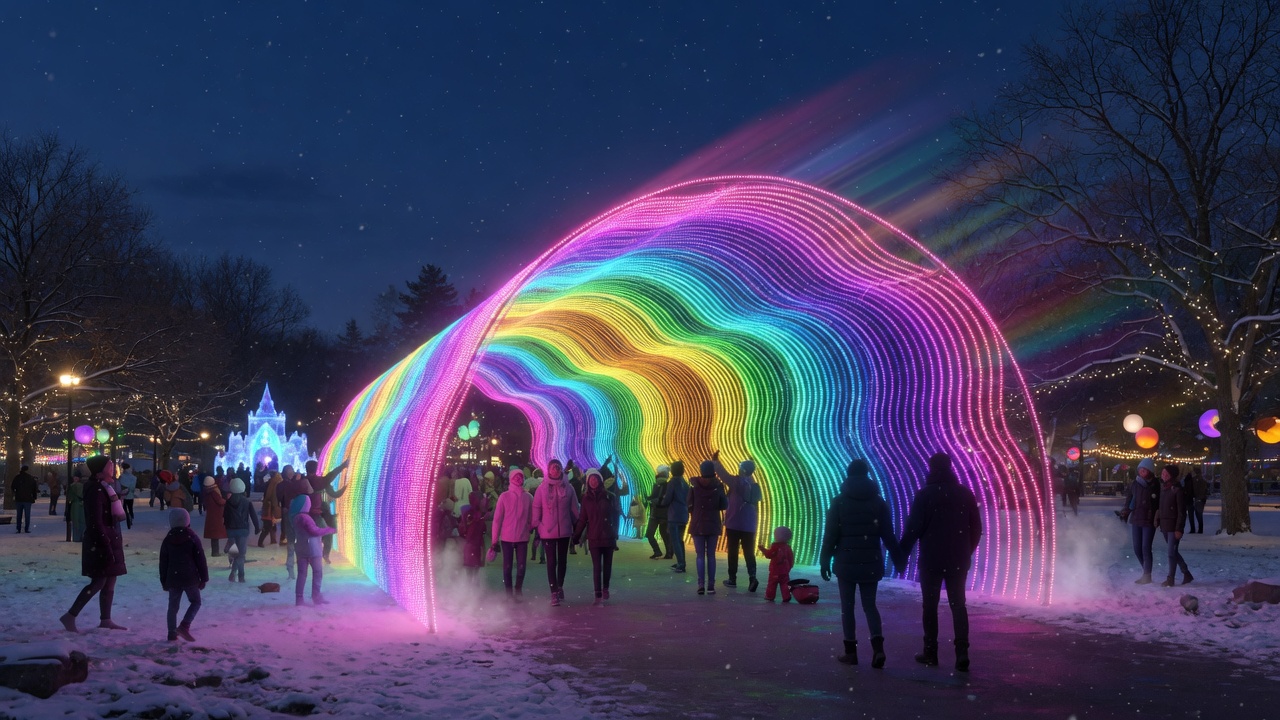
Scaling: distributing and synchronizing vast numbers of pixels
Large light corridors, tunnels, and sculptures have huge pixel counts. Engineering divides the installation into blocks with multi-channel sub-control to share the load and keep the motion fluid; content is then coordinated across multiple subsystems through the synchronization mechanism of network lighting-control standards such as sACN (ANSI E1.31)[1]. PowerMOS’s carrier-conversion controllers plug into the standard signal ecosystem and scale to vast pixel counts through multi-board cascading and video slicing. And two-wire wiring with high-voltage series-parallel connection significantly cuts the wiring cost of large-span sculptures.
Outdoor reliability: lasting the whole run
An event typically runs for weeks, operating every night, in harsh outdoor conditions. Reliability comes from three fronts at once:
- Waterproofing—select the right IP rating for the environment (IEC 60529[2]); open exposure to rain often needs IP67.
- Electrical immunity—follow the surge and electrostatic immunity of the IEC 61000 series[3].
- Architectural fault tolerance—an address-code architecture keeps a single failure from propagating and eases repair.
Only when waterproofing, immunity, and fault tolerance are all in place can the installation last the whole run without dropping out. For a deeper look, see Waterproofing and Protection for Outdoor Light Strings and EMC, ESD, and Surge Reliability Engineering for Addressable LEDs.
Crowd interaction: the memorable heart of the event
What people remember most about a light festival is often the interaction—light changing with a person’s approach, movement, or sound. Sensor or motion-capture signals are fed into the visual engine via protocols such as OSC[4] and mapped to pixel parameters in real time, so giant sculptures respond to the crowd. Per-pixel control and real-time signal drive are the prerequisites for interaction—the same lineage as Motion-Capture Interactive Lighting Engineering.
Selecting for your event
PowerMOS provides the addressable pixels, AC110/220V high-voltage solutions, multi-channel sub-control, and carrier-conversion controllers that large outdoor installations need, with two-wire wiring and high-voltage series-parallel connection cutting the cost of long-span wiring—suited to festival elements such as light corridors, light tunnels, giant sculptures, and tree illumination. See the full lineup at the product center. The Christmas Town 3D World offers a visualization in the style of the Oxford Street lights. Festival organizers, public-art teams, and large-event production teams are welcome to get in touch with PowerMOS with the scale of their site.
References and standards
- ANSI E1.31-2018 (sACN), Lightweight streaming protocol for transport of DMX512 using ACN. ESTA.
- IEC 60529, Degrees of protection provided by enclosures (IP Code). International Electrotechnical Commission.
- IEC 61000-4-5, Electromagnetic compatibility (EMC) — Surge immunity test. IEC.
- Wright, M. (2005). Open Sound Control: an enabling technology for musical networking. Organised Sound, 10(3). CNMAT, UC Berkeley.
This article is an educational overview of an application scenario. The names of the cited standards can be verified in the official catalogs of ESTA and IEC. PowerMOS point-control chips use a proprietary carrier protocol optimized specifically for LED point control.
FAQ
What do large-scale outdoor installations like light festivals require of addressable LEDs?
Three combined requirements: scale (swaths of light corridors, tunnels, and giant sculptures need vast numbers of pixels and sub-control), outdoor reliability (withstanding rain, snow, surges, and temperature changes), and crowd interaction (responding to the audience to create surprise). This is more comprehensive than any single application—a light festival tests scaled distribution, outdoor protection, and real-time interaction all at once.
How do the large sculptures of a light festival manage vast numbers of pixels?
Large light corridors, tunnels, and sculptures have huge pixel counts and need multiple channels of sub-control to divide the installation into blocks and share the load, keeping the motion fluid; content can be coordinated across multiple subsystems through the synchronization mechanism of network lighting-control standards such as sACN. PowerMOS's carrier-conversion controllers plug into the standard signal ecosystem and scale to vast pixel counts through multi-board cascading and video slicing.
How does an outdoor illumination event stay stable for the whole run?
An event typically runs for weeks, operating long hours every night in harsh outdoor conditions. Waterproofing must select the right IP rating for the environment (IEC 60529); electrical immunity follows the IEC 61000 series; and the architecture uses address-code fault tolerance so a single failure does not propagate. Only when waterproofing, immunity, and fault tolerance are all in place can the installation last the whole run without dropping out.
How does a light festival add elements of crowd interaction?
Interaction is the memorable heart of a light festival—light changing with a person's approach, movement, or sound. Sensor or motion-capture signals are fed into the visual engine via protocols such as OSC and mapped to pixel parameters in real time, so giant sculptures respond to the crowd. Per-pixel control and real-time signal drive are the prerequisites for interaction—the same engineering lineage as immersive spaces and motion-capture interactive lighting.
How can a festival organizer or production team obtain a solution?
PowerMOS provides the addressable pixels, AC110/220V high-voltage solutions, multi-channel sub-control, and carrier-conversion controllers that large outdoor installations need, with two-wire wiring and high-voltage series-parallel connection cutting the cost of long-span wiring. It suits festival elements such as light corridors, light tunnels, giant sculptures, and tree illumination. Festival organizers, public-art teams, and large-event production teams are welcome to get in touch with the scale of their site.
Upgrading your string lights to full pixel control?
Power MOS Electronics delivers the complete stack — driver ICs, addressing equipment, controllers and apps. Tell us about your product and our engineering team will spec it with you.
Contact PowerMOS Browse products