An addressable string hung outdoors has to survive rain, snow, dust, and washdowns. Its protection is measured by a code called the 'IP rating' — but what really separates IP65, IP67, and IP68? Choose wrong and, at best, water ingress causes a fault; at worst, the whole string is a write-off. This article makes clear how to read the IP code and which rating outdoor decorative lighting should choose.
An addressable string hung outdoors has to survive rain, snow, dust — even washdowns and brief flooding. Its protection is measured by a code called the “IP rating.”
But what really separates IP65, IP67, and IP68? Choose wrong and, at best, water ingress causes faults and dead pixels; at worst, the whole string is a write-off. This article makes clear how to read the IP code and which rating outdoor decorative lighting should choose — an unavoidable lesson in outdoor addressable lighting.
How to read the IP code: what the two digits mean
The IP protection rating is defined by the IEC 60529 standard[1], in the format “IP” plus two digits, each with a specific meaning:
- First digit (solids/dust) — 0 to 6. 0 means no protection, 6 means dust-tight (no dust can enter).
- Second digit (water) — 0 to 9. 0 means no protection; the higher the number, the stronger the water protection, with 9 withstanding high-temperature, high-pressure water jets.
For example, IP67 means dust-tight (6) and able to withstand temporary immersion to 1 meter (7). Read these two digits and you can judge which environment a string suits.
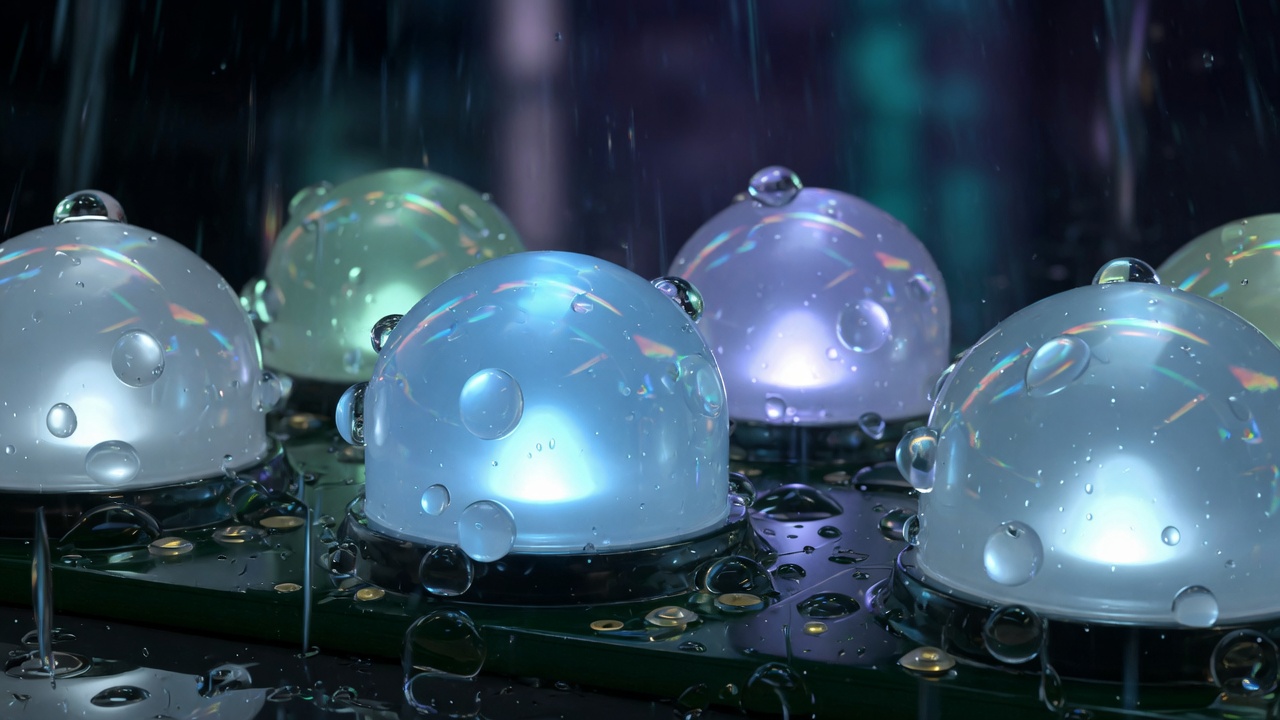
IP65 / IP67 / IP68: the real choice for outdoor strings
For outdoor decorative lighting, these three ratings come up most often:
- IP65 — dust-tight and protected against water jets, suitable for general sheltered outdoor use (under eaves, on sheltered walls).
- IP67 — dust-tight and able to withstand temporary immersion to 1 meter, suitable for environments that may pool or briefly flood (ground-level strings, open outdoor areas).
- IP68 — dust-tight and able to withstand prolonged immersion beyond 1 meter, suitable for demanding settings like water features, fountains, and burial.
Outdoor decorative strings commonly run IP65–IP67; only underwater or buried applications need IP68. The higher the rating, the higher the sealing craftsmanship and cost — selection is a balance between protection and cost.
A common fatal misconception: jetting ≠ immersion
There’s a trap here that engineering must clear up. IEC 60529 makes it explicit: above IPX6, the water ratings are not cumulative[1].
In other words, passing IPX7 (the immersion test) does not automatically mean passing IPX5 or IPX6 (the powerful water-jet test) — because immersion and jetting are entirely different test scenarios. If an outdoor environment carries both an immersion risk and high-pressure washing (for example, an installation that needs periodic cleaning), you must confirm the product meets both corresponding ratings, rather than assuming that “the higher number includes the lower.”
Waterproofing is only one part of outdoor reliability
It’s worth emphasizing that the IP rating only addresses “water and dust.” Outdoor addressable strings face other challenges too:
- Grid surges and ESD — can reference the immunity requirements of the IEC 61000 series; see EMC, ESD, and Surge Reliability Engineering for Addressable LEDs.
- Thermal cycling and UV aging — the weather resistance of the materials.
- Overall luminaire safety — can reference the IEC 60598 series of luminaire standards[2].
Waterproofing, electrical immunity, and material weather resistance — all three must be weighed together for an outdoor string to be truly durable.
Choosing for your outdoor application
PowerMOS offers carrier-based pixel-control ICs and addressable beads suited to outdoor high-voltage applications, with built-in interference protection; the waterproof rating is determined by the finished-product packaging, and PowerMOS helps engineering and manufacturing partners choose the right protection and sealing for their application environment (sheltered outdoor, rain-exposed, water features). See the product center for the full lineup.
Further reading: for the lifetime engineering of long-term outdoor operation, see How Long Do LED Beads Last; for the operation and maintenance of city illumination, see City Illumination and Architectural Facade Lighting.
Reference Standards and Literature
- IEC 60529, Degrees of protection provided by enclosures (IP Code). International Electrotechnical Commission.
- IEC 60598 series, Luminaires — General requirements and tests. International Electrotechnical Commission.
- IEC 61000-4-5, Electromagnetic compatibility (EMC) — Surge immunity test. IEC.
This article is an educational overview of protection engineering. The names and numbers of the standards cited can be verified in the official IEC catalog. PowerMOS addressable-control ICs use a proprietary carrier protocol optimized for LED pixel control; the waterproof rating is determined by the finished-product packaging.
FAQ
What do the two digits of an IP protection rating mean?
The IP code is defined by the IEC 60529 standard, in the format 'IP' plus two digits. The first digit indicates protection against solids/dust (0–6, where 6 is dust-tight); the second indicates protection against water (0–9, with higher numbers meaning stronger protection). For example, IP67 means dust-tight (6) and able to withstand temporary immersion to 1 meter (7). Read these two digits and you can judge which environment a string's protection suits.
What real difference do IP65, IP67, and IP68 make for outdoor light strings?
IP65 is dust-tight and protected against water jets, suitable for general sheltered outdoor use; IP67 is dust-tight and withstands temporary immersion to 1 meter, suitable for environments that may pool or briefly flood; IP68 is dust-tight and withstands prolonged immersion beyond 1 meter, suitable for demanding settings like water features and burial. Outdoor decorative strings commonly run IP65–IP67, while underwater or buried applications need IP68. The higher the rating, the higher the sealing and cost.
Are protection against water jets (IPX5/6) and against immersion (IPX7) the same thing?
No — this is a common misconception. IEC 60529 makes clear that above IPX6 the water ratings are not cumulative: passing IPX7 (immersion) does not mean passing IPX5/IPX6 (powerful water jets), because immersion and jetting are different test scenarios. If an outdoor environment involves both immersion and high-pressure washing (such as cleaning), you need to confirm the product meets both corresponding ratings.
Beyond waterproofing, what other reliability concerns do outdoor addressable strings have?
Beyond waterproofing (the IP rating), outdoor strings also face grid surges, electrostatic discharge, thermal cycling, and UV aging. Surge and ESD immunity can reference the IEC 61000 series; overall luminaire safety can reference the IEC 60598 series. Waterproofing is only one part of outdoor reliability and must be weighed together with electrical immunity and material weather resistance.
How do PowerMOS's outdoor pixel-control solutions address protection requirements?
PowerMOS offers carrier-based pixel-control ICs and addressable beads suited to outdoor high-voltage applications, with built-in interference protection; paired with appropriate packaging and sealing, they can reach the IP rating an outdoor setting requires. The waterproof rating is determined by the finished-product packaging, and PowerMOS helps engineering and manufacturing partners choose the right protection for their application environment (sheltered outdoor, rain-exposed, water features). Get in touch.
Upgrading your string lights to full pixel control?
Power MOS Electronics delivers the complete stack — driver ICs, addressing equipment, controllers and apps. Tell us about your product and our engineering team will spec it with you.
Contact PowerMOS Browse products