You buy a whole string of white lights of the same model, and once lit you find some lean yellow and some lean green—this is not a defect, but the innate individual variation of LEDs. Semiconductor processing leaves each pixel with slightly different chromaticity, so manufacturers use 'binning' to group the close ones together. This article is about how color difference is quantified, what a MacAdam ellipse is, and just how tightly you have to control things for a whole string to look consistent.
- Where color difference comes from: the individual variation of LEDs
- Binning: grouping the close ones together
- Turning color into coordinates: the CIE chromaticity system
- MacAdam ellipses and SDCM: how color difference is quantified
- The white-light red line: ANSI C78.377
- Addressable strings: whole-string consistency is the joint result of selection and drive
- Reference standards and literature
- FAQ
You buy a whole string of white lights of the same model, and once lit you find some lean yellow and some lean green—this is usually not a defect, but the innate individual variation of LEDs.
However precise semiconductor processing gets, it cannot make every die emit at exactly the same chromaticity. So the lighting industry developed a set of methods for selection and quantification: group close pixels together (binning), then use an objective scale to describe “how much difference is visible.” This article is about how color consistency is quantified, and just how tightly you have to control things for a whole string to look consistent.
Where color difference comes from: the individual variation of LEDs
Across a single LED wafer, epitaxial thickness, doping concentration, and phosphor coating all vary slightly from center to edge. These differences ultimately show up in three characteristics: chromaticity (color), luminous flux (brightness), and forward voltage.
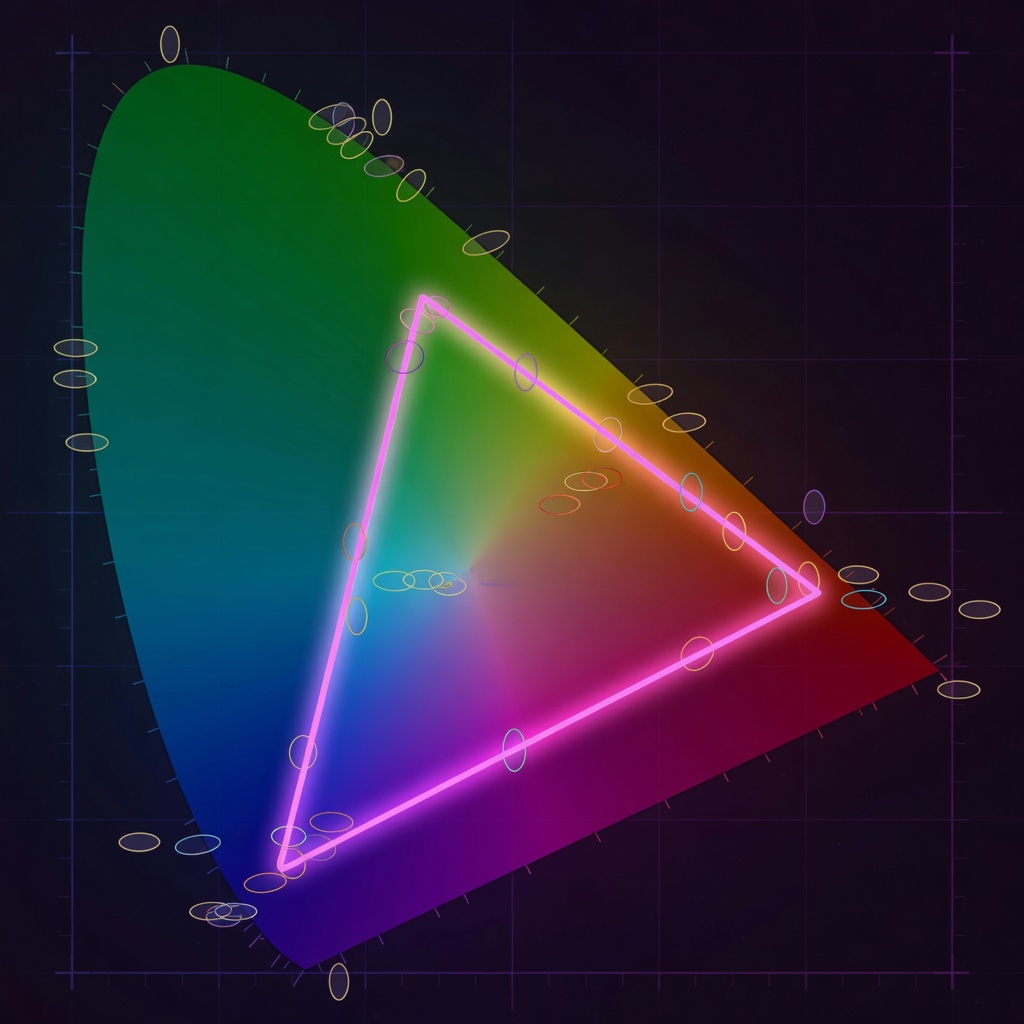
Of these, chromaticity has the most direct effect on perception. White is especially tricky—the eye is extremely sensitive to color differences in low-saturation white, and two white lights differing by a few hundred K in color temperature, or with color points leaning slightly green or pink on the chromaticity diagram, give themselves away side by side. That is why “binning” is a mandatory step before white LEDs ship.
Binning: grouping the close ones together
Binning is the sorting step at the end of LED manufacturing. Test equipment measures chromaticity, brightness, and voltage pixel by pixel, groups those in a close range into the same “bin,” and ships them classified by bin.
- Pixels within a bin have chromaticity in a controlled small range
- Finer binning gives better batch consistency, but lowers yield and raises cost
- Customers can specify a bin when ordering, ensuring the whole batch they receive is compatible in hue
Binning solves consistency “within a batch,” but to communicate “just what white is white” across batches and suppliers, you also need a shared coordinate system and specification.
Turning color into coordinates: the CIE chromaticity system
To talk about chromaticity, you first have to turn “color” into numbers. The CIE 1931 standard colorimetric system, established by the International Commission on Illumination (CIE), uses a set of color-matching functions to convert a spectrum into x and y coordinates, so any color can fall on a two-dimensional chromaticity diagram[1].
With this diagram, “this pixel leans green” can be expressed precisely as “its color point has shifted this far in the positive y direction.” The chromaticity diagram is the shared base map for all the color-difference quantification and white-light specification that follow.
MacAdam ellipses and SDCM: how color difference is quantified
With coordinates, you still need to know “how much difference the eye can see.” That is exactly the question David MacAdam’s classic 1942 research set out to answer[2].
He had observers make color matches repeatedly and mapped, around each reference point on the chromaticity diagram, the region where the eye “cannot tell a difference”—these regions are elliptical in shape and came to be called MacAdam ellipses. Using them as a unit:
- 1-step MacAdam (1 SDCM): an average person can barely perceive the color difference
- The larger the number, the more easily the color difference is seen
- The lighting industry commonly uses SDCM (Standard Deviation of Colour Matching) to specify products, such as “3-step” or “5-step”
A product marked “3-step” means its color point stays within 3 MacAdam ellipse steps of the target—the most common language for color consistency on a lighting quality datasheet.
The white-light red line: ANSI C78.377
Ellipses solve “how much difference,” but you still need to define “where white should fall.” ANSI C78.377 is the white-light chromaticity specification for solid-state lighting (SSL) products, published by NEMA[3].
On the CIE chromaticity diagram it sets several nominal points by correlated color temperature (CCT) (such as 2700K, 3000K, 4000K…) and draws a quadrilateral allowable range around each. Products falling within the same CCT quadrilateral are considered compatible in white-light hue. This lets manufacturers and users describe “which white this is” in a consistent language, rather than each speaking their own.
Addressable strings: whole-string consistency is the joint result of selection and drive
Addressable strings raise the difficulty of color consistency another notch. Hundreds of pixels in a string often meet the eye at once, and any single pixel’s chromaticity shift has nowhere to hide—especially for low-saturation colors like pure white and warm white, where the eye is pickiest.
Achieving whole-string consistency takes two indispensable things:
- Hardware end: select pixels with consistent chromaticity binning, pressing the individual variation at the source to a minimum
- Drive end: ensure every pixel outputs stable, reproducible brightness at the same code value, introducing no further drift from channel differences or voltage fluctuation
PowerMOS addressable control ICs offer high grayscale depth and a constant-current architecture, so every pixel’s brightness output is stable and consistent at the same code value—the drive foundation for maintaining visual consistency across a whole string of already-binned pixels. Constant current keeps brightness from changing with line voltage drop, while high grayscale lets even low-brightness regions render smoothly—together they hold the last mile of “whole-string consistency.” See the product center for the full model list.
Further reading: for white-light rendering and color rendition, see Full-Color Mixing and White-Light Rendering: The Rendering Engineering from RGB to RGBW; for grayscale and dimming, see Grayscale, Color, and Flicker-Free Dimming Engineering for Addressable LEDs.
Reference standards and literature
- CIE 015:2018, Colorimetry, 4th Edition. International Commission on Illumination (CIE). Covers the CIE 1931 standard colorimetric system.
- MacAdam, D. L. (1942), Visual Sensitivities to Color Differences in Daylight. Journal of the Optical Society of America (JOSA), Vol. 32, No. 5, pp. 247–274.
- ANSI C78.377, Electric Lamps — Specifications for the Chromaticity of Solid-State Lighting (SSL) Products. National Electrical Manufacturers Association (NEMA).
This article is an educational piece on LED color quality. The names of the standards cited can be verified in the official catalogs of the CIE and NEMA/ANSI and the JOSA literature archive. PowerMOS addressable control ICs use a proprietary carrier protocol optimized for LED pixel control.
FAQ
What is LED binning?
Binning is the sorting process in LED manufacturing. Semiconductor processing cannot make every die identical in chromaticity, brightness, and forward voltage, so during testing manufacturers group pixels of similar characteristics into the same 'bin' and ship by bin. Pixels within a bin fall within a small range of chromaticity, so customers receive a relatively color-consistent batch. Finer binning gives better consistency but costs more.
What are MacAdam ellipses and SDCM color tolerance?
MacAdam ellipses come from David MacAdam's 1942 research, describing the region on the chromaticity diagram where the human eye 'perceives no difference'—an ellipse in shape. Using it as a unit, 1-step MacAdam (1 SDCM) means an average person can barely see the color difference, and the larger the number, the more obvious the difference. The lighting industry commonly uses SDCM (Standard Deviation of Colour Matching) to specify a product's color consistency, for example '3-step' or '5-step.'
What does ANSI C78.377 specify?
ANSI C78.377 is the white-light chromaticity specification for solid-state lighting (SSL) products, published by NEMA. On the CIE chromaticity diagram it sets several nominal points and allowable ranges (quadrilateral regions) by correlated color temperature (CCT), so manufacturers and users can describe white-light color in a consistent language. Products falling within the same CCT quadrilateral are considered compatible in white-light hue.
Why do addressable strings have especially high color-consistency requirements?
Addressable strings often present hundreds of pixels to the eye at once, so any single pixel's chromaticity shift is easily noticed—especially for low-saturation colors like pure white and warm white, where the eye is most sensitive to color difference. Addressable products must therefore not only select consistently binned pixels but also rely on high grayscale and constant current from the driver to avoid introducing brightness or color-temperature drift at the drive end. Hardware consistency and drive consistency are both indispensable.
How does the PowerMOS solution support whole-string color consistency?
Color consistency is the joint result of pixel selection and drive control. PowerMOS addressable control ICs offer high grayscale depth and a constant-current architecture, so every pixel outputs stable, reproducible brightness at the same code value without drifting due to channel differences or voltage variation—the drive foundation for maintaining visual consistency across a whole string of already-binned pixels. See the product center for the full model list.
Upgrading your string lights to full pixel control?
Power MOS Electronics delivers the complete stack — driver ICs, addressing equipment, controllers and apps. Tell us about your product and our engineering team will spec it with you.
Contact PowerMOS Browse products