A full-color addressable LED can display tens of millions of colors, but mixing 'white' — and especially a good-looking, accurately rendering white — is another discipline entirely. White-light quality involves color temperature, the color rendering index, and a newer metric more comprehensive than CRI: TM-30. This article covers the color engineering behind RGB white-mixing, and how international standards define 'good white light.'
A full-color addressable LED can display tens of millions of colors, but mixing “white” — and especially a good-looking, accurately rendering white — is another discipline entirely.
White-light quality involves color temperature, the color rendering index, and a newer metric more comprehensive than traditional CRI: TM-30. This article covers the color engineering behind RGB white-mixing, and how international standards define “good white light” — which matters especially for decorative and display applications that need dynamic white.
How RGB mixes white, and its inherent limit
The white light of a full-color LED comes from additive color mixing: mixing the red, green, and blue channels in the right proportions synthesizes white light. This brings a distinctive advantage — white color temperature can be adjusted in real time: the same LEDs, by changing the RGB ratio, can switch between warm and cool white, a flexibility a fixed white LED cannot offer.
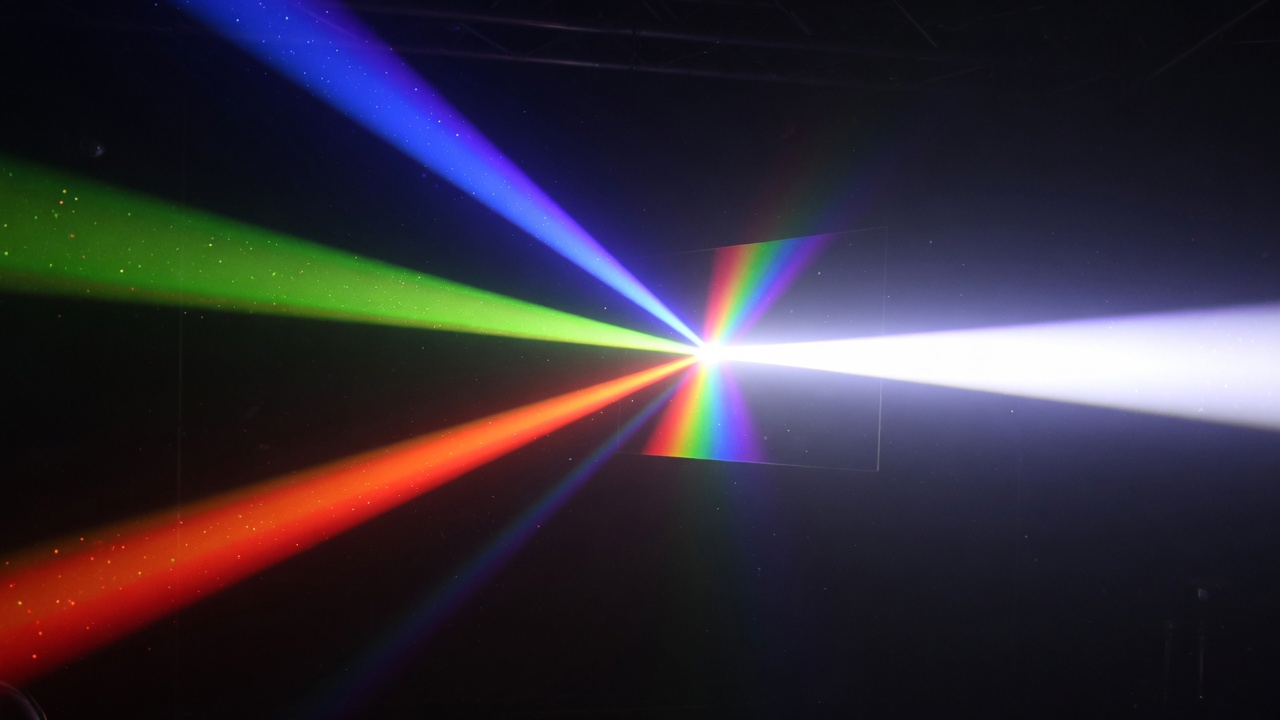
But RGB white-mixing has an inherent limit. Its spectrum is three narrow peaks of red, green, and blue, with gaps in between; whereas the spectrum of sunlight or a white LED is more continuous and complete. A discontinuous spectrum means objects of certain colors take on a color cast under it — which is the “rendering” problem the next section covers.
Color temperature, CRI, and TM-30: defining “good white light”
There are three levels of metrics for gauging white-light quality.
Color temperature (CCT) describes the warmth or coolness of white light, in kelvin (K): 2700K is warm yellow, 4000K is neutral, 6500K is cool. This is the most basic description of white light. The CIE’s standard colorimetric system lays the foundation for quantifying chromaticity and color temperature[1].
The color rendering index CRI assesses a source’s ability to reproduce the true colors of objects. Traditional CRI uses 8 soft color samples, out of 100, and has been in use for decades[1]. But its color samples are few and soft, and don’t necessarily reflect the rich colors of the real world.
IES TM-30 is a new-generation method for assessing rendering[2]. It uses 99 more diverse color samples and provides two complementary metrics: Rf (fidelity) measures reproduction accuracy, and Rg (gamut) measures saturation. Compared with CRI’s 8 samples, TM-30’s assessment is more comprehensive, and the industry sees it as gradually supplementing or even replacing CRI.
Why full-color pixel control leans toward display rather than lighting tasks
Once you understand the rendering principle, you understand the place of full-color pixel control. The three-narrow-peak spectrum of RGB white-mixing usually renders worse than the continuous spectrum of a white LED. Therefore:
- The home ground of full-color pixel control is dynamic color display, decorative lighting, and mood-setting — pursuits of color richness and motion, not high rendering.
- High-rendering lighting tasks (such as museum-exhibit lighting or merchandise display) are better suited to dedicated high-rendering white LEDs.
This is not a defect but a division of labor. Full-color pixel control trades the inherent rendering limit of white for tens of millions of colors that can change in real time — for decoration and display, a trade-off well worth it.
Color quality starts with constant current and grayscale
Even in display applications, color quality varies. PowerMOS pixel-control chips offer a constant-current architecture and high grayscale depth: constant current keeps the three channels’ currents balanced and stable and the whole string consistent in color; high grayscale makes color mixing and gradients finer. These are the foundation of color quality in full-color display. See the full lineup in the Product Center.
Further reading: for display quality in grayscale and dimming, see Grayscale, Color, and Flicker-Free Dimming Engineering for Addressable LEDs.
Reference Standards and Literature
- CIE 13.3 / CIE 15, Method of Measuring and Specifying Colour Rendering Properties of Light Sources; Colorimetry. International Commission on Illumination (CIE).
- ANSI/IES TM-30, IES Method for Evaluating Light Source Color Rendition. Illuminating Engineering Society.
This article is an educational piece on color engineering. The names of the cited standards can be verified in the official CIE and IES catalogs. PowerMOS pixel-control chips use a proprietary carrier protocol optimized specifically for LED pixel control.
FAQ
How do full-color RGB LEDs mix white light?
Mixing the three RGB channels in the right proportions synthesizes white light, the principle of additive color mixing. But the spectrum of RGB white-mixing is three narrow peaks, unlike the continuous spectrum of sunlight or a white LED, so its rendering ability (the ability to reproduce an object's true color) is usually inferior to a dedicated white source. The advantage of full-color pixel control is that white color temperature can be adjusted in real time, at the cost of an inherent limit on rendering.
What is color temperature (CCT)?
Color temperature (Correlated Color Temperature, CCT), in kelvin (K), describes the warmth or coolness of white light: 2700K is warm yellow (like an incandescent bulb), 4000K is neutral white, 6500K is cool white (like daylight). A full-color pixel LED can change white color temperature in real time by adjusting the RGB ratio, which is its flexibility over a fixed white LED, the same LEDs switching between warm and cool white.
What is the difference between the color rendering index CRI and the new TM-30?
CRI (color rendering index, based on the CIE method) uses 8 soft color samples to assess a source's ability to reproduce color, out of 100, a traditional metric used for decades. IES TM-30 instead uses 99 more diverse color samples and provides two metrics: Rf (fidelity, reproduction accuracy) and Rg (gamut, saturation). TM-30 is more comprehensive and is seen as gradually supplementing or even replacing CRI.
Why is the rendering of RGB white-mixing usually inferior to a white LED?
Rendering ability depends on whether a source's spectrum is continuous and complete. The spectrum of RGB white-mixing is three narrow peaks, red, green, and blue, with gaps in between, so objects of certain colors take on a color cast under it. A white LED (a blue chip plus phosphor) has a more continuous spectrum and renders better. This is why full-color pixel control is used mainly for dynamic color display and decoration, rather than lighting tasks that need high rendering.
How should you select PowerMOS full-color pixel control for color quality?
PowerMOS pixel-control chips offer a constant-current architecture and high grayscale depth: constant current keeps the three channels' currents balanced and stable for consistent color, and high grayscale makes color mixing and gradients finer. These are the foundation of color quality in full-color display. For decorative and display applications that need real-time adjustable white, PowerMOS offers matching high-quality full-color solutions. See the full lineup in the Product Center.
Upgrading your string lights to full pixel control?
Power MOS Electronics delivers the complete stack — driver ICs, addressing equipment, controllers and apps. Tell us about your product and our engineering team will spec it with you.
Contact PowerMOS Browse products