The colored water jets of a musical fountain surging to a melody, a ring of flowing glow at a poolside, a cascade of light on a building's water-curtain wall. Behind these stunning water features are LEDs submerged in water, or only centimeters from its surface. Water is the harshest environment in decorative lighting: it seeps into the smallest gap, and it turns an electrical fault into a safety incident. This article covers the two big matters of addressable water-feature and underwater lighting, waterproof sealing and electrical safety beneath the surface.
- What makes underwater lighting hard
- IP68: the threshold for underwater sealing
- SELV: pushing shock risk down to negligible
- IEC 60598-2-18: the dedicated standard for water-feature luminaires
- The distinctive advantages of pixel control in water features
- How PowerMOS supports water-feature and underwater lighting
- Reference Standards and Literature
- FAQ
The colored water jets of a musical fountain surging to a melody, a ring of flowing glow at a poolside, a cascade of light on a building’s water-curtain wall. Behind these stunning water features are LEDs submerged in water, or only centimeters from its surface.
Water is the harshest environment in decorative lighting. It seeps into the smallest gap, creeps slowly into the fixture along the seams of the wiring, and turns an otherwise harmless electrical fault into a genuine safety incident. This article covers the two big matters of addressable water-feature and underwater lighting, waterproof sealing and electrical safety beneath the surface, and why pixel control has its own distinctive advantages in this harsh environment.
What makes underwater lighting hard
Ordinary outdoor luminaires face rain and moisture; water-feature luminaires face continuous immersion. The two are entirely different orders of magnitude.
Rain hits the fixture and runs off, but immersion is a twenty-four-hour pressure: water seeps in slowly through any tiny gap, any aging crack in the sealant, any joint between wire and fixture. Once water gets in, the mild case is a dead LED, the severe case is a short circuit, corrosion, or even a live fixture. The first lesson of water-feature lighting is to acknowledge the penetrating power of water, then use engineering to keep it out.
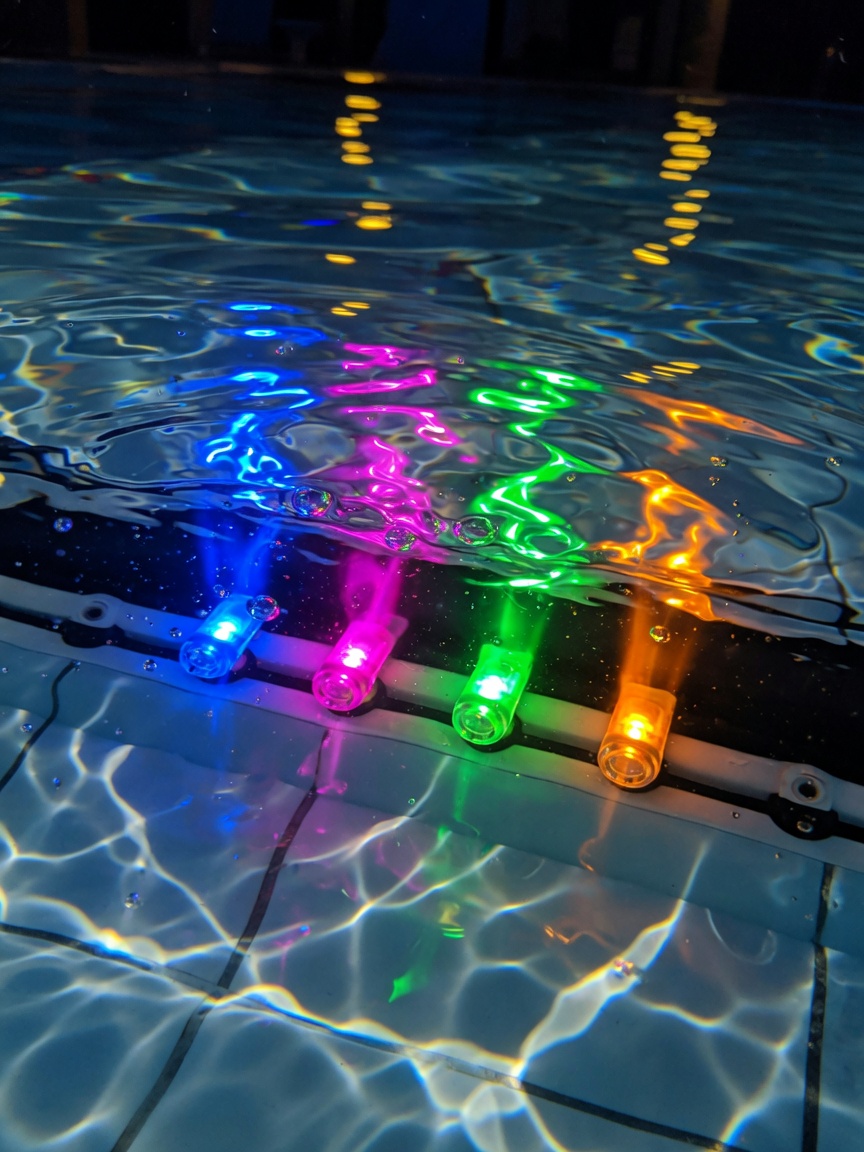
IP68: the threshold for underwater sealing
To talk about waterproofing, you first need a common ruler. That ruler is the IP code (Ingress Protection Code), defined by IEC 60529[1].
Of the two digits after IP, the first denotes dust protection (solid foreign objects) and the second denotes water protection. What water-feature lighting cares about is the second:
- IPX7: can be immersed in water for a short time (typically 1 meter, 30 minutes).
- IPX8: can be continuously immersed under conditions specified by the manufacturer, usually meaning long-term immersion deeper than 1 meter.
For scenes of long-term submersion like underwater lights, fountain nozzles, and water-curtain structures, the threshold usually lands at IP68: both fully dust-tight and capable of continuous immersion[1]. Note that IPX8’s actual depth and duration are rated by the manufacturer per product, not a fixed number, so when selecting, check carefully whether the manufacturer’s rated immersion conditions cover your actual installation depth.
And when it comes to waterproofing, the fewer the sealing points, the more reliable it is. Every hole where a wire penetrates the fixture, every connector, is a potential water-ingress path. We’ll return to this principle later on the advantage of pixel control.
SELV: pushing shock risk down to negligible
The second checkpoint of underwater lighting is electrical safety, and it is even less negotiable than waterproofing, because lives depend on it.
The crux: water greatly lowers the body’s electrical impedance. A voltage that isn’t lethal in a dry environment may well be dangerous on a body soaked in water. So the general rule for underwater and pool lighting is to use extra-low-voltage supply.
IEC 61140 is the common standard for shock protection, classifying equipment protection into levels 0, I, II, and III[2]. Of these, Class III is equipment supplied by SELV (Safety Extra-Low Voltage): not exceeding 50V AC or 120V DC. Within this voltage range, the shock risk under normal conditions is considered negligible[2]. Underwater pool lights are a typical Class III application, in practice often supplied at a low voltage such as 12V.
In other words, the electrical design philosophy of water-feature lighting is not “insulate the electricity well enough” but keep the voltage so low from the source that even contact isn’t dangerous. This is passive safety, and the most reliable kind.
IEC 60598-2-18: the dedicated standard for water-feature luminaires
Waterproofing has the IP code, electrical safety has SELV, but is there a standard written specifically for “lights submerged in water”? Yes.
IEC 60598-2-18 is the particular-requirements standard for “luminaires for swimming pools and similar applications”[3]. It applies explicitly to fixed luminaires used in, or in contact with, water, covering scenes including swimming pools, fountains, paddling pools, and garden ponds, the very core of water-feature lighting. It sets concrete requirements for electrical safety, water ingress, and mechanical strength, and its 2022 third edition was rewritten to apply to both traditional light sources and LEDs, keeping pace with the reality of LED adoption[3].
For water-feature engineering teams, the existence of this standard means underwater lights aren’t simply “outdoor lights with extra waterproofing”; they carry a whole set of safety requirements considered in their own right.
The distinctive advantages of pixel control in water features
Back to the lighting effect itself. A musical fountain needs each jet to change color to the melody, a water curtain needs light waves to flow from top to bottom, a poolside needs a ring of color to drift slowly. These all need independent, pixel-by-pixel and section-by-section control, the very forte of addressable lighting.
But in the harsh environment of water features, pixel control brings three further engineering advantages:
- Fewer wires = fewer sealing points: the two-wire power-line carrier approach lets signal and power share two wires, with no separate data line. Fewer wires means fewer holes penetrating the underwater fixture, and fewer water-ingress paths, an innate advantage for waterproofing.
- Non-propagating single-point failure: in a long string of underwater LEDs, if one failure drags down the whole string, the repair cost in an underwater or water-feature structure is extremely high. A design where single-point failures don’t propagate keeps one dead LED from affecting the rest, shrinking maintenance to “replace that one.”
- Local-replacement repair: water-feature structures are often deeply encased or embedded. Being able to replace only the failed LED rather than dismantle the whole run directly determines long-term maintenance cost.
How PowerMOS supports water-feature and underwater lighting
PowerMOS pixel-control chips use two-wire power-line carrier: signal and power share two wires, with no separate data line — fewer wires means fewer sealing penetration points, an innate reliability advantage for underwater sealing.
On reliability, the chips have surge protection and a single-point-failure containment design, so one failed LED won’t drag down the whole string, and LEDs can be replaced locally, lowering the maintenance cost that comes with the deep embedding and encasing of water-feature structures. For high-power outdoor scenes like fountains and water curtains, they can meet the higher 7-20mA drive-current need; and high-voltage AC capability gives long-distance water-feature wiring more flexibility. Note that the actual waterproof rating, SELV supply, and standards compliance depend on the design of the complete luminaire and power system — PowerMOS provides the pixel-control chip in that chain. See the full lineup in the Product Center.
Further reading: for outdoor waterproof ratings, see IP Waterproof Ratings for Outdoor LED Lighting; for humid and vehicle environments, see Decorative Lighting for Marine and Vehicles.
Reference Standards and Literature
- IEC 60529, Degrees of protection provided by enclosures (IP Code). International Electrotechnical Commission (IEC).
- IEC 61140, Protection against electric shock — Common aspects for installation and equipment. International Electrotechnical Commission (IEC).
- IEC 60598-2-18, Luminaires — Part 2-18: Particular requirements — Luminaires for swimming pools and similar applications. International Electrotechnical Commission (IEC).
This article is an educational piece on water-feature lighting. The names of the cited standards can be verified in the official IEC catalog. PowerMOS pixel-control chips use a proprietary carrier protocol optimized specifically for LED pixel control.
FAQ
What level of waterproofing do underwater luminaires need?
Luminaires that are submerged or continuously immersed usually require IP68. The IP code is defined by IEC 60529, where the first digit denotes dust protection and the second denotes water protection; the digit 8 means 'suitable for continuous immersion under conditions specified by the manufacturer,' the rating for continuous submersion (higher than 7, which covers brief immersion). Fountain jet-splash zones, water curtains, and underwater pool lights all fall in this range. The actual immersion depth and duration are rated by the manufacturer per product.
Why does underwater lighting use extra-low voltage (SELV)?
Water greatly lowers the body's electrical impedance, making shock risk far higher than in a dry environment. So underwater and pool lighting commonly use SELV (Safety Extra-Low Voltage). IEC 61140 classifies shock protection into levels 0, I, II, and III, of which Class III is equipment supplied by SELV, not exceeding 50V AC or 120V DC; at this voltage the shock risk under normal conditions is considered negligible. Pool lights are a typical Class III application.
Are there dedicated standards for pool and water-feature luminaires?
Yes. IEC 60598-2-18 is the particular-requirements standard for 'luminaires for swimming pools and similar applications,' covering fixed luminaires used in or in contact with water, including swimming pools, fountains, paddling pools, and garden ponds. It sets requirements for electrical safety, water ingress, and mechanical strength, and its 2022 third edition was rewritten to apply to both traditional light sources and LEDs.
What failure does water-feature lighting fear most?
It fears water ingress and cascading failure most. Once a seal fails, moisture or water intrudes and causes short circuits and corrosion; and in a long string of LEDs, if one failure drags down the whole string, repair means dismantling and replacing the entire run, which in an underwater or water-feature structure means huge maintenance cost. So water-feature lighting places special weight on non-propagating single-point failures and on repair designs that allow local replacement.
How do PowerMOS solutions support water-feature and underwater lighting?
PowerMOS pixel-control chips use two-wire power-line carrier, with signal and power sharing the same two wires, so fewer wires means fewer sealing penetration points, an innate advantage for underwater sealing. The chips have surge protection and a single-point-failure containment design, so one failed LED won't drag down the whole string; LEDs can be replaced locally, lowering the maintenance cost of water-feature structures. Outdoor parts can meet the higher 7-20mA current needs. See the full lineup in the Product Center.
Upgrading your string lights to full pixel control?
Power MOS Electronics delivers the complete stack — driver ICs, addressing equipment, controllers and apps. Tell us about your product and our engineering team will spec it with you.
Contact PowerMOS Browse products