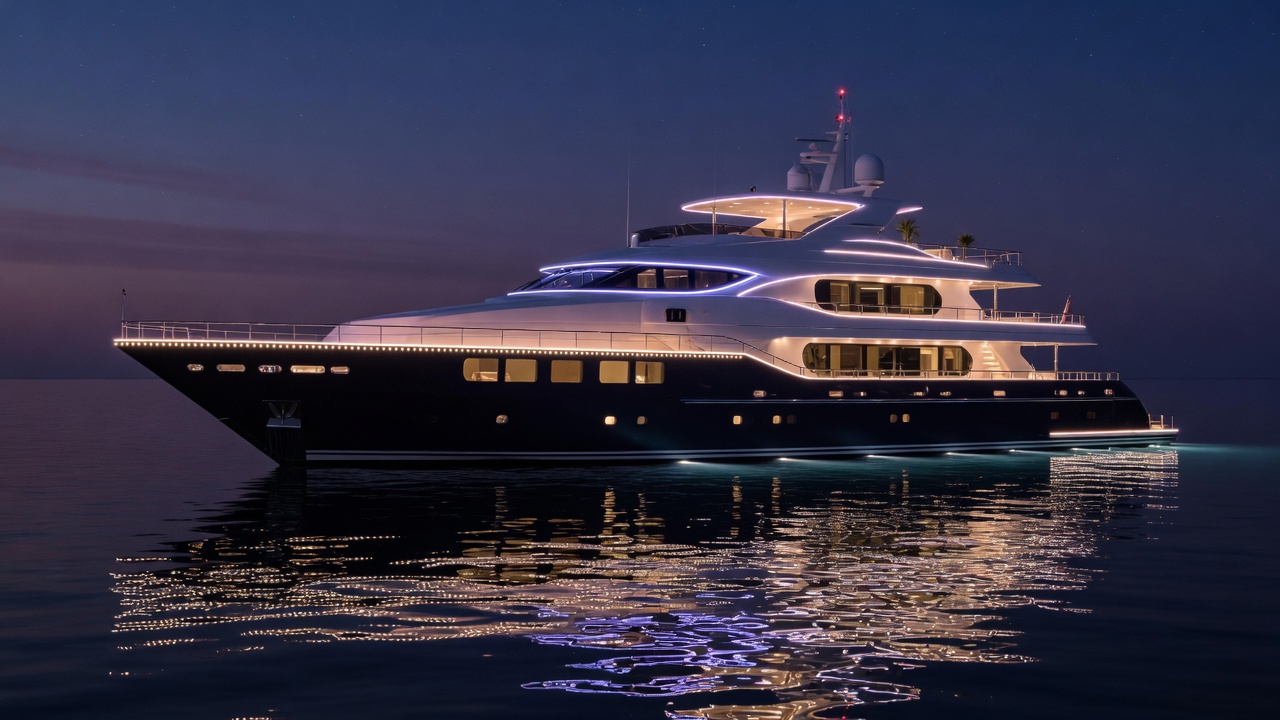
A yacht sailing at night, its hull outline flowing with a breathing light; an RV out camping, its interior mood shifting color with the night. Decorative lighting for spaces on the move is a distinctive application of addressable LEDs—it brings ambiance to places that travel, under the constraints of low-voltage DC, vibration, moisture, and limited wiring room. This article is about the engineering of point-control lighting for spaces on the move.
A yacht sailing at night, its hull outline flowing with a breathing light; an RV out camping, its interior mood shifting color with the night.
Decorative lighting for spaces on the move is a distinctive application of addressable LEDs. Under the constraints of low-voltage DC, vibration, moisture, and limited wiring room, it brings ambiance to places that travel. This article is about the engineering of point-control lighting for spaces on the move—a scenario unlike both home and outdoor settings.
Three special constraints of spaces on the move
Decorative lighting for yachts, RVs, and custom vehicles differs fundamentally from ordinary home light strings in three ways:
- Power—mostly 12V/24V low-voltage DC (battery, generator), not mains AC.
- Environment—vibration and temperature-humidity swings are harsher than indoors, with salt-fog corrosion at sea.
- Wiring—space is limited and shapes are irregular, so wiring is constrained.
Together, these three constraints define what spaces on the move need from addressable lighting: low-voltage compatibility, resistance to vibration and moisture, and clean wiring. And this is exactly the fit for two-wire point-control pixels.
Low voltage and wiring: the natural advantage of two wires
Spaces on the move are mostly 12V/24V low-voltage DC systems. Addressable point-control pixels can adapt to low-voltage applications—PowerMOS offers low-detection-voltage models for battery-powered scenarios.
More important is the wiring. Two-wire power-plus-signal greatly simplifies wiring in low-voltage systems: each pixel needs only two wires to be independently addressed, suiting the limited wiring room and irregular shapes of yachts and RVs. In the precious space of a moving vehicle, one wire fewer means one degree more freedom in installation.
Vibration and moisture: reliability in a mobile environment
Spaces on the move have constant vibration and temperature-humidity swings, plus salt fog at sea. This places demands on reliability:
- Waterproofing and weather resistance—select the right IP rating for the environment (IEC 60529[1]); at sea and outdoors, higher protection is needed.
- Vibration-resistant connections—connection points must withstand long-term vibration without loosening.
- Architectural fault tolerance—the addressable address-code architecture keeps a single failure from propagating, especially practical for spaces on the move that are hard to open up and repair.
Spaces on the move are often inconvenient to service, so the “one dead pixel doesn’t affect the others” fault-tolerance trait is worth even more here than in fixed installations.
Selecting for your space on the move
PowerMOS provides addressable pixels, controllers, and solutions adapted to low voltage; two-wire wiring suits the limited space and shape needs of spaces on the move, and low-detection-voltage models fit battery power. See the full lineup at the product center. Yacht, RV, vehicle-modification, and amusement-ride teams are welcome to discuss pixel selection and solutions with PowerMOS, with their power conditions and shape requirements in hand.
Further reading: for the pixel craft of low-voltage battery applications, see Copper-Wire Lights, Shoe Lights, and Glowing Wearables; for outdoor protection, see Waterproofing and Protection for Outdoor Light Strings.
References and standards
- IEC 60529, Degrees of protection provided by enclosures (IP Code). International Electrotechnical Commission.
- IEC 61000-4-2, Electromagnetic compatibility (EMC) — Electrostatic discharge immunity test. IEC — immunity reference for mobile electrical environments.
This article is an educational overview of an application scenario. The names of the cited standards can be verified in the official IEC catalog. PowerMOS point-control chips use a proprietary carrier protocol optimized specifically for LED point control, with low-voltage-adapted models available.
FAQ
How does decorative lighting for yachts and RVs differ from ordinary home light strings?
Three key differences. Power: spaces on the move are mostly 12V/24V low-voltage DC (battery/generator), not mains. Environment: vibration, moisture, and salt fog (at sea) are harsher than indoors. Wiring: space is limited and shapes are irregular. So addressable lighting for spaces on the move needs low-voltage compatibility, resistance to vibration and moisture, and clean wiring—exactly the fit for two-wire point-control pixels.
How are addressable pixels driven in a low-voltage DC environment?
Addressable point-control pixels can adapt to low-voltage applications, and PowerMOS offers low-detection-voltage models (for battery-powered scenarios, for example). Two-wire power-plus-signal makes wiring cleaner in 12V/24V low-voltage systems—each pixel needs only two wires to be independently addressed, suiting the limited wiring room and irregular shapes of yachts and RVs.
How do vibration and moisture in mobile environments affect reliability?
Spaces on the move have constant vibration and temperature-humidity swings, and at sea there is salt-fog corrosion. This requires good protection and weather resistance for pixels and connections—waterproofing selected by IP rating for the environment (IEC 60529), and connections that resist vibration. The addressable architecture's address-code fault tolerance keeps a single failure from propagating, which is especially practical for spaces on the move that are hard to service.
What effects can this kind of lighting for spaces on the move produce?
Just like other addressable applications, it can do flowing, chasing, color-shifting, music-reactive, and mood-scene switching effects. A yacht can trace its hull outline and set a deck-party mood; an RV can create interior scene lighting reactive to audio and video; a custom vehicle can do underbody ambient lighting and outline lighting. Per-pixel control brings rich dynamic light ambiance to spaces on the move too.
How can a yacht, RV, or vehicle-modification team obtain a solution?
PowerMOS provides addressable pixels, controllers, and solutions adapted to low voltage; two-wire wiring suits the limited space and shape needs of spaces on the move, and low-detection-voltage models fit battery power. Yacht, RV, vehicle-modification, and amusement-ride teams are welcome to discuss pixel selection and solutions with their power conditions and shape requirements in hand.
Upgrading your string lights to full pixel control?
Power MOS Electronics delivers the complete stack — driver ICs, addressing equipment, controllers and apps. Tell us about your product and our engineering team will spec it with you.
Contact PowerMOS Browse products