A single Christmas light string looks like it uses too little power to bother counting. But multiply 'watts per bulb x number of bulbs x hours lit per day x days in the season' and the number is usually far bigger than intuition suggests—especially for old-style incandescent bulbs. This article works out the energy math of a decorative light string: how much an LED really saves, whether the ENERGY STAR program still exists, and how to estimate your own bill.
- Incandescent vs LED: the efficiency gap of a single bulb
- ENERGY STAR did not disappear: decorative light strings are the exception
- What the specification requires: efficiency tied to durability
- Working out the bill: a repeatable method
- The PowerMOS role: making ‘saving power’ real saving
- References and standards
- FAQ
A single Christmas light string looks like it uses too little power to bother counting.
But multiply ‘watts per bulb x number of bulbs x hours lit per day x days in the season’ and the number is usually far bigger than intuition suggests—especially for old-style incandescent bulbs. This article works out the energy math of a decorative light string: how much an LED really saves, whether the ENERGY STAR program still exists, and how to estimate your own bill.
Incandescent vs LED: the efficiency gap of a single bulb
Eighty percent of the energy consumption of a decorative light string comes down to the type of light source.
A traditional incandescent bulb glows by heating a filament, turning most of the electrical energy into heat and only a fraction into light—it ‘incidentally’ provides illumination while its real business is generating heat. An LED, glowing through a semiconductor, needs only a fraction of the power for the same brightness.
On the assessment of the U.S. Department of Energy (DOE) Solid-State Lighting program, the efficacy of white LEDs can be several times to roughly ten times that of an incandescent source[1]. Reflected in decorative lights: a traditional incandescent bulb is often on the order of several watts each, while an LED decorative light meeting efficiency requirements can be as low as under 0.2W each. This is not a difference of a few percent; it is a difference of an order of magnitude.
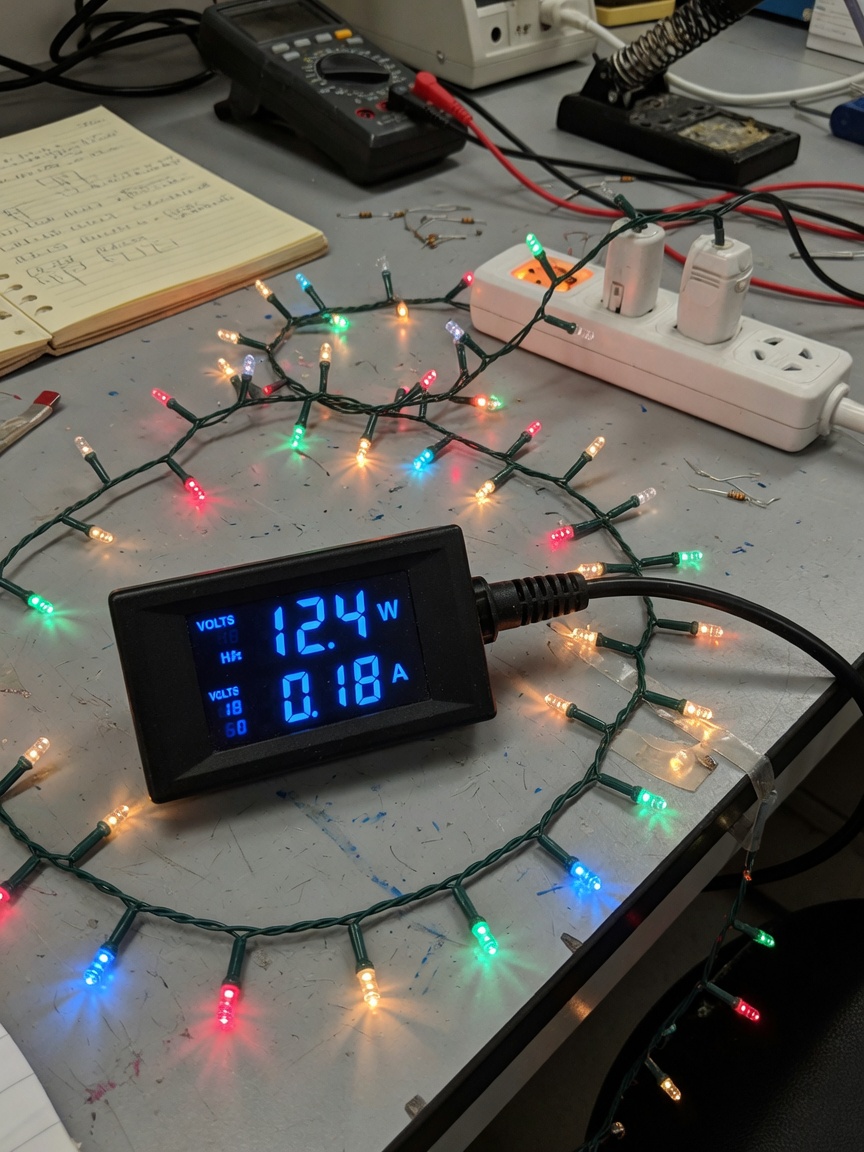
ENERGY STAR did not disappear: decorative light strings are the exception
There is a common misconception worth clearing up here. Many people have heard that ‘the ENERGY STAR lighting specifications were cancelled’—and that is half right.
The U.S. Environmental Protection Agency (EPA) did indeed sunset most bulb and luminaire ENERGY STAR specifications at the end of 2024. But Decorative Light Strings were retained and remain a certifiable category[2].
Why keep this one alone? The reasons are very practical:
- Decorative light strings are not covered by U.S. Department of Energy (DOE) regulation—they are not brought under mandatory efficiency standards the way ordinary bulbs are, so a voluntary mark still has value
- The efficiency and quality differences in the market remain wide—even among products all called ‘LED strings,’ good and bad can differ greatly
- The industry wants to keep the mark to help consumers tell them apart
In other words, in the field of decorative lighting, ENERGY STAR is still alive—and precisely because there is no mandatory standard, this voluntary mark carries all the more signalling value.
What the specification requires: efficiency tied to durability
The ENERGY STAR decorative-light-string program requirements do not look at ‘saving power’ alone. Under its program requirements, a product has to meet efficiency and quality thresholds together[2], with typical requirements including:
- No more than 0.2W per bulb
- A 3-year warranty
- Overvoltage protection
- Stable light output (no rapid decay with use)
The intent of this design is clear: to tie ‘saving power’ to ‘lasting and safe,’ so a maker cannot chase ultra-low wattage while sacrificing lifetime and safety. A string that saves power but breaks after two seasons has poor overall resource efficiency. Refer to the official document for the actual version and clauses.
Working out the bill: a repeatable method
Estimating the bill needs no complex tool—one multiplication is enough:
Total string power (W) x hours lit per day x days in the season / 1000 = seasonal consumption (kWh) then multiply by price per kWh = seasonal bill
A worked comparison:
- LED string: 5W total, lit 6 hours a day for 60 days -> 5 x 6 x 60 / 1000 = 1.8 kWh
- Same-spec incandescent string: at 50W total, same conditions -> 50 x 6 x 60 / 1000 = 18 kWh
For the same lighting habit, incandescent eats ten times the power of LED. If a mall, a neighborhood or a theme park installs hundreds or thousands of strings, that tenfold gap is magnified enormously.
The point here is not the exact figure of ‘1.8 kWh’—that will shift with your actual power, hours and price—but the methodology: multiply the four variables and you can produce a visible bill for any product and any usage scenario.
The PowerMOS role: making ‘saving power’ real saving
An efficiency mark governs product thresholds; the foundation of efficiency is drive quality. PowerMOS pixel-control ICs use a constant-current architecture so every LED works under a steady current—avoiding the efficiency loss and lifetime decay caused by current fluctuation. This directly supports both the ‘low power draw’ and ‘stable light output’ requirements.
In addition, high-grayscale dimming makes ‘dimming’ correspond to genuine power saving rather than just looking darker; the constant-current and surge-resistant design also answers quality requirements like overvoltage protection. To be clear, the PowerMOS IC itself is not an implementation of any efficiency mark; it uses a proprietary carrier protocol optimized for LED pixel control—but a stable, controllable, durable drive foundation is precisely the premise on which a product achieves low power draw and long life. See the full model range at the product center.
Further reading: for drive efficiency, see Constant-Current Drive and Efficiency: The Power Engineering of Decorative Lighting; for lifetime and light decay, see LED Lifetime and Lumen Maintenance.
References and standards
- U.S. Department of Energy, Solid-State Lighting Program — Energy Savings Potential of Solid-State Lighting in General Illumination Applications. U.S. Department of Energy (DOE).
- ENERGY STAR, Program Requirements for Decorative Light Strings. U.S. Environmental Protection Agency (EPA).
This article is an educational piece on energy efficiency. The names and current status of the cited program and specification can be verified in the official catalogs of ENERGY STAR and the U.S. Department of Energy; the official document governs actual requirements. PowerMOS pixel-control ICs use a proprietary carrier protocol optimized for LED pixel control.
FAQ
How much does an LED string save over incandescent bulbs?
A great deal. On the assessment of the U.S. Department of Energy (DOE) Solid-State Lighting program, the efficacy of white LEDs can be several times to roughly ten times that of an incandescent source. Reflected in decorative strings: a traditional incandescent bulb is often on the order of several watts each, while an LED decorative light meeting efficiency requirements can be as low as under 0.2W each. Swap the same string to LED and the seasonal bill can drop to a fraction—which is why the market has shifted entirely to LED.
Does ENERGY STAR still certify decorative light strings?
Yes, and it is worth noting. The U.S. Environmental Protection Agency (EPA) sunset most bulb and luminaire ENERGY STAR specifications at the end of 2024, but Decorative Light Strings were retained and remain certifiable. The reason is that decorative light strings are not covered by U.S. Department of Energy (DOE) regulation, the efficiency and quality differences in the market remain wide, and the industry wants to keep the mark to tell good from bad.
What does the ENERGY STAR decorative-light-string specification require?
Under the ENERGY STAR Decorative Light Strings program requirements, a product has to meet efficiency and quality thresholds—for example, no more than 0.2W per bulb, a 3-year warranty, overvoltage protection, and stable light output. These requirements tie 'saving power' to 'lasting,' so a maker cannot chase low wattage alone at the expense of lifetime and safety. Refer to the official document for the actual version and clauses.
How do you estimate a string's bill for a whole season?
The method is straightforward: total string power (watts) x hours lit per day x days in the season / 1000 = seasonal consumption (kWh), then multiply by your price per kWh for the bill. For example, a 5W LED string lit 6 hours a day for 60 days is 5x6x60/1000 = 1.8 kWh; a same-spec incandescent string at 50W under the same conditions is 18 kWh—a tenfold difference. The methodology matters more than the exact number.
How does the PowerMOS solution address efficiency and quality needs?
PowerMOS pixel-control ICs use a constant-current architecture so every LED works under a steady current, avoiding the efficiency loss and lifetime decay caused by current fluctuation; high-grayscale dimming also means 'dimming' genuinely saves power rather than just looking darker. The IC itself is not an implementation of any efficiency mark, but a stable, controllable drive is the foundation on which a product achieves low power draw, long life and overvoltage protection. See the product center for the full model range.
Upgrading your string lights to full pixel control?
Power MOS Electronics delivers the complete stack — driver ICs, addressing equipment, controllers and apps. Tell us about your product and our engineering team will spec it with you.
Contact PowerMOS Browse products