Why is one addressable string uniformly bright from end to end, while another dims toward the tail? The answer often lies in the drive — how current is supplied to each bead. The choice between constant-current and non-constant-current decides brightness uniformity, color stability, and the efficiency of a large-scale string. This article is about drive and efficiency, and why addressable LEDs care about every milliamp.
Why is one addressable string uniformly bright from end to end, while another dims toward the tail?
The answer often lies not in the beads themselves but in the “drive” — how current is supplied to each bead. The choice between constant-current and non-constant-current decides brightness uniformity, color stability, and the efficiency of a large-scale string. This article is about drive and efficiency, and why addressable LEDs care about every milliamp.
Constant-current vs. non-constant-current: does the tail dim?
An LED’s brightness is decided by the current through it. This brings a key drive choice:
- Constant-current drive keeps the current through the LED fixed, unaffected by supply-voltage fluctuation or string voltage drop.
- Non-constant-current drive has current that varies with voltage.
The difference is amplified on long strings. As current flows through a long string, the wire’s internal resistance causes a voltage drop — the tail voltage is lower than the front. Under non-constant-current drive, the lower voltage reduces current, so the tail dims or even shifts color. Constant-current drive gives each bead a fixed current, unaffected by voltage drop, so the whole string stays uniformly bright.
For large-area applications like city lighting and mesh lights, this “does the tail dim?” difference directly decides the uniformity and quality of the finished product.
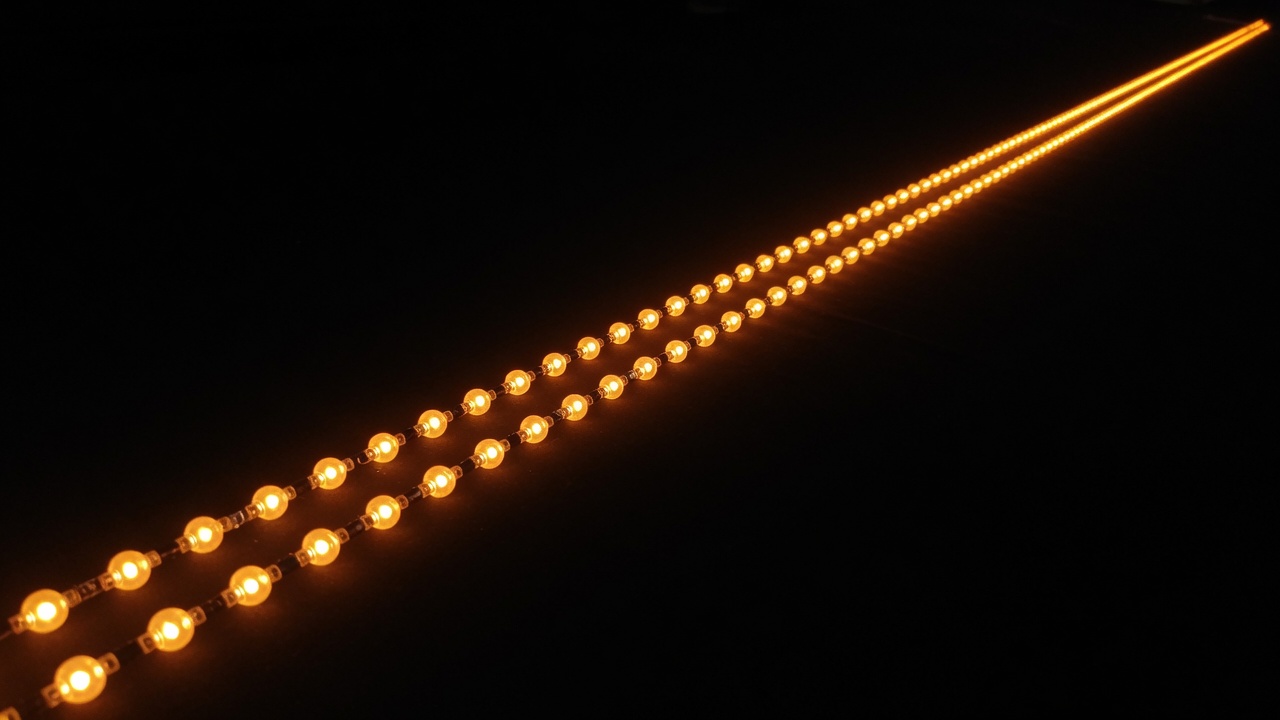
LM-79: measuring efficiency with a unified method
The other side of drive is efficiency. In a large-scale string, the bead count is huge, and each bead’s power draw accumulates into a considerable total energy use — affecting power design and running cost.
Gauging LED efficiency needs a unified method. IES LM-79 is the standard test method for measuring the photometric and electrical characteristics of LED products[1], covering luminous flux, power, efficacy (lumens per watt), chromaticity, and more. It provides an objective basis for comparing the efficiency of different LED products — when you evaluate the running cost of a large-scale solution, the efficacy defined by LM-79 is the key number.
Managing energy use and voltage drop at scale
Placing drive and efficiency in a large-scale scene, the engineering countermeasure has two levels:
- Topology level — use a high-voltage AC 110/220V, high-voltage low-current series-parallel topology to reduce current and lower voltage drop and line loss. At the scale of a whole building or bridge, this markedly lowers energy use and cabling cost.
- Drive level — constant-current drive keeps the tail brightness uniform, avoiding pushing the front current too high to compensate for voltage drop (which would raise energy use and heat and shorten lifespan).
A reasonable drive current (indoor 3.5–7mA, outdoor 7–20mA per channel) balances brightness, efficiency, and lifespan — more current is not better, it should match the application.
The drive choice is a trade-off of uniformity and cost
The drive architecture is ultimately a selection decision. PowerMOS pixel-control chips offer constant-current and non-constant-current architectures, selectable drive currents, and high-voltage series-parallel solutions suited to large scale. The constant-current version is especially key for large-area applications that need color uniformity; the drive current can be selected per brightness, efficiency, and lifespan needs. See the Product Center for full part parameters.
Further reading: for the lifespan engineering behind brightness, see How Long Can an LED Bead Last; for the display quality of color uniformity, see Grayscale, Color, and Flicker-Free Dimming Engineering for Addressable LEDs.
References and standards
- IES LM-79, Approved Method: Optical and Electrical Measurements of Solid-State Lighting Products. Illuminating Engineering Society.
- IES LM-80, Approved Method: Measuring Luminous Flux and Color Maintenance of LED Packages, Arrays and Modules. Illuminating Engineering Society.
This article is an educational overview of drive engineering. The names of the cited standards can be verified in the Illuminating Engineering Society (IES) official catalog. PowerMOS pixel-control chips use a proprietary carrier protocol optimized for LED pixel control.
FAQ
What is the difference between constant-current and non-constant-current drive?
Constant-current drive keeps the current through the LED fixed, unaffected by supply-voltage fluctuation or string voltage drop; with non-constant-current, the current varies with voltage. The difference: constant-current makes the whole string's brightness and color more uniform (the tail won't dim or shift color from voltage drop), which matters especially for long strings and large-area applications; non-constant-current is cheaper and suits short strings or scenes with low uniformity demands.
Why does the tail of a long string dim, and how does constant-current solve it?
As current flows through a long string, the wire's internal resistance causes a voltage drop, so the tail voltage is lower than the front. Under non-constant-current drive, the lower voltage reduces current, so the tail dims or even shifts color. Constant-current drive gives each bead a fixed current, unaffected by voltage drop, so the whole string stays uniformly bright. This is key to keeping a large-area addressable installation even.
What is LM-79, and how does it relate to efficiency?
IES LM-79 is the standard test method for measuring the photometric and electrical characteristics of LED products (luminous flux, power, efficacy, chromaticity, etc.). It provides a unified basis for gauging an LED product's efficiency (lumens per watt). Efficiency matters in large-scale strings — when the bead count is huge, each bead's power draw accumulates into a considerable total energy use, affecting power design and running cost.
How does a large-scale addressable string manage energy use and voltage drop?
Two means. First, use a high-voltage AC 110/220V, high-voltage low-current series-parallel topology to reduce current and lower voltage drop and line loss. Second, use constant-current drive to keep the tail brightness uniform, avoiding pushing the front current too high to compensate for voltage drop. A reasonable drive current (indoor 3.5–7mA, outdoor 7–20mA) balances brightness, efficiency, and lifespan.
What options does PowerMOS offer for drive and efficiency?
PowerMOS pixel-control chips offer constant-current and non-constant-current architectures, selectable drive currents, and high-voltage series-parallel solutions suited to large scale. The constant-current version is especially key for large-area applications that need color uniformity (city lighting, mesh lights); the drive current can be selected per brightness, efficiency, and lifespan needs. See the Product Center for full part parameters.
Upgrading your string lights to full pixel control?
Power MOS Electronics delivers the complete stack — driver ICs, addressing equipment, controllers and apps. Tell us about your product and our engineering team will spec it with you.
Contact PowerMOS Browse products