Picture this: you press one switch and hundreds of lights across a whole building react at once. There is no central wiring between these lights — they rely on relaying wirelessly to one another. This is Bluetooth Mesh. It takes lighting from 'one-to-one remote control' to 'a many-to-many network.' But here is the intriguing question: if it can wirelessly control this many lights, why is the per-bead color animation of a decorative string usually not left to it? The answer lies in how it passes messages.
- From point-to-point to many-to-many
- Managed flooding: reaching the whole network without routing tables
- Mesh 1.1: better suited to large commercial networks
- Why it does not suit per-bead pixel control
- Wireless to the controller, carrier to the bead
- How PowerMOS supplies bead-level pixel control
- References and standards
- FAQ
Picture this: you press one switch and hundreds of lights across a whole building react at once.
There is no central wiring between these lights — they rely on relaying wirelessly to one another. This is Bluetooth Mesh. It upgrades lighting from “one-to-one remote control” to “a many-to-many network.” But here is a question worth savoring: if it can wirelessly control this many lights, why is the kind of per-bead color animation in a decorative string usually not left to it? The answer lies in how it passes messages.
From point-to-point to many-to-many
The Bluetooth we usually know is a one-to-one or one-to-few point-to-point connection — phone to earbuds, to a wristband. Its range and node count are both limited.
Bluetooth Mesh is different. Built on top of Bluetooth Low Energy (BLE), it was formally defined by the Bluetooth SIG in July 2017 in the Mesh Profile Specification 1.0[1], turning Bluetooth into a many-to-many network. Messages can be relayed among hundreds or thousands of nodes, covering a range far beyond a single link. This is exactly why it can handle whole-building lighting and building automation.
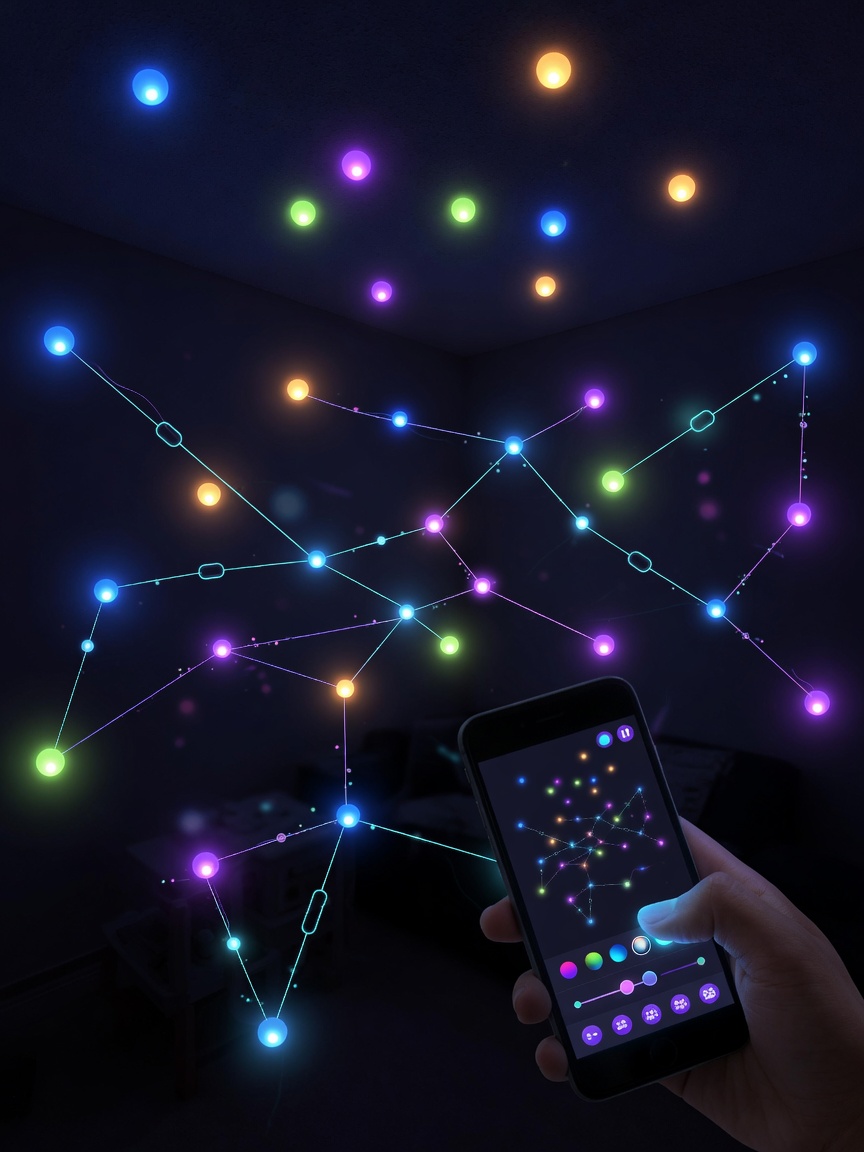
Managed flooding: reaching the whole network without routing tables
How does Bluetooth Mesh get a message across the whole network? The answer is managed flooding.
Unlike traditional networks, it does not maintain a complex routing table or compute optimal paths. Instead, a message is broadcast and flooded, and neighboring nodes relay it onward, spreading in waves until it reaches all destinations[1]. To keep messages from multiplying endlessly, the mechanism adds two gates:
- TTL (Time To Live): limits how many hops a message can be forwarded before it stops.
- Message cache: each node remembers messages it has recently seen and discards duplicates, avoiding echo storms.
The upside of this design is that it is robust and simple: there is no single routing point to fail, joining or removing nodes is forgiving, and coverage is wide. The trade-off is that in bandwidth and latency it is optimized for “reliable delivery” rather than “high-speed per-point updates.”
Mesh 1.1: better suited to large commercial networks
In 2023, the Bluetooth SIG released Mesh Protocol 1.1, strengthening it against the pain points of large commercial networks[2]. Two items are especially relevant to lighting:
- Directed Forwarding: beyond pure flooding, it allows forwarding along more efficient paths, improving the efficiency and predictability of large networks.
- Device firmware update and the Network Lighting Control profile: standardizes common lighting-control needs, making it easier for lights from different vendors to interoperate.
These advances make Bluetooth Mesh more mature at group and scene control — but its essential positioning has not changed.
Why it does not suit per-bead pixel control
Back to the opening question. Managed flooding is good at reliably delivering a single group command to a set of lights — grouped actions like “dim the whole third floor to 50%” or “meeting mode” it does steadily and well.
But per-bead pixel animation is an entirely different requirement: sending different data to tens of thousands of independent points, at a high refresh rate, with strict timing synchronization. Flood-style broadcasting is not designed for this kind of real-time, dense, per-point data stream in any of three dimensions — bandwidth, latency, and synchronization. Forcing it to run pixel animation would hit a ceiling on refresh rate and sync.
So this is not “Bluetooth Mesh isn’t good enough,” but a matter of matching tool to task: its sweet spot is room-, zone-, and group-level control, while real-time pixel-level control needs a different mechanism.
Wireless to the controller, carrier to the bead
This brings out the natural division of labor between Bluetooth Mesh and addressable strings — they are not competitors but each guards a layer:
- Bluetooth Mesh: handles the “wireless, to the controller/luminaire” layer. Users can issue group and scene commands without running control wiring.
- The pixel-control carrier of an addressable string: handles the “wired, to the bead” layer. Inside the string it precisely addresses and synchronizes every bead to run pixel-level animation.
A typical complete architecture: Bluetooth Mesh delivers a “switch scene” group command to the string’s controller, and the controller then drives the per-bead effects inside the string over the power line via carrier. Wireless solves cabling and grouping; carrier solves beads and synchronization.
How PowerMOS supplies bead-level pixel control
PowerMOS pixel-control chips focus on the very layer Bluetooth Mesh is not built for — addressing and pixel control at the bead level. Inside the string, they complete per-bead addressing over a two-wire power-line carrier, with 512-code address depth, dual-layer address (laser-trimmed metal fuse + in-line poly-fuse rewriting), and in-line address writing, providing the precision and synchronization that pixel-level animation needs; indoor current is 3.5–7mA and outdoor 7–20mA, with support for single-point-failure containment and bead-swap repair. If the upstream uses Bluetooth Mesh for group and scene control, the PowerMOS solution supplies exactly the bead-level pixel control it lacks, each playing to its strengths. See the Product Center for the full part list.
Further reading: for smart-home lighting protocols, see The Smart Home Lighting Protocol Landscape; for a comparison of pixel-control methods, see Comparing LED Pixel-Control Technologies.
References and standards
- Bluetooth SIG, Mesh Profile Specification, Version 1.0 (2017). Bluetooth Special Interest Group.
- Bluetooth SIG, Mesh Protocol Specification, Version 1.1 (2023). Bluetooth Special Interest Group.
This article is an educational overview of wireless lighting control. The names of the cited standards can be verified on the Bluetooth SIG official website. PowerMOS pixel-control chips use a proprietary carrier protocol optimized for LED pixel control, complementary to Bluetooth Mesh in a lighting architecture.
FAQ
What is Bluetooth Mesh, and how does it differ from ordinary Bluetooth?
Bluetooth Mesh is a networking technology built on top of Bluetooth Low Energy (BLE), defined by the Bluetooth SIG in July 2017 in the Mesh Profile Specification 1.0. Ordinary Bluetooth is a one-to-one or one-to-few point-to-point connection; Bluetooth Mesh is a many-to-many network — messages can be relayed among many nodes, covering a range far beyond a single Bluetooth link, which suits large-scale lighting control and building automation.
What is managed flooding?
This is how Bluetooth Mesh relays messages. Instead of following fixed routes, a message is flooded — broadcast out — and neighboring nodes that receive it relay it onward until it reaches all destinations. To prevent endless spread, the mechanism adds two controls: a TTL (time to live) limits how many times a message can be forwarded, and a message cache — each node remembers messages it has recently seen and discards duplicates. This lets the network reliably cover a large area without maintaining complex routing tables.
Why does Bluetooth Mesh suit group control rather than per-bead pixel control?
Managed flooding is good at reliably delivering a single group command to a set of lights — for example, 'dim the whole third floor to 50%.' But per-bead pixel animation needs to send different data to tens of thousands of points at a high refresh rate with strict synchronization; flood-style broadcasting is not designed for that in bandwidth, latency, or sync. So Bluetooth Mesh is positioned for room-, zone-, and group-level control, while real-time pixel-level control needs a different mechanism.
Are Bluetooth Mesh and addressable strings competitors?
No — it is more a division of labor. Bluetooth Mesh handles the 'wireless, to the controller/luminaire' layer, letting users issue group commands without running control wiring. The pixel-control carrier of an addressable string handles the 'wired, to the bead' layer — precisely addressing and synchronizing every bead inside the string. A common split: Bluetooth Mesh delivers a group command to the string's controller, and the controller then drives per-bead effects over the power line via carrier.
How does the PowerMOS solution pair with wireless lighting control like Bluetooth Mesh?
PowerMOS pixel-control chips focus on addressing and pixel control at the bead level. Inside the string, they complete per-bead addressing over a two-wire power-line carrier (512-code address depth, dual-layer address, in-line address writing), providing the precision and synchronization that pixel-level animation needs. If the upstream uses Bluetooth Mesh for group and scene control, the PowerMOS solution supplies exactly the bead-level pixel control it is not built for — wireless to the controller, carrier to the bead, each playing to its strengths. See the Product Center for the full part list.
Upgrading your string lights to full pixel control?
Power MOS Electronics delivers the complete stack — driver ICs, addressing equipment, controllers and apps. Tell us about your product and our engineering team will spec it with you.
Contact PowerMOS Browse products