When you build a point-control light-string product, the first question is not which IC to use but which architecture. Shift registers (the WS2811 family), DMX512, and power-line carrier each make fundamentally different trade-offs in wiring, speed, reliability, and manufacturing. This article lays out all three from an engineering perspective, once and for all.
Shift registers: king of speed, cursed by break points
The shift-register architecture is descended from LED display panels. Constant-current driver chips like the 74HC595 (8-bit) and MBI5026 (16-bit) control multiple outputs via clock, data, and latch signals—well suited to displays with dense pixel pitch routed on a single PCB. When advertising lights needed low-density “single-point” control over long spans, engineers reduced a display chip’s outputs to three constant-current channels (R, G, B), and the point-control chip was born.
The following decade of evolution was, in essence, a “wire-reduction campaign”:
- Five in, five out: clock, data, latch plus VCC and GND—many solder joints, five wires required.
- Four in, four out: the latch is integrated into the chip (example: PowerMOS D9813), saving one wire.
- Three in, three out: clock and data are modulated onto the same port (examples: the WS2811/2812 family, PowerMOS D9823), reaching the optimized state of three-wire control—still the mainstream of the strip and pierced-light markets today.
The advantages of three-wire control are very real: fast transmission (8 MHz class), thousands of pixels per port, and highly standardized controllers and host software—users can develop their own patterns without a dedicated electronics engineer, and a decade of market accumulation has made it the de facto standard.
But the architectural weakness is just as unavoidable: data is relayed pixel by pixel, so if any chip in the string fails, the signal breaks at that point and everything after it goes out of control. The break-point-recovery variant tolerates only a single failure, cannot handle two consecutive faults, and adds another signal wire that pushes up cost. This is the fundamental reason shift-register products have struggled to enter the high-end outdoor market and remain confined to strips and pierced lights—and three-wire control has now hit a plateau, with no architecture-level upgrade in recent years.
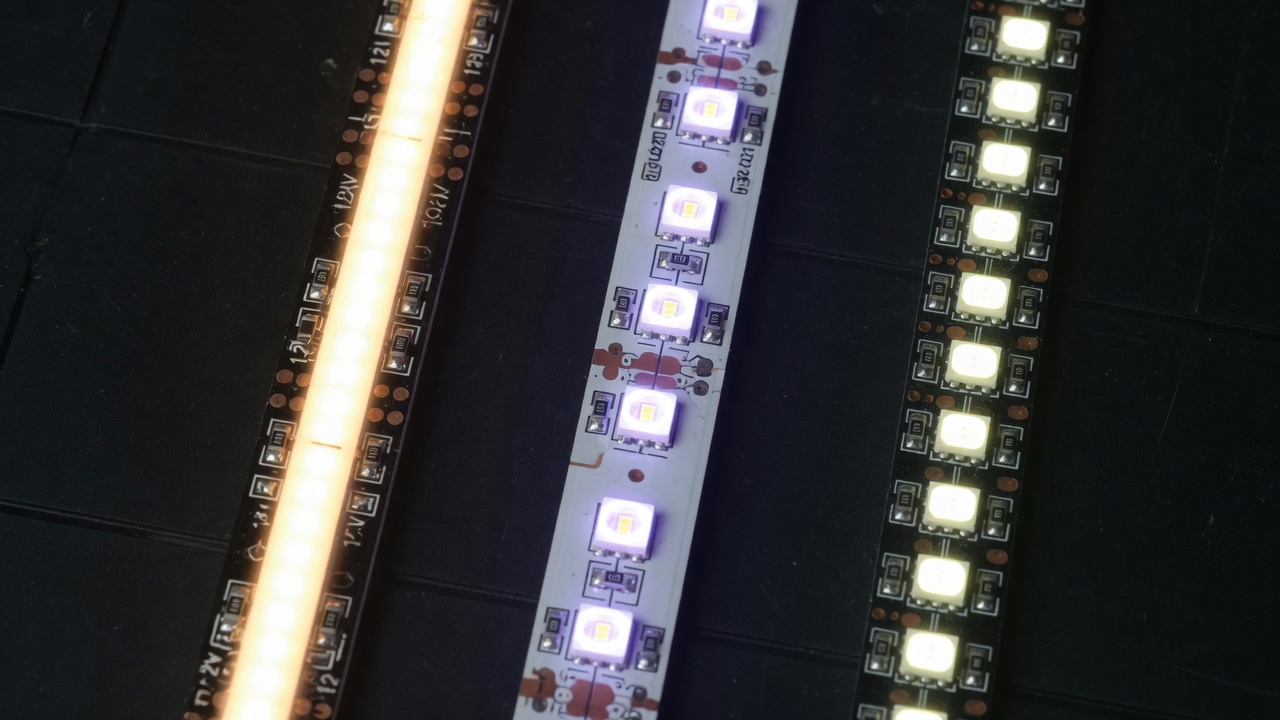
DMX512: address broadcasting with theater heritage
DMX512 is a protocol defined by the U.S. theater technology association on top of the industrial EIA-485 interface: at 250 Kbps it controls 512 nodes and transmits 256 levels of grayscale. The companion driver chips include a built-in DMX512 decoder, memory that can be read and written many times to store an address, and a three- or four-channel constant-current LED driver.
Its value proposition is exactly complementary to shift registers:
- Every fixture has its own address—a single failure does not break the other pixels, so reliability is inherently better than shift registers.
- Addresses can be written and modified in-line via the address line, keeping repair costs low.
- The stage-lighting ecosystem is mature, widely accepted in European and American markets, and customers can author their own patterns.
The price is speed and cost: at 250 Kbps the refresh rate (FPS) is clearly inadequate for many-fixture applications, and the unit cost runs higher. DMX512 suits stage and architectural projects with a limited number of fixtures where reliability comes first—not large-area dynamic imagery of thousands of points.
Power-line carrier: a complete protocol within two wires
The first two architectures share one premise: at least one independent signal wire. Shift registers need a minimum of three wires in and out; DMX512 needs five ports. But the bulbs of a traditional Christmas light string have only two legs—a physical constraint that cannot be worked around. Power-line carrier (PLC) is the only answer: modulate the signal onto the power line so that power and data travel together.
Two-wire transmission brings three core engineering challenges that also define the architecture’s technical barrier to entry:
Challenge one: no 0V available
With signal and power sharing a port, the traditional 0V/5V logic distinction fails—the voltage must always stay above the chip’s reset voltage. The carrier architecture encodes 0 and 1 with a “raised low level” combined with pulse-width modulation (PWM), which each pixel demodulates internally to recover.
Challenge two: the wire itself is the enemy
The wire’s internal resistance causes signal attenuation; an overly long wire’s parasitic inductance distorts the waveform; and when multiple wires are twisted together (net lights, curtain lights), out-of-sync signals interfere with each other and produce high-frequency spikes. A mature carrier chip must work hard on its decoding logic: decoding that resists distortion and noise, so it stays stable in real-world wiring conditions.
Challenge three: the manufacturing craft of the address code
The most decisive competitive edge of the carrier architecture lies not in the protocol itself but in how quickly each pixel can be given and identified by its address. Fixed-address versions require manual or vibratory-bowl sorting and suit only low-pixel-count applications; writable-address versions use a dual-layer scheme of “factory metal fuse for a base code plus production-line silicon fuse for rewriting,” so pixels can be assembled randomly and addressed in-line, with address and position perfectly synchronized—making it possible for automated assembly machines to produce fully point-controlled light strings at 2,400 pixels per hour. For the details of the craft, see PowerMOS core technology.
The limits of the carrier architecture deserve an honest accounting too: signal attenuation limits the number of pixels a single channel can connect; the data rate is lower than shift registers, so refresh rate drops with many pixels and must be compensated with multi-channel output; and high-voltage applications must have thorough anti-spike design at both the chip and controller ends, or you get address shifts, missing colors, and dead pixels.
Cheat sheet for the three architectures
| Dimension | Shift register (WS2811 family) | DMX512 | Power-line carrier (PLC) |
|---|---|---|---|
| Wiring required | 3 wires (signal + power) | 5 ports | 2 wires |
| Transmission speed | Fast (8 MHz class) | Slow (250 Kbps) | Medium |
| Independent address | None (by chain order) | Yes, in-line writable | Yes, fixed code or dual-layer writable |
| Single-pixel failure impact | Everything after the fault fails | Non-propagating | Non-propagating |
| Pixels per channel | About 1,000 | 512 nodes | 256+ (depending on wire and voltage) |
| Ecosystem maturity | Very high, de facto standard | Stage-engineering standard | Proprietary protocols are mutually incompatible; the companion controller defines the experience |
| Typical markets | Strips, pierced lights, advertising lights | Stage, architectural lighting projects | Christmas strings, net lights, curtain lights, copper-wire lights |
A selection decision guide
Compress the decision into four questions:
- 1. How many wires does the product structure allow? A two-wire structure (traditional strings, copper-wire lights) leaves power-line carrier as the only option; if you can run three or more wires, the shift register’s ecosystem and cost advantages are still considerable.
- 2. Can you accept fault propagation? High-end outdoor, field-serviceable projects and retail products should favor an architecture with independent addresses; short-life indoor products can tolerate the shift register’s break-point risk.
- 3. What are your pixel-count and refresh-rate targets? Pixels per channel and FPS are inversely related. With a typical carrier part, a single string of 200 pixels runs about 16 FPS; anything larger scales linearly through multi-channel sub-controller boards.
- 4. What manufacturing process will you use? Fixed-code chips have a low unit price, but multi-address inventory and manual sorting are hidden costs; writable-address solutions let pixels be drawn at random and addressed in-line, fitting automated production lines, so total cost is actually lower at volume.
FAQ
Why does a whole WS2811 strip go dark after one pixel fails?
WS2811 uses a shift-register architecture: the data signal is relayed pixel by pixel, each chip taking its own data and forwarding the rest to the next. If any chip fails, the signal chain breaks at that point, and every pixel after it receives no data and goes out of control. Break-point-recovery versions can tolerate only a single failure, and they require an extra signal wire.
What is the difference between DMX512 and WS2811?
DMX512 is an address-broadcast protocol based on EIA-485: every fixture has its own address, so a single failure does not affect the others—but the speed is only 250 Kbps, so with many fixtures the refresh rate is low and cost is higher. WS2811 is a serial shift-register architecture that is fast (around 800 KHz data rate, thousands of pixels per port) but where a single-point failure breaks the whole string. The former wins on reliability, the latter on speed and cost.
What is power-line carrier (PLC) LED point-control technology?
Power-line carrier technology modulates the address code and grayscale data onto the power line using pulse-width modulation (PWM); each pixel demodulates it internally and executes the corresponding lighting parameters. A pixel needs only two wires (power positive and negative), fully compatible with traditional Christmas-light construction, while still offering independent addressing, non-propagating single-pixel failures, and support for automated in-line address writing.
What should you watch for when selecting a point-control light string for a project?
Four key dimensions. One, structural constraints—a two-wire structure leaves only power-line carrier; three or more wires allow shift registers. Two, reliability requirements—high-end outdoor applications should favor an architecture with address codes. Three, pixel count and refresh rate—the more pixels per channel, the lower the FPS, so large projects need multiple channels. Four, manufacturing—fixed codes are cheap but complicate material management, while writable-address solutions support random assembly and automated production lines.
Upgrading your string lights to full pixel control?
Power MOS Electronics delivers the complete stack — driver ICs, addressing equipment, controllers and apps. Tell us about your product and our engineering team will spec it with you.
Contact PowerMOS Browse products