Consumers are already used to controlling the lights at home with their phone and their voice. When an addressable Christmas light string wants to join that smart-home ecosystem, it runs into a pile of acronyms: Matter, Thread, Zigbee, Wi-Fi. This article sorts out how those protocols divide the work, and how an addressable pixel-control string bridges the gap between per-bead effects and smart-home integration.
Consumers are already used to controlling the lights at home with their phone and their voice. When an addressable Christmas light string wants to join that smart-home ecosystem, it runs into a pile of acronyms: Matter, Thread, Zigbee, Wi-Fi.
This article sorts out how those protocols divide the work, and how an addressable pixel-control string bridges the gap between per-bead effects and smart-home integration—a key step in turning a smart light string into a product.
The smart-home protocol map: who does what
Let’s untangle that pile of acronyms first.
Matter is an interoperability standard from the Connectivity Standards Alliance (CSA), formerly Project CHIP[1]. What it sets out to solve is fragmentation—letting devices from different brands interoperate on the same platform. Matter is not itself a wireless technology; it runs over existing networks, supporting three underlying options: Ethernet (IEEE 802.3), Wi-Fi (IEEE 802.11), and Thread[1].
Zigbee and Thread are the underlying wireless technologies, both built on IEEE 802.15.4 (a low-power 2.4 GHz wireless standard), each adding its own routing and security[2]. Zigbee is a mature smart-home protocol widely used for lighting control; Thread is a newer IP-based mesh network and one of the networks Matter supports.
Wi-Fi, in turn, is the high-bandwidth, no-extra-gateway option, well suited to devices with larger data volumes or that want to connect directly to the router.
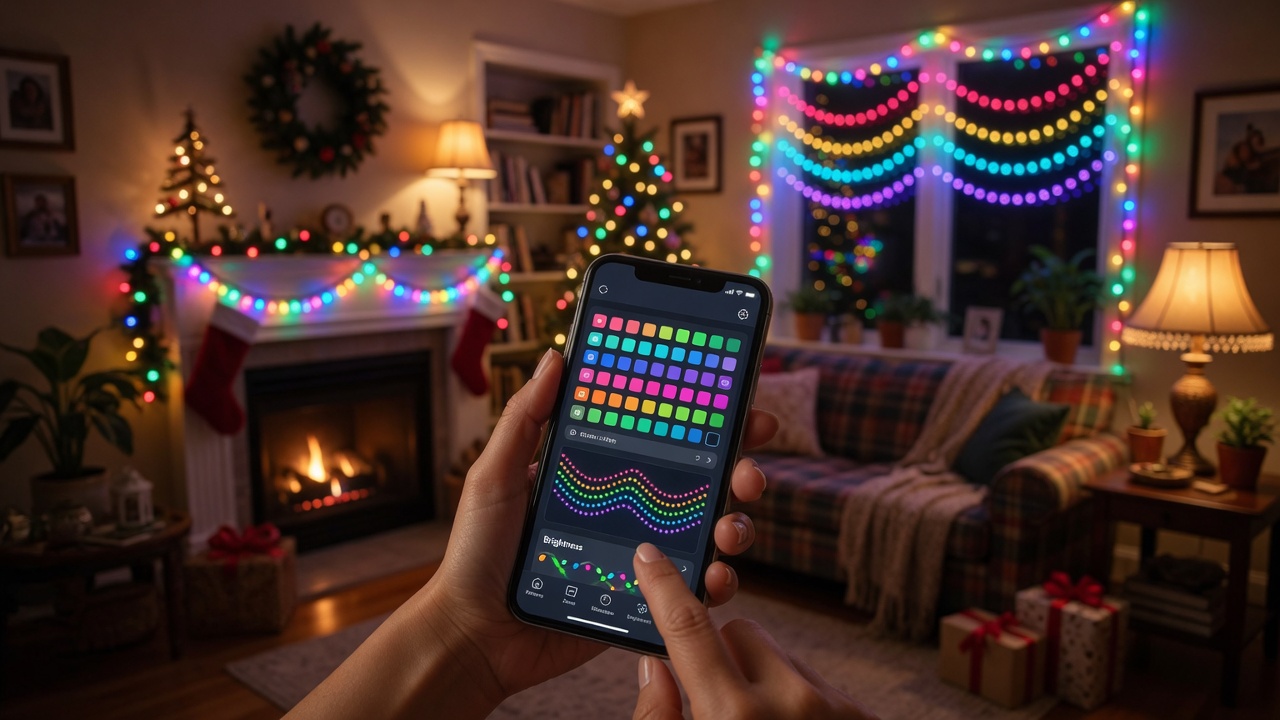
A layered architecture: local rendering + network interoperability
The key to connecting an addressable Christmas string into the smart home is a layered architecture:
- Local layer (per-bead rendering)—the addressable string is driven by a local controller responsible for per-bead effects and power-line carrier transmission. The high-frequency, low-latency real-time control that music-reactive motion and dynamic patterns demand happens in this layer.
- Network layer (smart interoperability)—the controller connects into the smart-home ecosystem over Wi-Fi, Zigbee, or Thread, with Matter interoperability. The commands a user issues through a phone app or voice assistant (on/off, effect selection, brightness, scheduling) pass through this layer.
Why layer it? Because the two run at completely different tempos. Per-bead effects need high-frequency, low-latency real-time rendering, handled most efficiently between the local controller and the carrier string; smart integration is lower-frequency commands (on/off, mode switching) that suit a wireless network. Layering lets each do its job—local handles real-time rendering, the network handles smart interoperability, and neither drags the other down.
Smart integration is the dividing line for smart light strings
Whether a product can join the smart home is becoming the dividing line for smart light strings—consumers expect the lights they buy to be controllable by phone and voice and to work alongside their other smart devices.
PowerMOS provides addressable pixel-control beads and a local-controller solution: the controller handles per-bead effects and carrier drive, and can pair with Wi-Fi/Bluetooth wireless modules to connect into smart-home apps and voice ecosystems, on top of which brands can integrate Matter/Zigbee/Thread ecosystems. See the product center for the full solution.
Further reading: for the product engineering of smart strings, see Retail Smart Christmas Lights; for the future of merging lighting and communication, see When a Light Is More Than a Light: Visible Light Communication.
References
- Connectivity Standards Alliance (CSA), Matter Specification. (Formerly Project CHIP; supports Ethernet/Wi-Fi/Thread.)
- IEEE Std 802.15.4, IEEE Standard for Low-Rate Wireless Networks. IEEE Standards Association — the underlying standard for Zigbee and Thread.
- IEEE Std 802.11, Wireless LAN Medium Access Control (MAC) and Physical Layer (PHY) Specifications. IEEE — the Wi-Fi standard.
This article is an educational piece on smart lighting. The names of the standards cited can be verified in the official catalogs of the CSA and the IEEE Standards Association. PowerMOS pixel-control ICs use a proprietary carrier protocol optimized for LED pixel control, integrating with smart-home ecosystems through a local controller.
FAQ
What is Matter, and what problem does it try to solve?
Matter is a smart-home interoperability standard from the Connectivity Standards Alliance (CSA), formerly Project CHIP. Its goal is to unify a fragmented smart-home ecosystem so devices from different brands can interoperate on the same platform. Matter runs over three underlying networks—Ethernet, Wi-Fi, and Thread—so a Matter-capable light can be controlled by different brands' apps and voice assistants.
How are Zigbee, Thread, and IEEE 802.15.4 related?
Zigbee and Thread are both built on IEEE 802.15.4, a low-power wireless standard (2.4 GHz), each adding its own routing and security. Zigbee is a mature smart-home wireless protocol widely used for lighting control; Thread is a newer IP-based mesh network and one of the networks Matter supports. Both suit low-power, multi-node home lighting.
How does an addressable Christmas string connect to the smart home?
The typical architecture is: the addressable string is driven by a local controller (responsible for per-bead effects and carrier transmission), and the controller connects into the smart-home ecosystem over Wi-Fi, Zigbee, or Thread, with Matter interoperability. The user issues commands through a phone app or voice assistant (on/off, effect selection, brightness, scheduling), and the controller translates them into per-bead control of the string. Per-bead effects run locally; smart integration happens at the network layer.
Why handle smart integration and per-bead effects in separate layers?
Per-bead effects need high-frequency, low-latency real-time control (music-reactive motion, dynamic patterns), which is handled most efficiently between the local controller and the carrier string; smart-home integration is lower-frequency commands (on/off, mode switching) that suit Wi-Fi/Zigbee/Thread. Layering lets each do its job—local handles real-time rendering, the network handles smart interoperability, and neither drags the other down.
How does PowerMOS support smart-home lighting integration?
PowerMOS provides addressable pixel-control beads and a local-controller solution, where the controller handles per-bead effects and carrier drive and can pair with Wi-Fi/Bluetooth wireless modules to connect into smart-home apps and voice ecosystems. Brands can build on this to integrate Matter/Zigbee/Thread ecosystems. Smart lighting brands are welcome to discuss bead and control solutions along with their product plans.
Upgrading your string lights to full pixel control?
Power MOS Electronics delivers the complete stack — driver ICs, addressing equipment, controllers and apps. Tell us about your product and our engineering team will spec it with you.
Contact PowerMOS Browse products