For a whole string of beads to be individually addressable, every single chip has to leave the factory carrying its own address. This question — where does the address come from? — looks like a mere manufacturing detail, yet it decides the cost, yield, and repairability of an addressable string. This article breaks down the address-writing processes behind pixel-control chips — laser trimming, dual-layer fuses — and how they answer the two most practical challenges in addressable lighting: inventory cost and field repair.
For a whole string of beads to be individually addressable, every single chip has to leave the factory carrying its own address.
This question — where does the address come from? — sounds like a mere manufacturing detail, yet it is the root of the most practical cost and repair challenges in addressable lighting. This article breaks down the address-writing processes behind pixel-control chips, and how they determine the cost, yield, and repairability of an addressable string.
The carrier of the address: fuses and laser trimming
The mainstream way to give an addressable LED its address is to lock it in using a fuse. Once written, a fuse’s state is irreversible; when the bead powers up it reads its own address — it knows its position in the string, and the controller addresses each bead accordingly.
There are two kinds of fuse, corresponding to two different moments of writing:
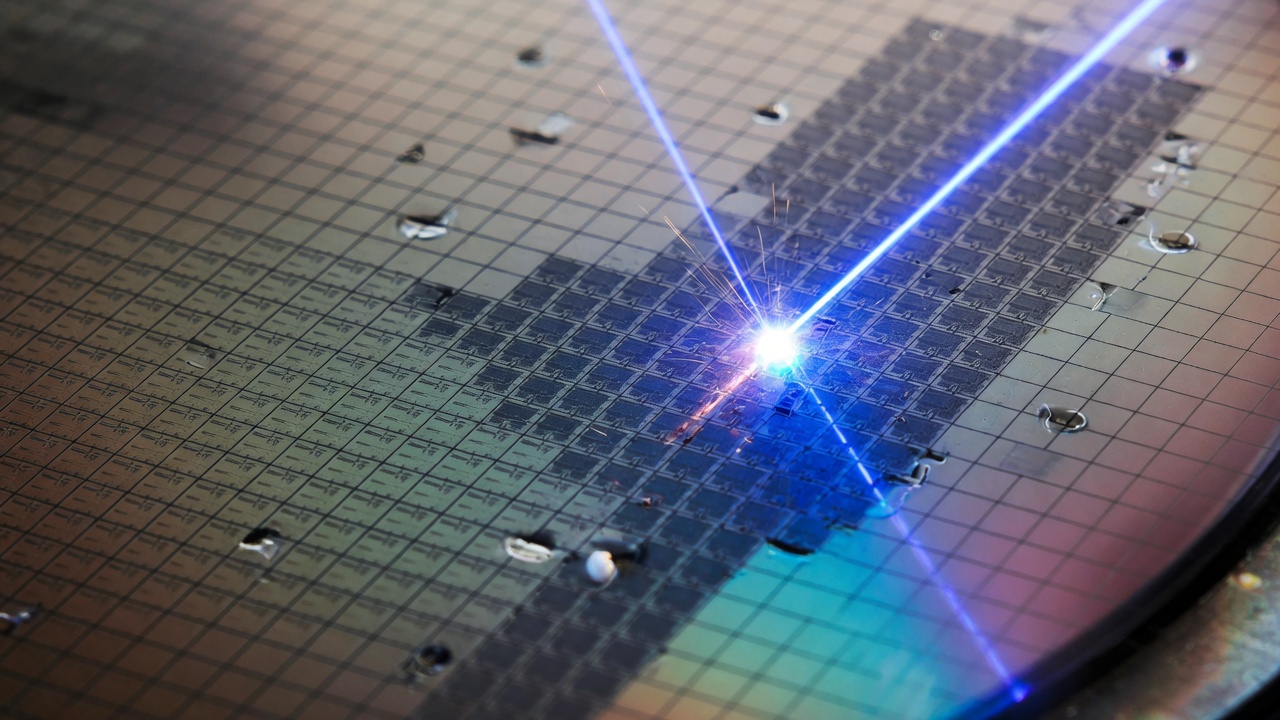
- Metal fuse — written chip by chip at the wafer stage via laser trimming to set the factory address. Laser trimming is a mature precision-tuning process in semiconductor manufacturing; here it is used to burn a dedicated address code into each chip.
- Poly fuse — can be written a second time in-line, after the beads have been assembled into a string, by an address-writing machine.
The difference between these two fuses is more than a technical detail — it is the dividing line for the cost structure of the entire production line.
Two pain points of fixed codes: inventory and repair
Schemes that rely solely on the factory-fixed address (metal fuse) have two structural pain points.
Inventory hell. Fixed-code beads have their address set at the factory, so assembling a sequential string means placing beads with different addresses by position — the line therefore has to stock feed reels for many address sequences. On an SMD placement line, that means complex management, easy mistakes, and high cost.
Difficult repair. If one bead in the middle of a fixed-code string fails, the replacement’s address may not match the original position, making repair difficult or even scrapping the whole string. For large-area, high-value installations such as city lighting, mesh lights, and 3D light sculptures, this is a crippling operating cost.
Dual-layer addressing: one chip, two fuse layers
PowerMOS’s dual-layer address technology is a direct response to both pain points — integrating two fuse layers, metal and poly, on the same chip[1]:
- The metal fuse provides wafer-level factory coding;
- The poly fuse allows in-line rewriting by an address-writing machine after assembly into a string.
This delivers two direct benefits. On inventory, a single feed reel can complete assembly and address reset for every bead within the valid address range, with no need for multiple sequence-sorted reels. On repair, a replaced faulty bead can have its correct address rewritten — repair equipment can automatically detect the faulty position and rewrite after the bead is swapped — making repair of large-area installations feasible.
From fixed address to two-section address
On top of these address-writing processes, PowerMOS has further developed its patented Two-Section Address technology: it splits a single chip’s address code into two sections, each recognized by the controller as an independent address — letting even a fixed-code string run segmented flow and random twinkle at the same time, approaching the segmentation flexibility of addressable lighting (such as DALI, IEC 62386[2]) at extremely low cost. The full explanation of this technology is on the Two-Section Address lighting solution page.
Address process is also a selection dimension
Different address processes correspond to different cost, flexibility, and repair needs. PowerMOS pixel-control chips are offered in process versions such as metal fuse, poly fuse, and dual-layer address, and extend into patented technologies such as two-section addressing. When selecting parts, beyond effects and electrical parameters, the address process (whether in-line rewriting or repairability is needed) should also be part of the consideration. See the Product Center and Core Technology pages for the full part list and processes.
Further reading: for address processes on the manufacturing side, see Copper-Wire Lights, Shoe Lights, and Wearable Illumination; for their value in large-area repair, see Curtain Lights and Mesh Lights.
References and standards
- PowerMOS technical material, Dual-layer address (metal fuse + poly fuse) address-writing process for pixel-control chips. (See the Core Technology page and related patents.)
- IEC 62386, Digital Addressable Lighting Interface (DALI). International Electrotechnical Commission — the international standard reference for addressable lighting.
This article is an educational overview of chip processes. Standards cited can be verified in the IEC official catalog. PowerMOS pixel-control chips use a proprietary carrier protocol optimized for LED pixel control, together with dual-layer and two-section address processes.
FAQ
How is the address written into an addressable LED chip?
The mainstream approach uses a fuse to permanently set an address code inside the chip. Metal fuses are written chip by chip at the wafer stage via laser trimming, fixing the factory address; poly fuses can be written a second time in-line, after the beads have been assembled into a string, by an address-writing machine. Once written, the address is locked; when the bead powers up it knows its position in the string, and the controller addresses each bead accordingly.
What is dual-layer address technology, and what problem does it solve?
Dual-layer addressing integrates two fuse layers on the same chip — a metal fuse (factory coding) and a poly fuse (in-line rewriting on the production line). It resolves the two big pain points of fixed-code schemes. First, inventory: a single feed reel can complete assembly and address reset for every bead within the valid address range, so there is no need to stock reels sorted by address. Second, repair: after a faulty bead is replaced, its address can be rewritten, so a single failure no longer scraps the whole string.
Why is the inventory cost of fixed-address schemes so high?
Fixed-code beads have their addresses set at the factory. To assemble a sequential string you must place beads with different addresses at specific positions, so the line has to stock feed reels for many address sequences. On an SMD placement line this means complex management, easy mistakes, and high cost. In-line address rewriting lets a single reel do the job — the key to lowering the manufacturing cost of pixel-control strings.
How does in-line address rewriting help with repair?
In a traditional fixed-code string, if one bead in the middle fails, the replacement's address may not match the original position, making repair difficult or scrapping the whole string. In-line rewriting lets repair equipment automatically detect the faulty bead's position and, after replacement, rewrite the correct address — making repair feasible for large-area, high-value addressable installations such as city lighting, mesh lights, and 3D light sculptures.
Which PowerMOS technologies and part numbers correspond to these address processes?
PowerMOS pixel-control chips are offered in different process versions — metal fuse, poly fuse, and dual-layer address — and extend into patented technologies such as two-section addressing (splitting a single chip into two independent address groups). Different processes suit different cost, flexibility, and repair needs. See the Product Center and Core Technology pages for the full part list and processes.
Upgrading your string lights to full pixel control?
Power MOS Electronics delivers the complete stack — driver ICs, addressing equipment, controllers and apps. Tell us about your product and our engineering team will spec it with you.
Contact PowerMOS Browse products