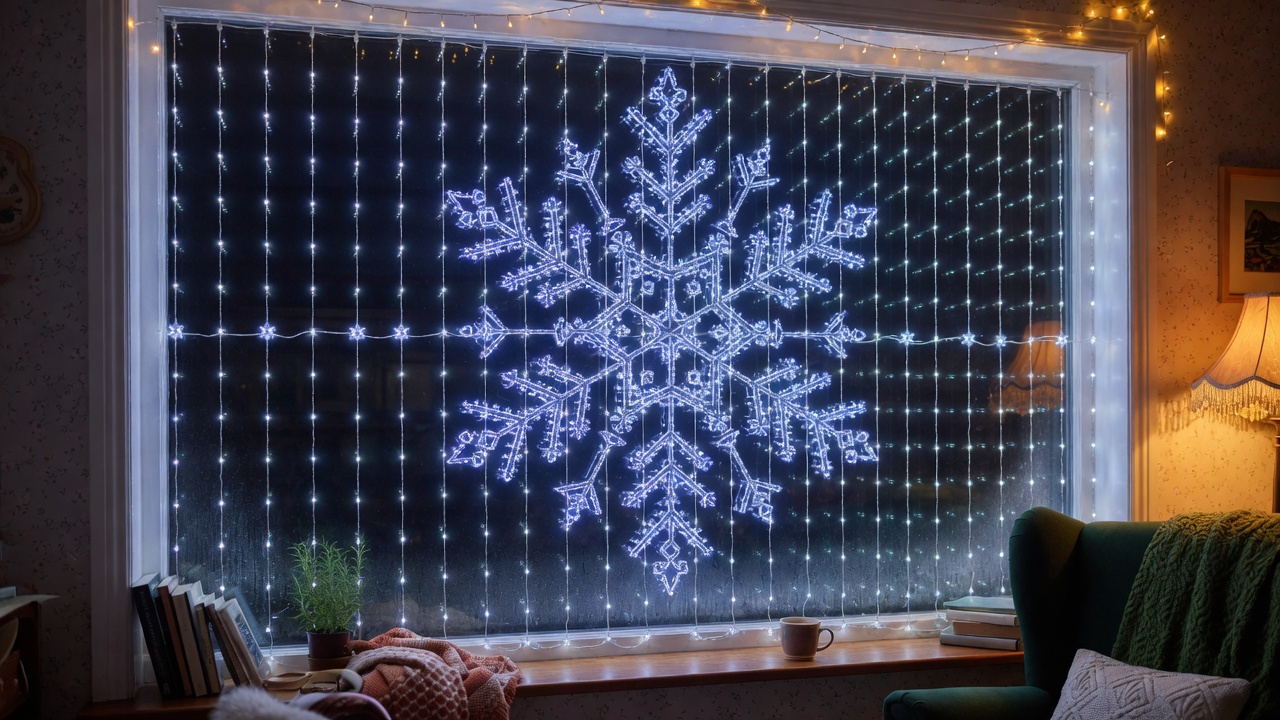
A curtain that plays patterns, a net spread into a starry sky, a wall of light flowing down a facade. Curtain lights and net lights expand addressable LEDs from "a single line" into "a whole surface." That leap from 1D to 2D brings new engineering challenges, signal interference in twisted multi-wire bundles, consistency between address and position, and maintainability across large areas.
A curtain that plays patterns, a net spread into a starry sky, a wall of light flowing down a facade. Curtain lights and net lights expand addressable LEDs from “a single line” into “a whole surface.”
That leap from 1D to 2D may look like nothing more than packing strings closer together, but in engineering terms it brings a fresh set of challenges. This article unpacks the three keys to a 2D addressable light net: signal immunity, address consistency, and large-area repair.
Challenge one: signal interference in twisted bundles
Curtain and net lights are built from multiple strings wired together. When several signal wires are twisted into one bundle, out-of-sync signals interfere with each other and produce high-frequency spikes, a problem a single 1D string never encounters.
The engineering countermeasure lives on the chip: noise-resistant decoding avoids misreads, so multi-wire applications like net and curtain lights read data reliably.
Challenge two: consistency between address and position
For a 2D surface to play a pattern correctly, each LED’s address must strictly match its spatial position. This is the basis of pixel mapping, mapping a graphic or video onto the row-column position of every LED across the net surface so that “this cell of the image” corresponds to “this pixel of the net.”
Here the value of the address-writing process stands out: through dual-layer addressing (a factory address plus in-line rewriting), all strings share a consistent address sequence tied to position. So in multi-string builds (2D curtains, 3D structures), strings are interchangeable, and swapping one string won’t scramble the image.
Challenge three: maintainability over large areas
Repairing a large-area net is the hidden cost of 2D applications. The direct benefit of consistent addressing is this: a faulty string can be replaced on the spot without being bound to a specific controller. Strings with a parallel structure further support automatic detection of faulty LEDs and rewriting after replacement, making repair of large installations fast and practical.
As for smoothness: for addressable LEDs, per-channel pixel count is inversely related to refresh rate. A large net has many pixels, so you must use multi-channel sub-control to divide the surface into blocks and share the load to keep motion fluid. Plan by first setting a “surface resolution x refresh rate” target, then working back to the sub-control architecture.
Choosing parts for your 2D light net
PowerMOS provides the addressable LEDs, dual-layer address process, multi-channel sub-control boards, and carrier-conversion controllers that curtain and net lights need. The parallel structure supports automatic detection of faulty LEDs and rewriting after replacement, ideal for large-area, repairable applications; two-wire carrier combined with high-voltage series-parallel also lowers wiring cost over large areas. See the full lineup in the Product Center. The homepage and the starfield net-light scene in the 3D Christmas Town offer a visual demonstration.
Reference Standards and Literature
- ANSI E1.31-2018 (sACN), Lightweight streaming protocol for transport of DMX512 using ACN. ESTA — a network-transport standard for large-scale pixel mapping.
- IEEE Std 1901.2-2013, IEEE Standard for Low-Frequency Narrowband Power Line Communications for Smart Grid Applications. IEEE Standards Association — a reference for narrowband power-line channel characteristics.
This article is an educational piece on application engineering. PowerMOS pixel-control chips use a proprietary carrier protocol optimized specifically for LED pixel control, together with a dual-layer address process.
FAQ
How does the engineering of curtain and net lights differ from ordinary light strings?
An ordinary light string is 1D (a single line); curtain and net lights are 2D (a whole surface) built from multiple strings wired together. That brings two new challenges. First, when several signal wires are twisted into one bundle, out-of-sync signals interfere and generate high-frequency spikes, requiring noise-resistant decoding on the chip side. Second, for a 2D surface to play a pattern correctly, each LED's address must strictly match its spatial position.
How do net lights play patterns and video (pixel mapping)?
Pixel mapping maps a graphic or video onto the spatial position of each LED across a net surface. That requires every LED to have a known row-column position and an independent address, so that 'this cell of the image' corresponds to 'this pixel of the net.' Addressable LEDs are the physical prerequisite for 2D pixel mapping; only when address and position agree does the image stay coherent.
With a net made of many strings, how do you keep addresses consistent and interchangeable?
This is exactly the value of the address-writing process. Through dual-layer addressing (a factory address plus in-line rewriting), all strings share a consistent address sequence tied to position, so they can be swapped in multi-string builds (2D curtains, 3D structures). A faulty string can be replaced on the spot without being bound to a specific controller, which is critical for maintaining large-area installations.
How does a large-area net keep smooth motion?
For addressable LEDs, per-channel pixel count is inversely related to refresh rate; a large net has many pixels, so a single channel slows down. Engineering-wise, multi-channel sub-control divides the net surface into blocks to share the load and keep the picture updating smoothly. Plan by first setting a 'surface resolution x refresh rate' target, then working back to how many channels and sub-control boards you need.
Who provides the addressable solution for curtain and net lights?
PowerMOS provides the addressable LEDs, dual-layer address process, multi-channel sub-control boards, and carrier-conversion controllers that curtain and net lights need. The parallel structure supports automatic detection of faulty LEDs and rewriting after replacement, ideal for large-area, repairable applications. Two-wire carrier combined with high-voltage series-parallel also lowers wiring cost over large areas. Makers and event-decor teams are welcome to discuss solutions.
Upgrading your string lights to full pixel control?
Power MOS Electronics delivers the complete stack — driver ICs, addressing equipment, controllers and apps. Tell us about your product and our engineering team will spec it with you.
Contact PowerMOS Browse products