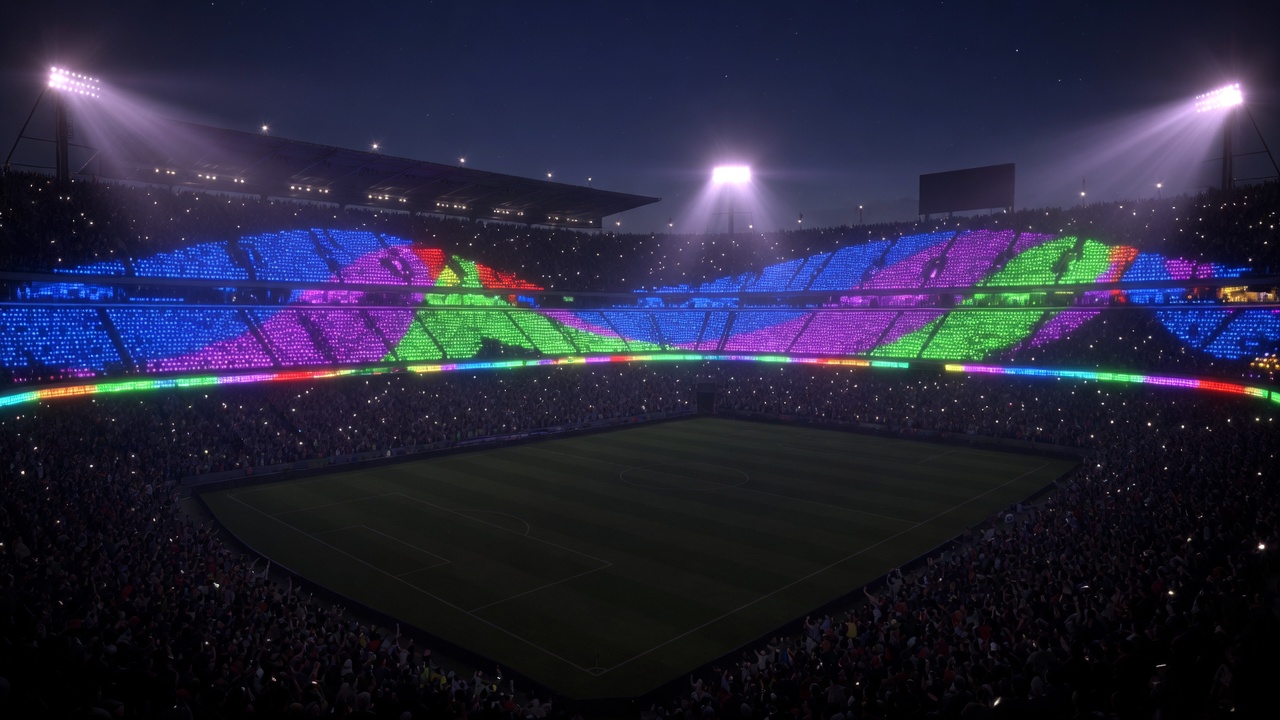
As a big match reaches its climax, a wave of color rolls across the whole stand—not spontaneous crowd movement, but addressable LEDs spread across the seating, staging a light show. Stadiums turn tens of thousands of seats into one giant, moving screen, making every spectator both a viewer and part of the picture. This article is about the engineering of the venue-scale light show.
As a big match reaches its climax, a wave of color rolls across the whole stand—not spontaneous crowd movement, but addressable LEDs spread across the seating, staging a light show.
Stadiums turn tens of thousands of seats into one giant, moving screen, making every spectator both a viewer and part of the picture. This article is about the engineering of the venue-scale light show—an extreme test of addressable LED on massive scale, real-time synchronization, and outdoor reliability.
Turning the stand into a screen: pixelization at extreme scale
The core idea of a venue light show is direct: turn every seat into a pixel.
Addressable LEDs are placed on the seats, railings, or spectators’ wristbands, each position mapped to one pixel, and pixel mapping projects a pattern or animation across the whole stand. Because every bead can be addressed independently, tens of thousands of points form a giant low-resolution screen—rolling a wave of light, spelling out a team crest, playing effects synced to the game.
This is what addressable LED’s “per-bead control” looks like at extreme scale. Without independent addressing, tens of thousands of points can only brighten and dim together—no picture at all.
Syncing to the game: pre-choreographed + live-triggered
A venue light show works best with two tempos in play:
- Pre-choreographed—the fixed sequences for kickoff, halftime, and awards, designed in advance.
- Live-triggered—the bursts at a goal, a score, or the final whistle, triggered in real time by the event production system or the on-site director’s signal.
Live triggers are distributed to the stand’s beads through the show control system (sACN/Art-Net)[1]. Per-bead control lets the whole venue burst in sync at the key moment, amplifying the action into a stadium-wide visual event—the same thread as the real-time interaction in Esports Arena Lighting Engineering, just scaled up to tens of thousands of seats.
Distributing a massive bead count: treating the venue as one canvas
The beads across tens of thousands of seats are a distribution challenge at extreme scale. In engineering terms, content is coordinated across multiple zones through the synchronization mechanism of network lighting-control standards such as sACN[1], splitting the stand into blocks with multi-channel sub-control.
PowerMOS carrier-conversion controllers connect into standard signal ecosystems and scale to a massive number of beads through multi-board cascading and video splitting—managing the entire venue as one unified canvas. Two-wire runs and high-voltage series/parallel connection also keep the cost of long-span wiring in check.
Outdoor reliability: no room for error on a global broadcast
Outdoor venues face sun, rain, temperature swings, and heavy crowds, while major events are often broadcast worldwide—the light show cannot afford to fail. Reliability comes from three fronts at once: waterproofing with the right IP rating (IEC 60529[2]), electrical immunity referencing the IEC 61000 series, and an architecture with address-code fault tolerance so a single-bead failure does not spread. In front of hundreds of millions of viewers, reliability is a hard requirement of venue-scale applications.
Selecting for your venue
PowerMOS provides the addressable beads, carrier-conversion controllers, and multi-channel sub-control that large scale demands, connecting into standard show-signal ecosystems, with two-wire runs and high-voltage series/parallel connection lowering the cost of long-span wiring, suited to large-scale installation across stands, facades, and venue outlines. See the product center for the full solution. Venue operations, event production, and large-event teams are welcome to talk with PowerMOS at venue scale.
References
- ANSI E1.31-2018 (sACN), Lightweight streaming protocol for transport of DMX512 using ACN. ESTA — the standard for large-scale synchronized distribution.
- IEC 60529, Degrees of protection provided by enclosures (IP Code). International Electrotechnical Commission.
- Art-Net 4, DMX-over-Ethernet protocol specification. Artistic Licence.
This article is an educational piece on applications. The names of the standards cited can be verified in the official catalogs of ESTA and IEC. PowerMOS pixel-control ICs connect to standard show-signal ecosystems through a carrier-conversion controller and use a proprietary carrier protocol.
FAQ
How does a stadium turn an entire stand into a screen?
Addressable LEDs are placed on the seats, railings, or spectators' wristbands, each position mapped to one pixel, and pixel mapping projects a pattern or animation across the whole stand. Because every bead can be addressed independently, tens of thousands of points form a giant low-resolution screen—rolling a wave of light, spelling out a team crest, or playing effects synced to the game. This is addressable LED at extreme scale.
How does a venue light show sync to the rhythm of the game?
The show can be pre-choreographed (fixed sequences for kickoff, halftime, and awards) or triggered live (bursts at a goal, a score, or the final whistle). Live triggers come from the event production system or the on-site director's signal, distributed to the stand's beads through the show control system (sACN/Art-Net). Per-bead control lets the whole venue burst in sync at the key moment, amplifying the action into a stadium-wide visual event.
How are the beads across tens of thousands of seats managed and synchronized?
This is a distribution challenge at extreme scale. Content is coordinated across zones through the synchronization mechanism of network lighting-control standards such as sACN, splitting the stand into blocks with multi-channel sub-control. PowerMOS carrier-conversion controllers connect into standard signal ecosystems and scale to a massive number of beads through multi-board cascading and video splitting—managing the entire venue as one unified canvas.
How is lighting reliability guaranteed in an outdoor stadium?
Outdoor venues face sun, rain, temperature swings, and heavy crowds. Waterproofing follows the IP rating chosen for the environment (IEC 60529), electrical immunity references the IEC 61000 series, and the architecture uses address-code fault tolerance so a single-bead failure does not spread. Major events are broadcast worldwide, the light show cannot afford to fail, and reliability is a hard requirement of venue-scale applications.
How do venue operators or event teams obtain a solution?
PowerMOS provides the addressable beads, carrier-conversion controllers, and multi-channel sub-control that large scale demands, connecting into standard show-signal ecosystems, with two-wire runs and high-voltage series/parallel connection lowering the cost of long-span wiring. It suits large-scale installation across stands, facades, and venue outlines. Venue operations, event production, and large-event teams are welcome to discuss at venue scale.
Upgrading your string lights to full pixel control?
Power MOS Electronics delivers the complete stack — driver ICs, addressing equipment, controllers and apps. Tell us about your product and our engineering team will spec it with you.
Contact PowerMOS Browse products