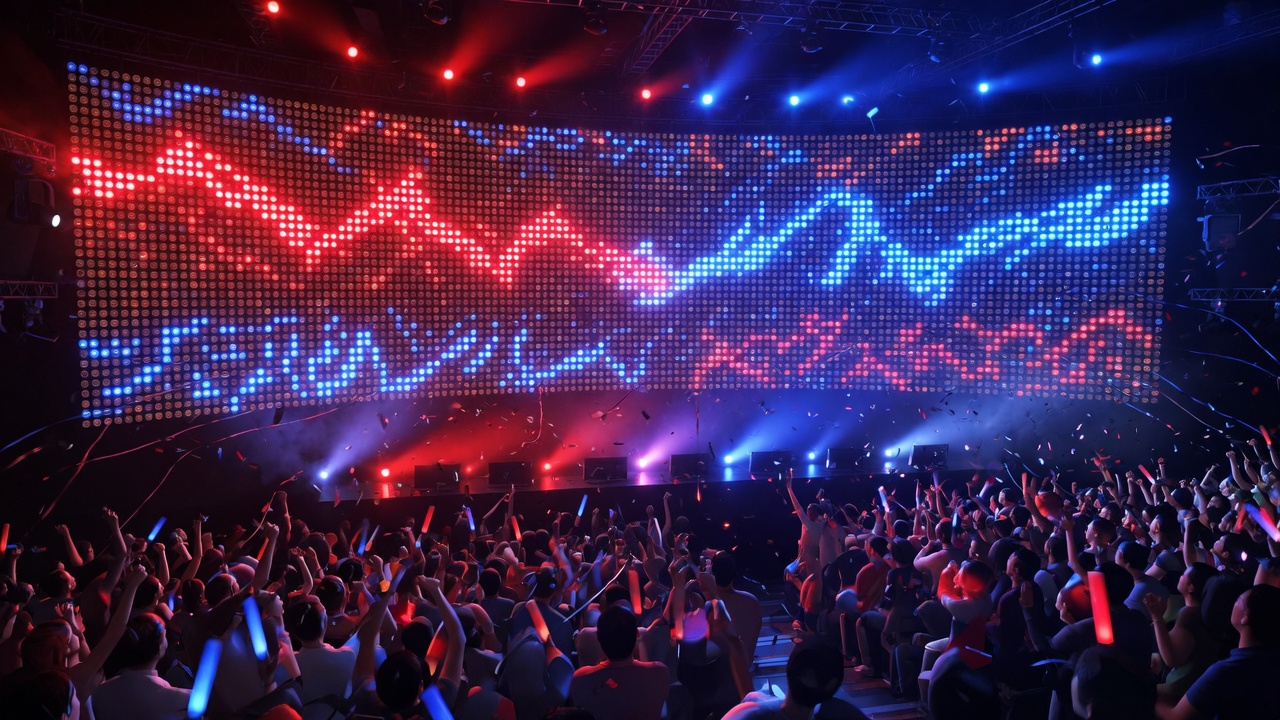
A kill lands on screen and the arena's entire light wall erupts in red at once; a team ability fires and a blue ripple sweeps the stands. Esports is turning lighting into an extension of the match, making the audience seats, the stage, and the structures behind the players all into visual amplifiers of play. What makes it possible underneath is every LED being independently addressable and instantly responsive.
A kill lands on screen and the arena’s entire light wall erupts in red at once; a team ability fires and a blue ripple sweeps the stands. Esports is turning lighting into an extension of the match, making the audience seats, the stage, and the three-dimensional structures behind the players all into visual amplifiers of play.
Delivering this “light erupting with the game” experience takes a real-time reactive system, and one often-overlooked foundation that decides success or failure: every LED being independently addressable and instantly responsive.
The essence of esports lighting: real-time, unpredictable, on the beat
Esports lighting differs from traditional stage lighting in one fundamental way. Traditional stages are mostly pre-choreographed fixed programs, with the lighting designer arranging every change in advance. But the core of esports lighting is real-time reactivity: content is driven live by unpredictable play, and no one can arrange in advance which second of a match brings a kill.
That imposes two engineering requirements: one, a system that can receive live events and dynamically map them to lighting; two, a light medium that can respond instantly, pixel by pixel. When a key instant happens, the entire wall must burst in sync at the millisecond level, and the burst must line up with the picture on screen, since too much delay loses the impact.
From the state of play to a whole-wall burst: the three-layer architecture of reactivity
A reactive esports light wall can be broken into three layers:
- Event layer — captures play from the game’s data interface. This may be a game-event API, trigger signals from the event production system (the broadcast desk), or screen-capture analysis. What it outputs are semantic events like “kill / ability / round end / win-loss.”
- Control layer — a mapping engine translates events into lighting events (kill → red burst, ability → blue sweep), then distributes them through a show-control system. Professional venues often use sACN (ANSI E1.31) or Art-Net, DMX-over-Ethernet standards, to send data to each node.
- Display layer — addressable LEDs and sub-control boards. Each LED has an independent address and can be written instantly, so the whole wall can fire a burst aligned with the match in sync.
What PowerMOS provides is the core of the control and display layers: addressable LEDs with a built-in carrier driver chip, carrier-conversion controllers that accept standard show signals, and multi-channel sub-control boards.
Why addressable LEDs are the key — and a word on reliability
The “instantaneous whole-wall burst” of esports lighting needs every LED to be written independently and in real time, something a whole-color-changing light bar simply cannot do; what it needs is precisely pixel-by-pixel control.
Beyond the effect, there is a dimension venue operators care about even more: reliability. Esports events run for hours, and the broadcast cannot go dark for its entire length. With an architecture that uses independent address codes, a single failed LED won’t cut off all LEDs downstream the way a shift register does (three-wire, like the WS2811 series); address-code fault tolerance keeps failures from propagating. For a venue where “one dead pixel can’t stop the whole show,” the value of this architectural difference far exceeds any transmission speed on paper. For a deeper comparison of architectural fault tolerance, see Three LED Pixel-Control Technologies Explained.
Want game-reactive lighting in your venue
Whether it’s an esports arena, a broadcast studio, or a brand esports event, PowerMOS provides the core components from addressable LEDs to control/conversion solutions. To feel the effect directly, the “esports cabin / reactive” scene in the 3D Christmas Town and the esports scenario video on the homepage both offer a visual demonstration. Bring your venue’s scale and reactivity needs to PowerMOS, and we’ll help you complete LED selection and sub-control architecture planning.
Reference Standards and Literature
- ANSI E1.31-2018 (sACN), Entertainment Technology — Lightweight streaming protocol for transport of DMX512 using ACN. ESTA.
- Art-Net 4, DMX-over-Ethernet protocol specification. Artistic Licence.
- ANSI E1.11 (DMX512-A), Asynchronous Serial Digital Data Transmission Standard for Controlling Lighting Equipment and Accessories. ESTA.
This article is an educational piece on application engineering. PowerMOS pixel-control chips connect to the standard show-signal ecosystem through a carrier-conversion controller, while themselves using a proprietary carrier protocol optimized specifically for LED pixel control.
FAQ
How does an esports arena's lighting sync in real time with the game on screen?
Esports reactivity captures the state of play through the game's data interface, a game-event API, trigger signals from the event production system, or screen-capture analysis, and maps events like 'kill, ability cast, round win/loss' into lighting events, such as a kill bursting red or an ability sweeping blue. These events pass through a show-control system (sACN / Art-Net) or a direct lighting controller to the addressable LEDs. Because each LED is independently addressable, an entire wall can fire a burst synced to the match in milliseconds.
What does esports lighting demand of response speed?
Esports bursts are all about hitting the beat: the light burst has to line up with the key instant on screen, and too much delay looks disconnected and loses impact. That requires the whole chain from event trigger to light response to be fast enough, including event capture, mapping, signal transport, and LED update. Addressable LEDs, which can be written instantly pixel by pixel, support this kind of instantaneous whole-wall burst.
How does esports arena lighting differ from ordinary stage lighting?
Ordinary stage lighting is mostly pre-choreographed fixed programs; the core of esports lighting is 'real-time reactivity', with content driven live by unpredictable play rather than arranged in advance. That needs a system able to receive live events and dynamically map them to lighting, plus addressable LEDs that respond instantly pixel by pixel. The two can coexist: a pre-choreographed ambience plus a real-time reactive burst.
What components does a reactive esports light wall need?
Roughly three layers: an event layer (capturing play from the game/event system), a control layer (a mapping engine plus a show-control system, sACN / Art-Net, or a dedicated controller), and a display layer (addressable LEDs and sub-control boards). PowerMOS provides the core of the display and control/conversion layers, addressable LEDs with a built-in carrier chip, carrier-conversion controllers (that accept standard show signals), and multi-channel sub-control boards.
How do you keep smoothness and reliability at large wall scales?
Two key points. Smoothness: for addressable LEDs, per-channel pixel count is inversely related to refresh rate, so a large wall spreads the load across multiple sub-control channels to keep a high FPS. Reliability: with an architecture that uses independent address codes, a single failed LED won't cut off the whole string the way a shift register does, which is critical for a venue running for hours that cannot go dark mid-show.
Upgrading your string lights to full pixel control?
Power MOS Electronics delivers the complete stack — driver ICs, addressing equipment, controllers and apps. Tell us about your product and our engineering team will spec it with you.
Contact PowerMOS Browse products