You want to build a smart-light under your own brand and sell it into Western retail. A user opens the app, picks a Christmas animation, and the string lights up—simple to describe, but four layers of technology are stacked behind it: bead, controller, app, cloud. Each layer is a discipline of its own, and each is an investment. The good news is you do not have to build every layer yourself. Working out which layer is your brand value and which can be handed to a solution partner is the key to shipping the product without burning through your budget.
- Splitting a smart-light into four layers
- Layer one: the addressable bead—the physical layer that decides success or failure
- Layer two: the controller—the BLE, Wi-Fi, Thread connectivity choice
- Layer three: the app—the experience the brand truly should control
- Layer four: the cloud—accounts, OTA and content distribution
- Where the interfaces sit: what the brand owner should build, what to outsource
- PowerMOS: hand the bottom two layers to one partner
- References and Standards Cited
- FAQ
You want to build a smart-light under your own brand and sell it into Western retail.
A user opens the app, picks a Christmas animation, and the string lights up from the first bead to the last—simple to describe, but four layers of technology are stacked behind that single action: bead, controller, app, cloud. Each layer is a discipline of its own, and each is an investment. This article pulls the four layers apart, explains what each does and where the interfaces sit, and, for a brand owner, which layer you truly should control and which you can hand off.
Splitting a smart-light into four layers
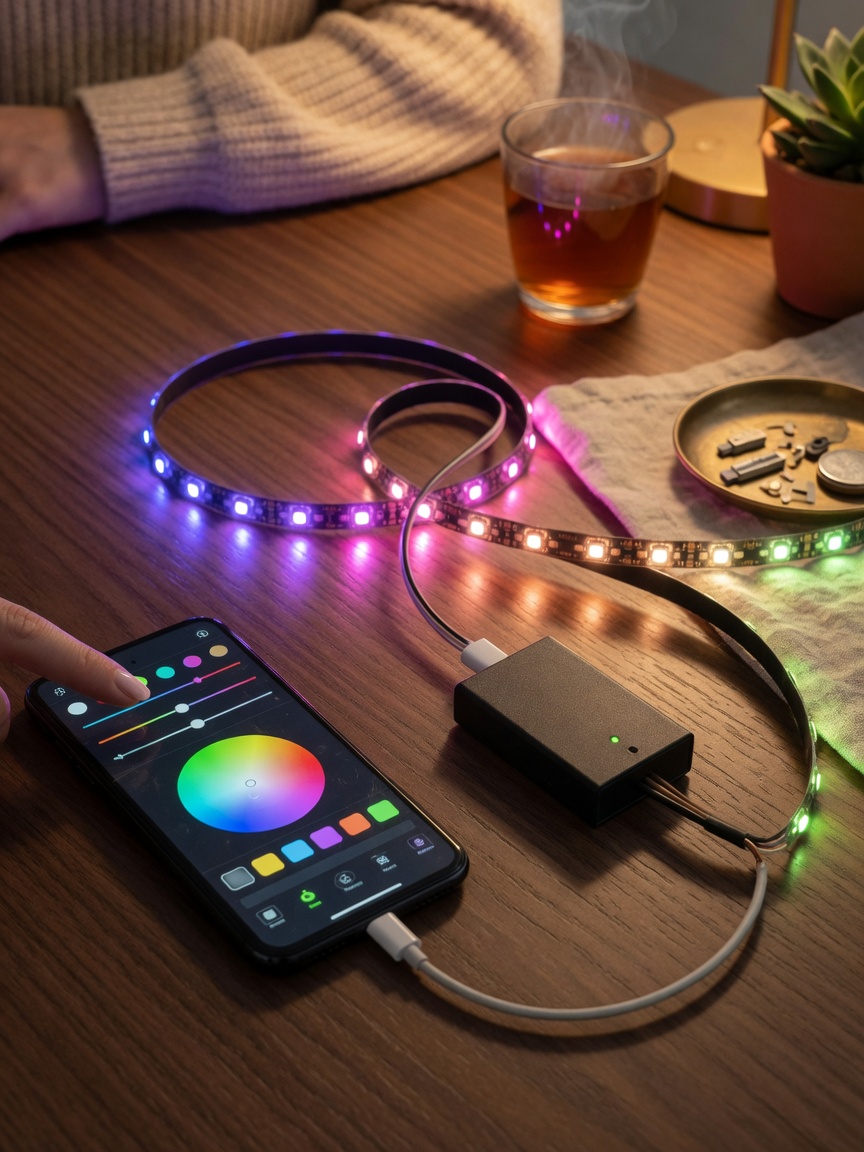
Start with the whole picture. A modern smart-light, from the bottom up, is these four layers:
- Bead layer: the addressable control IC inside each light, deciding whether it can be individually lit, colored and dimmed.
- Controller layer: the string’s “brain and power supply,” delivering power, sending pixel-control signals to each bead, and connecting outward over a wireless protocol.
- App layer: the operating interface in the user’s hand—choosing scenes, scheduling, tuning color, playing animations.
- Cloud layer: the account system, OTA firmware updates, and distribution of content and animations.
Between these four layers are clear interfaces, and the interface is precisely the seam of the division of labor—define it clearly, and who builds one layer does not affect the others.
Layer one: the addressable bead—the physical layer that decides success or failure
The bottom layer, and the one most easily underrated.
Inside every “addressable” bead is a control IC that lets it be individually addressed, dimmed and colored. This layer decides what your product is physically capable of: whether it can run a bead-by-bead flowing animation, whether the grayscale is fine enough, whether it survives rain outdoors, and whether one dead bead takes the whole string down with it.
The difficulty here is not “making it light up” but consistency and yield. A single string may hold several hundred beads, and even a small shortfall in yield, multiplied across hundreds of beads, magnifies into a visible dead-bead rate and returns. How the address gets written into each bead, whether the line can write addresses automatically, whether a bad bead can be replaced individually—these are the hard craft of the bead layer, and exactly the part a pure app team should not, and cannot, take on itself.
Layer two: the controller—the BLE, Wi-Fi, Thread connectivity choice
The controller is the string’s “brain and power supply.” It does two things: downward, it turns the effect the app wants into pixel-control signals sent bead by bead; upward, it connects to phone and cloud over a wireless protocol.
That upward path involves one key choice—which wireless protocol:
- BLE (Bluetooth Low Energy): short-range direct connection, router-free, quick pairing, low cost—the most common choice for light strings. To network many nodes, it can pair with a Bluetooth mesh solution (the Bluetooth Mesh Profile 1.0 was formally adopted by the Bluetooth SIG in 2017[2]).
- Wi-Fi: connects directly to the cloud and supports remote control, but with higher power and cost—better suited to fixed installations that need to be online at all times.
- Thread: a low-power IPv6 mesh network built on IEEE 802.15.4, released in 2022 alongside Matter 1.0 as Matter’s low-power transport layer[3].
If you want the product to be integrated into mainstream smart-home ecosystems in the future, Matter is a name you cannot avoid. Matter 1.0 was released by the Connectivity Standards Alliance (CSA) in October 2022, with lighting products included in the very first version, aiming to let smart-home devices from different brands interoperate[1]. Whether and when the controller supports Matter is the strategic question of this layer.
Layer three: the app—the experience the brand truly should control
At this layer you finally reach the place where the user actually feels your brand.
The same string, the same bead and controller, paired with a smooth, well-made app with beautiful animations and rich scenes—versus paired with a laggy, awkward app—produces two completely different product verdicts. The app is the face of the brand: color, animation library, festive themes, scheduling and scenes, and integration with voice assistants—these are your differentiation, and the hardest part for competitors to copy.
So the conclusion for this layer is clear: the app and the brand experience are the brand owner’s to control. This is where you invest resources and build your moat. Whether the foundation can support these effects reliably is one thing, but the authority to decide “what experience to present” must stay in the brand’s own hands.
Layer four: the cloud—accounts, OTA and content distribution
The top layer is usually the least conspicuous, yet it is the key to whether the product can “stay alive” over the long term.
The cloud layer handles three things: accounts (users, device binding, multi-device sync), OTA firmware updates (fixing bugs and adding features after launch, without a recall), and content distribution (new animations and festive themes pushed after the fact). A product that can do OTA has, in effect, bought insurance that it “can still evolve after launch”—especially important for the festive category, where the string range is refreshed every year.
Where the interfaces sit: what the brand owner should build, what to outsource
With the four layers laid out, the real commercial decision surfaces: the seam of the division of labor is at the interfaces.
- Between bead and controller is the pixel-control signal protocol (for example power-line carrier), which decides how data reaches each light reliably.
- Between controller and app/cloud are the wireless protocols and application-layer API.
Once these two interfaces are clear, who builds the foundation (bead + controller + address-writing line) does not affect the brand experience above. So the most pragmatic split is this: the brand owner builds the app and the brand layer, and hands the hard, heavy foundation—bead, controller, automated address-writing, which take years to accumulate—to a solution partner with full-chain capability on a white-label basis. What you get is a stable physical foundation; what you invest is your own brand value.
PowerMOS: hand the bottom two layers to one partner
The “two foundation jobs” above—bead and controller—are exactly what PowerMOS has done, and only done, for nearly two decades.
PowerMOS provides full-chain, one-stop capability from IC, pixel-control protocol and automated address-writing line to controller and app—in effect carrying the bead layer and controller layer end to end on a white-label basis, so the brand owner can focus on its own app and brand. The hard numbers of the foundation are on the table too: over 500KK ICs shipped in total (incl. the P9864 and P9831/P9832 series), a defect rate of about 50 PPM, dual-layer addressing and single-reel assembly, and support for bead-replaceable repair—precisely the real craft behind “the bead layer decides success or failure.” Add the protection of 18 US and European patents (7 owned + 11 formally licensed), and customers gain intellectual-property protection along with the solution, so they can enter mainstream Western channels with confidence. See the flagship pixel-control models (such as P9864/P9866 and P9865/P9873) and the full solution at the product center.
Want to evaluate building your product line on a PowerMOS solution? Write to sales-02@powermos.com and the engineering and commercial teams will engage directly. You are also welcome to start with About PowerMOS and our competitive advantages.
Further reading: for the wireless-protocol choice, see A Complete Guide to Smart-Home Lighting Protocols; for the physical-layer principles of the pixel-control bead, see Two-Wire Addressable Lighting.
References and Standards Cited
- Connectivity Standards Alliance (CSA), Matter Specification, Version 1.0. Released October 2022; the first version incorporated the interoperability standard for smart-home devices including lighting.
- Bluetooth SIG, Mesh Profile Specification, Version 1.0. Formally adopted by the Bluetooth SIG in 2017, defining the mesh network for Bluetooth Low Energy.
- Thread Group, Thread Specification, Version 1.3. Built on IEEE 802.15.4, released in 2022 alongside Matter 1.0 as its low-power mesh transport layer.
This article is an educational piece on smart-light product architecture. The names of the standards cited can be verified in the official catalogs of the CSA, the Bluetooth SIG and the Thread Group. PowerMOS pixel-control ICs use a proprietary carrier protocol optimized for LED pixel control.
FAQ
What layers of technology make up a smart-light product?
Roughly four. At the bottom is the addressable bead, containing a control IC that decides whether each light can be individually addressed and dimmed; above it is the controller, which supplies power, sends pixel-control signals, and connects to phone and cloud over BLE, Wi-Fi or Thread; above that is the app, the interface where the user works with animations, scenes and schedules; at the top is the cloud, handling accounts, OTA firmware updates and content distribution. Each of the four is a discipline in its own right.
Does a brand owner have to develop all four layers themselves?
No. Most successful brands concentrate their resources on the app experience and the brand layer—the parts the user actually feels and the hardest to copy—while the bead, controller and address-writing line, the underlying foundation, can be provided on a white-label basis by an IC solution partner with full-chain capability. That way the brand owner ships faster and hands the engineering risk to the specialist.
Where are the interfaces between bead, controller and app?
Between bead and controller is the pixel-control signal protocol (for example power-line carrier), which decides how data reaches each light; between controller and app/cloud are the wireless protocols (BLE, Wi-Fi, Thread/Matter) and the application-layer API. These two interfaces are the seams of the division of labor: define the interfaces clearly and who builds the layer beneath does not affect the brand experience above.
BLE, Wi-Fi or Thread for the controller's connectivity?
BLE suits short-range, router-free direct connection—low cost, quick pairing—and is the most common choice for light strings; Wi-Fi suits scenarios needing remote control and a direct cloud link, but with higher power and cost; Thread is a low-power mesh network and, in 2022, became Matter 1.0's low-power transport layer. In practice many products use a combination of BLE direct connection plus a gateway to the cloud.
How does the PowerMOS solution map to this technology stack?
PowerMOS provides full-chain, one-stop capability from IC, pixel-control protocol and automated address-writing line to controller and app—effectively carrying the bottom two layers, bead and controller, on a white-label basis, so the brand owner can focus on the app and the brand. See the product center for the flagship pixel-control models (such as P9864/P9866 and P9865/P9873) and the solution scope.
Upgrading your string lights to full pixel control?
Power MOS Electronics delivers the complete stack — driver ICs, addressing equipment, controllers and apps. Tell us about your product and our engineering team will spec it with you.
Contact PowerMOS Browse products