The string of Christmas lights a consumer takes home is quietly becoming a consumer electronics product — pick effects from a phone, react to the music, spell out patterns and text on the tree. Behind this shift are addressable beads, an app ecosystem, and a string of often-overlooked product engineering that decides whether a product makes it to the shelf: flicker-free dimming, electromagnetic compatibility, and photobiological safety. This article is for brands and importers looking to bring smart light strings into retail channels across the US, Europe, and Japan.
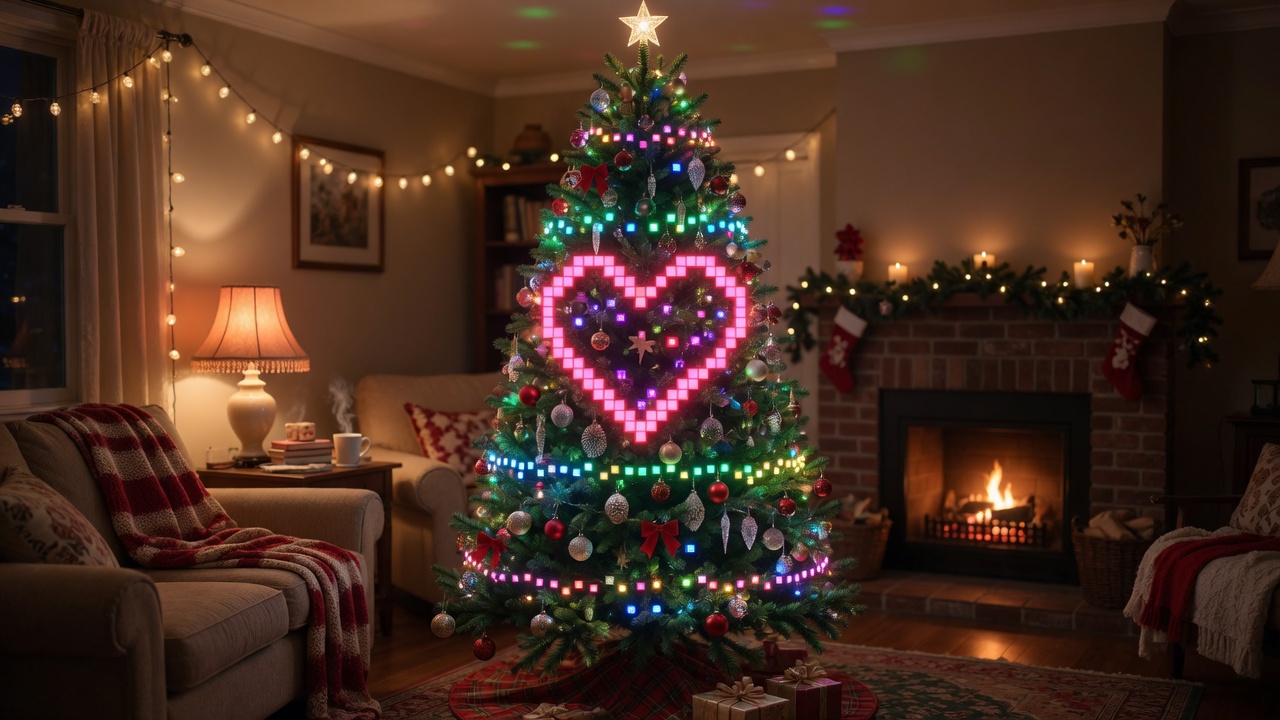
The string of Christmas lights a consumer takes home is quietly becoming a consumer electronics product. Pick effects from a phone, react to the music, spell out smiley faces and text on the tree — this is no longer “a light that blinks” but a light surface hung on the tree that you can keep creating on.
This shift is both an opportunity and a barrier for lighting brands and importers. Because bringing a smart light string into retail channels across the US, Europe, and Japan rests on a string of product engineering that’s often underestimated yet decides whether it reaches the shelf — and the return rate. This article breaks down three of the keys.
Per-bead control: the functional foundation of smart strings
The divide between a smart string and traditional Christmas lights comes down to one line: whether each bead can be independently addressed.
Traditional Christmas lights blink in unison or run fixed patterns stored on the chip; a smart string gives every bead its own address, each able to show a different color and brightness, so you can pick effects from an app, react to music, and spell out emoji and text on the tree. This “per-bead control” is the prerequisite for consumers to create their own patterns — and the root of the product’s price premium.
PowerMOS power-line carrier pixel-control ICs provide exactly this capability: giving every bead its own address, over just two wires, fully compatible with the structure of traditional two-pin Christmas lights. For a hands-on feel, try entering text or switching effects in the bead simulator.
The app ecosystem: handing creative control to the consumer
A smart string’s price premium comes from handing creative control back to the consumer. Typical app capabilities cover an effects library to browse and play, audio reactivity, brightness and speed adjustment, custom colors, scheduled on/off and daily cycles; more advanced ones support multi-node Wi-Fi/Bluetooth networked sync, color sampling from images, and even camera-based addressing to locate each bead’s spatial position, plus smart-speaker voice integration.
This whole app experience is what opens up a price gap between smart and traditional strings on the shelf — you can still play with it and change it after taking it home, rather than it being fixed the moment it’s hung up.
The invisible barriers to the shelf: certification, dimming, and safety
What truly decides whether a product reaches the shelf is often three things the consumer never sees.
Electromagnetic compatibility (EMC) certification. Getting onto the shelf requires passing the target market’s safety and EMC certifications, meeting the immunity and emission requirements of standards like the IEC 61000 series[1]. There’s a cost unique to power-line carrier products here: passing certification usually needs a filter capacitor on every bead — this must be built into the product-design stage, not discovered only at testing.
Flicker-free dimming. When LEDs are dimmed by pulse-width modulation (PWM), the rapid switching of current can cause visible or invisible flicker. IEEE 1789-2015 notes that flicker at certain frequencies, even when hard for the eye to detect, may still have physiological effects on people, and it gives a recommended range for dimming frequency[2]. For household Christmas lights viewed at close range for long periods, adopting high-frequency dimming in line with the recommendations is part of product quality and a detail that lowers complaints.
Photobiological safety. A luminaire’s blue-light and radiation safety can reference the photobiological safety assessment of IEC 62471[3], which is especially important for products aimed at children and families.
Bringing smart light strings into retail channels
PowerMOS provides the core of smart light strings — addressable beads with a built-in power-line carrier driver IC, the accompanying controller and app ecosystem, and filter-design guidance to help pass certification. Two-wire compatibility lets existing light-string products be upgraded directly to full pixel control, with no need to redesign the tooling.
Further reading: for the two-section addressing technology behind smart strings, see the two-section address string solution; for the technical context of addressable lighting, see The Two-Wire Debate in Addressable Lighting. Bring your product plans and target markets to PowerMOS to discuss solutions and selection.
Reference Standards and Literature
- IEC 61000 series, Electromagnetic compatibility (EMC). International Electrotechnical Commission.
- IEEE Std 1789-2015, IEEE Recommended Practices for Modulating Current in High-Brightness LEDs for Mitigating Health Risks to Viewers. IEEE Standards Association.
- IEC 62471, Photobiological safety of lamps and lamp systems. International Electrotechnical Commission.
- IEC 62386, Digital Addressable Lighting Interface (DALI). IEC / DALI Alliance.
This article is an educational overview of product engineering. The names and numbers of the standards cited can be verified in the official catalogs of the IEC and the IEEE Standards Association. PowerMOS addressable-control ICs use a proprietary carrier protocol optimized for LED pixel control.
FAQ
What is the core difference between smart Christmas lights and traditional ones?
Traditional Christmas lights blink in unison or run fixed patterns; a smart string gives every bead an independent address, each able to show a different color and brightness, so you can pick effects from an app, react to music, and even spell out emoji, text, or patterns on the tree. This 'per-bead control' is the prerequisite for consumers to create their own patterns, and it's the biggest functional divide between smart and traditional strings.
What certifications does a smart light string need to enter US and European retail channels?
Getting onto the shelf requires passing the target market's safety and electromagnetic compatibility (EMC) certifications, with a lengthy application cycle. On EMC, it must meet the immunity and emission requirements of standards like the IEC 61000 series; the luminaire's photobiological safety can reference IEC 62471. Note in particular: power-line carrier products usually need a filter capacitor on every bead to pass certification — a necessary cost for a pixel-control string entering retail, which must be factored in at the product-design stage.
Why does a smart light string need to take 'flicker-free' dimming seriously?
When LEDs are dimmed by pulse-width modulation (PWM), the rapid switching can cause visible or invisible flicker. IEEE 1789-2015 notes that flicker at certain frequencies, even when hard for the eye to detect, may still have physiological effects on people, and it offers recommendations for dimming frequency. For household Christmas lights viewed at close range for long periods, adopting high-frequency dimming in line with the recommendations is part of product quality and the consumer experience.
What features does a smart light string's app control typically support?
Typical features include an effects library to browse and play, audio reactivity, brightness and speed adjustment, custom colors, scheduled on/off and daily cycles; more advanced ones support multi-node networked sync, color sampling from images, and even camera-based addressing to locate each bead's spatial position. Control methods span Wi-Fi, Bluetooth, and smart-speaker voice. These let consumers keep creating after taking the product home — the source of a smart string's price premium.
How can brands or importers get the core solution for smart light strings?
PowerMOS provides the core of smart light strings — addressable LED beads with a built-in power-line carrier driver IC, the accompanying controller and app ecosystem, and filter-design guidance to help pass certification. Two-wire power-and-signal delivery is compatible with the structure of traditional light strings, so existing products can be upgraded directly. Brands and importers are welcome to bring their product plans and target markets to discuss solutions and selection.
Upgrading your string lights to full pixel control?
Power MOS Electronics delivers the complete stack — driver ICs, addressing equipment, controllers and apps. Tell us about your product and our engineering team will spec it with you.
Contact PowerMOS Browse products