A winter resort at night is defined by its lights: the warm glow tracing the roofline of each chalet, the crisp wayfinding at the gondola station, the points of light flickering in snow-covered trees. But these lights have to run all winter without fail—in fifteen or twenty below, buried in snow, hung with ice, and occasionally clipped by a sled or a shoulder. The interesting part is that the cold is actually good for the LED itself. What turns fragile is everything around it. This article is about the reliability engineering of winter outdoor lighting.
A winter resort at night is defined by its lights: the warm glow tracing the roofline of each chalet, the crisp wayfinding at the gondola station, the points of light flickering through snow-covered trees.
But these lights have to make it through an entire winter without failing—in fifteen or twenty below, buried in snow, hung with ice, occasionally clipped by a sled or a shoulder. The interesting thing is that cold is actually good for the LED itself; what turns fragile in deep winter is everything around it. This article is about the reliability engineering of winter outdoor addressable lighting: the two faces of cold, impact resistance, and waterproofing.
Cold is good for LEDs: clearing up a misconception first
Many people assume cold harms LEDs. The truth is the opposite: for the LED die itself, cold is mostly good.
Luminous efficiency rises as junction temperature falls—a cold environment lets the die run more efficiently and brighter. More important is lifetime: LED lumen depreciation is strongly tied to operating temperature, and the lower the temperature, the longer luminous flux is maintained.
This is not a hunch. LM-80 is the method for measuring how an LED maintains luminous flux and color, and it requires long-duration testing at temperatures such as 55°C and 85°C[1]; TM-21 then projects long-term flux maintenance from that data—for example the L70 hours at which output decays to 70% of initial[2]. The method makes it clear: the lower the operating temperature, the slower the depreciation. So in a cold climate, the LED die’s lifetime actually comes out ahead.
What actually turns brittle: wiring, sealant, and plastic parts
If the LED die is at an advantage in the cold, where do the reliability problems in winter lighting come from? From everything except the die.
Cold changes the mechanical properties of materials: wire insulation hardens and embrittles, so repeated flexing produces cracks; sealant loses its elasticity, so a sealing interface that once expanded and contracted with temperature becomes stiff and prone to splitting; and plastic housings and diffusers lose impact resistance in the cold, cracking on the slightest knock.
In other words, winter lighting failures are often not “the light went dark” but “the wire snapped, the sealant split, the housing cracked, and water got in.” That shifts the reliability focus from the electrical back to the mechanical and the material—and to the two engineering metrics that follow: impact resistance and waterproofing.
IK rating: standing up to ice load and impact
The winter environment applies more mechanical force than you might think: the weight of accumulated snow and ice (ice load) presses continuously on the fixture; snow-clearing scrapes, brushes, and blows against it; and accidental impacts from sleds, boards, and pedestrians are routine.
The measure of a fixture’s toughness is its IK rating, defined by IEC 62262[3]. It grades from IK00 to IK10, where a higher number means the fixture withstands higher impact energy, assessed through a standardized impact test (a specified hammer, specified energy, specified point of impact)[3].
For a resort, the more a location is likely to be touched or loaded by snow and ice—around gondola stations, alongside walkways, low tree lights—the more its IK rating deserves attention during selection. Outline lights placed high and out of reach can be more relaxed; the low, high-traffic spots cannot cut corners.
Waterproofing under freeze-thaw
Winter waterproofing is hard for one reason: freezing.
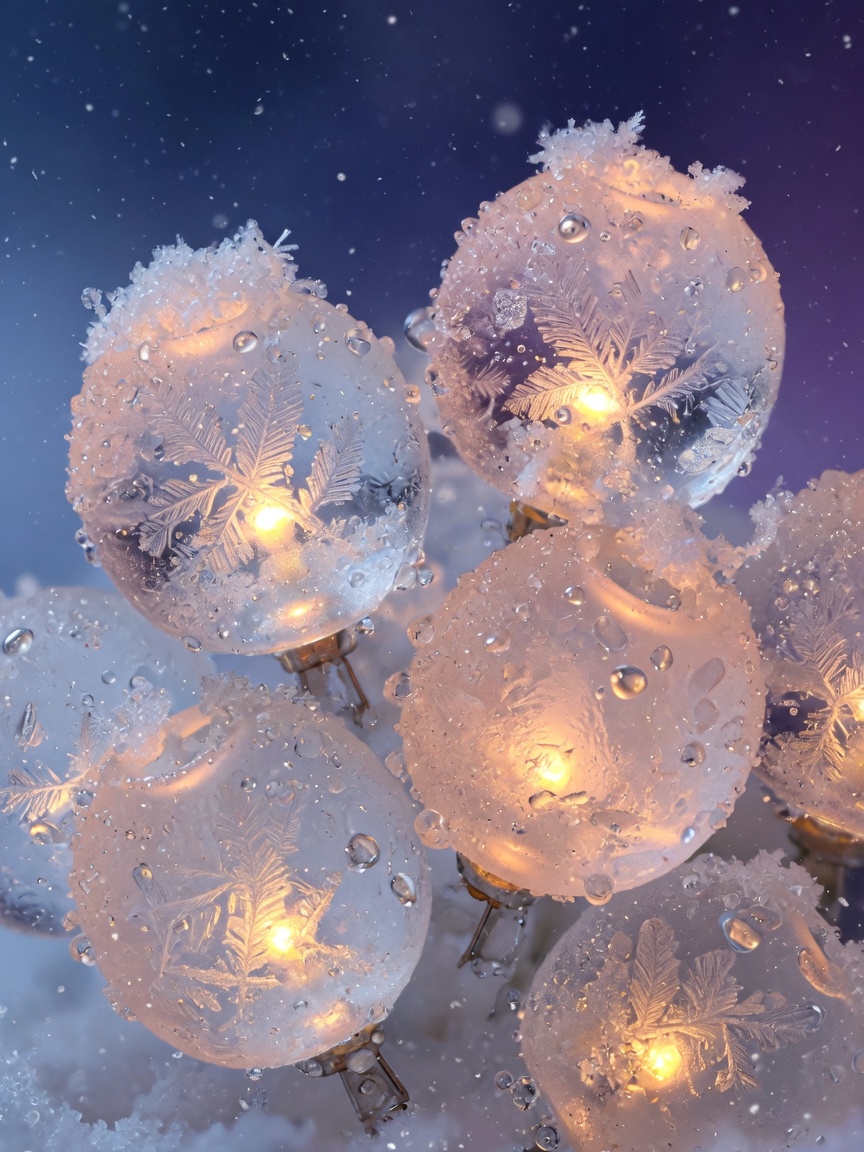
Snow melts and refreezes. The repeated freeze-thaw cycle is a silent killer of seals: meltwater is forced into every tiny gap, then expands as it refreezes—prying the crack wider so the next round penetrates deeper, a vicious circle. Add the meltwater that surrounds the fixture for long stretches, and the waterproofing demand on a winter outdoor light (the IP code, IEC 60529[4]) is no lower than in summer.
And the cold embrittlement noted earlier only compounds this: sealant turns brittle in the cold, weakening exactly the property that resists freeze-thaw. So when selecting materials for winter lighting, give particular thought to cold-rated sealing solutions, rather than simply carrying summer specifications over.
How PowerMOS suits winter outdoor lighting
PowerMOS pixel-control ICs use two-wire power-line carrier, so signal and power share the same two conductors—fewer wires, fewer seal points—directly reducing the risk of water ingress under freeze-thaw. Wire joints are a hot spot for winter failures, and every joint removed is one less point of risk.
On reliability, surge protection and a single-point-failure containment design mean that an individual bead failing from snow, ice, or impact will not take down the whole string; beads can be replaced locally, shrinking maintenance to a single unit across a long ski season. For outdoor, large-area settings such as gondola stations and tree lights, the higher 7–20mA drive current is supported, and high-voltage AC capability gives resort-scale, long-distance wiring more flexibility. One caveat worth stating: the fixture’s overall IK impact resistance, IP waterproofing, and cold-rated sealing depend on the complete luminaire design—PowerMOS provides the pixel-control IC, one link in that chain. See the product center for the full model list.
Further reading: for the winter-village theme, see Christmas Markets and Winter Village Lighting; for lifetime and depreciation, see LED Lifetime and Lumen Maintenance.
References
- IES LM-80, Measuring Luminous Flux and Color Maintenance of LED Packages, Arrays, and Modules. Illuminating Engineering Society (IES).
- IES TM-21, Projecting Long-Term Luminous Flux Maintenance of LED Light Sources. Illuminating Engineering Society (IES).
- IEC 62262, Degrees of protection provided by enclosures for electrical equipment against external mechanical impacts (IK code). International Electrotechnical Commission (IEC).
- IEC 60529, Degrees of protection provided by enclosures (IP Code). International Electrotechnical Commission (IEC).
This article is an educational piece on winter lighting. The names of the standards cited can be verified in the official catalogs of IES and IEC. PowerMOS pixel-control ICs use a proprietary carrier protocol optimized for LED pixel control.
FAQ
Is extreme cold good or bad for LEDs?
For the LED die itself, cold is mostly good. Luminous efficiency rises as junction temperature falls, and a lower operating temperature slows lumen depreciation and extends life—something you can see directly in LM-80 measurements at different temperatures and the TM-21 lifetime projections built on them: the lower the temperature, the longer luminous flux is maintained. What actually turns fragile in the cold is everything around the die—wire insulation, sealant, and plastic parts, which harden, embrittle, and crack.
Why do winter outdoor lights need an IK impact rating?
Because the winter environment throws a lot of mechanical force at a fixture: the weight of accumulated snow and ice (ice load), impacts from snow-clearing work, and accidental knocks from sleds, boards, and pedestrians. The IK rating is defined by IEC 62262 and graded from IK00 to IK10, where a higher number means the fixture can withstand higher impact energy. For fixtures that are easily touched or bear snow and ice loads, it is worth checking during selection whether the IK rating is high enough for the real-world forces on site.
How does cold affect the life of a light?
LED lumen depreciation is strongly tied to operating temperature. LM-80 is the method for measuring how well an LED maintains luminous flux, tested at temperatures such as 55°C and 85°C; TM-21 then projects long-term flux maintenance (for example, L70) from that data. The rule is simple: the lower the operating temperature, the slower the depreciation. So in a cold climate, the die's lifetime is actually at an advantage—provided the housing, seals, and wiring can survive the mechanical stress of the cold.
Why is waterproofing especially important for winter lighting?
Because snow melts and refreezes, and the repeated freeze-thaw cycle drives water into every tiny gap, then expands it as it refreezes—prying cracks wider in a vicious circle. Add the meltwater that surrounds the fixture for long stretches, and the waterproofing demand on a winter outdoor light (the IP code, IEC 60529) is no lower than in summer. Sealant embrittling in the cold only makes it worse, so cold-rated sealing solutions belong in the material selection.
How do PowerMOS solutions suit winter outdoor lighting?
PowerMOS pixel-control ICs use two-wire power-line carrier, so there are fewer conductors and fewer seal points—reducing the risk of water ingress under freeze-thaw. Surge protection and a single-point-failure containment design mean that an individual bead failing from snow, ice, or impact will not take down the whole string, and beads can be replaced locally. Outdoor models support the higher 7–20mA current range, and high-voltage AC capability suits the long wiring runs of a resort. See the product center for the full model list.
Upgrading your string lights to full pixel control?
Power MOS Electronics delivers the complete stack — driver ICs, addressing equipment, controllers and apps. Tell us about your product and our engineering team will spec it with you.
Contact PowerMOS Browse products