You have a product idea for a smart light string—what happens next? Many first-time private-label teams have no clear picture of the gates that stand between a single sample and thousands of units on the shelf, so they underestimate both the time and the risk. This article breaks the road from prototype to mass production into a handful of milestones and lays them out on a timeline—so you know what each stage is doing, where the sticking points usually are, and how automation transforms the most labor-intensive step of all.
- Milestone one: sample evaluation—can the idea stand up?
- Milestone two: engineering verification—will the design hold up?
- Milestone three: certification testing—the least compressible stretch
- Milestone four: production ramp-up—turning design into process
- Automated in-line address writing: killing off the manual pixel-sequencing bottleneck
- Milestone five: the first mass-production run and its quality gates
- A one-stop solution that keeps the timeline under control
- References and standards
- FAQ
You have a product idea for a smart light string. What happens next?
Many first-time private-label teams have no clear picture of the gates that stand between a single sample and thousands of units on the shelf—so they underestimate both the time and the risk. They often think ‘once the prototype is OK, we’re nearly ready to ship,’ only to fall into one pit after another on certification, production ramp-up, and first-run quality. This article breaks the road from prototype to mass production into a handful of milestones, laid out on a timeline, so you know what each stage is doing, where the sticking points usually are, and how automation transforms the most labor-intensive step of all.
Milestone one: sample evaluation—can the idea stand up?
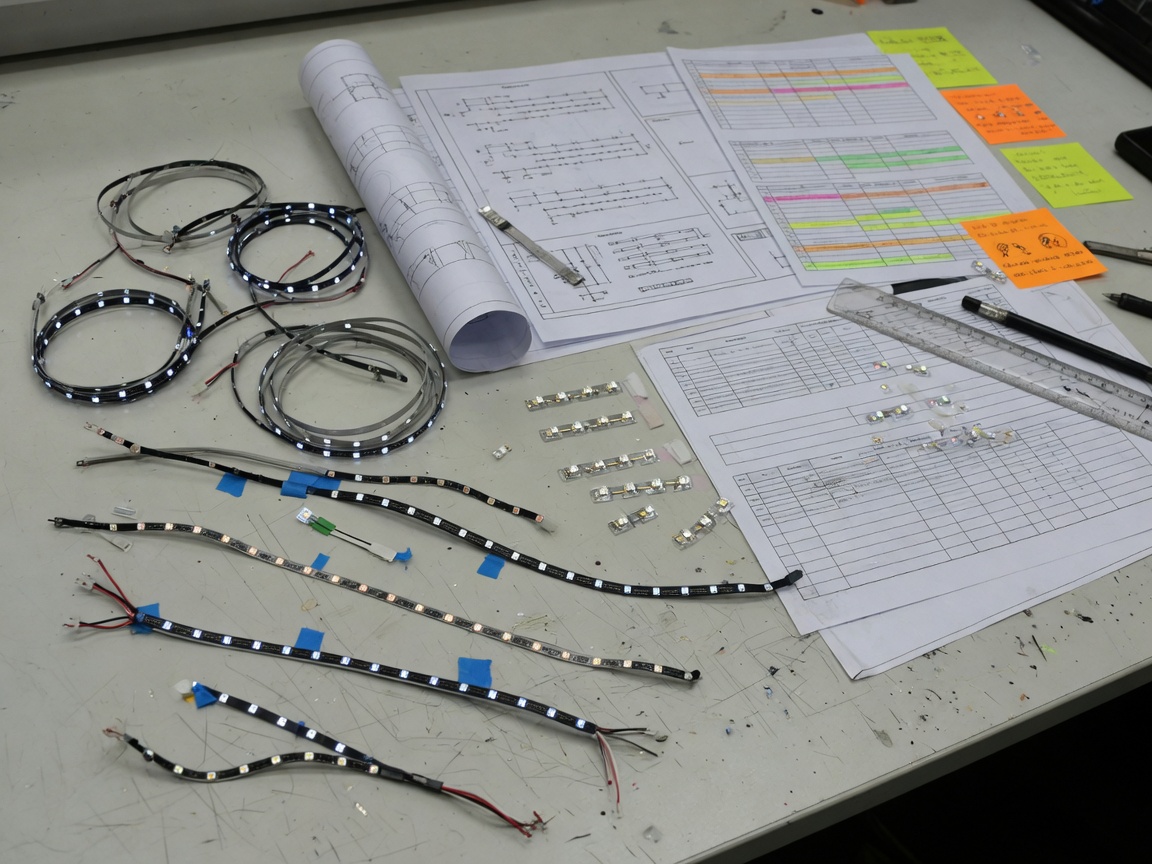
The first stop is sample evaluation (proof of concept / sample). The question this stage answers is basic but crucial: Does the idea hold up technically? Do the appearance and function match the product in your head?
At this point you’ll get a sample of the chip solution, or a demo light string, and check whether the point-control effect, color rendering, control method, and the feel of the wire meet expectations. The goal of sample evaluation isn’t perfection—it’s to rule out dead ends quickly. If some effect simply can’t be achieved, or the cost structure can’t support the target price, it’s far better to find out here than after you’ve committed to tooling and mass production.
Milestone two: engineering verification—will the design hold up?
A sample that lights up doesn’t mean the design is mature. Engineering verification (EVT, Engineering Verification Test) checks one thing: does this design run stably under a range of conditions?
This stage puts the product through harsher scenario testing: temperature swings, voltage fluctuation, long-duration operation, mechanical stress, and connection reliability. The aim is to move from ‘it happens to work in the lab’ to ‘every unit that comes off the line works.’ Engineering verification often takes repeated iteration—find a problem, change the design, verify again—until the design is robust enough to reach the next step, ‘design freeze.’ The time spent here often decides how smoothly mass production goes later.
Milestone three: certification testing—the least compressible stretch
After design freeze comes certification testing. This is the step brand owners most often underestimate.
Testing has to be scheduled after the design is stable, because the samples submitted must represent the mass-production state—change the design after submitting, and you may have to retest the whole thing. In practice, safety certification (for light strings, to standards such as IEC 60598-2-20, Luminaires — Part 2-20: Particular requirements — Lighting chains[1]) and EMC certification often fall on the critical path of the entire project, because the certification cycle carries fixed queue and test schedules that no amount of extra money can compress indefinitely.
A practical recommendation: schedule the project around the certification timeline as its backbone, and leave buffer for a retest. Too many teams’ launch delays get stuck at exactly this gate.
Milestone four: production ramp-up—turning design into process
The design is right, certification is passed—now it has to become a line that produces stably. That’s production ramp-up.
The heart of this step is turning ‘a design that can be made well once’ into ‘a process that makes it well every time’—fixtures, workstations, parameters, and inspection points all have to be pinned down. For addressable light strings, there’s a historic bottleneck here worth a dedicated word: address writing.
Automated in-line address writing: killing off the manual pixel-sequencing bottleneck
Every pixel in an addressable light string needs its own address before the controller can light them one by one. The old approach was to sequence and write an address into each pixel by hand—for a string of several hundred pixels, arranging them one at a time by hand is slow and error-prone, the biggest labor bottleneck on the whole line and a source of yield uncertainty.
Automated in-line address writing changes this: addresses are written into pixels automatically on the line, with no manual sequencing. That brings three direct effects—consistent output, higher yield, and viable multi-SKU production. Only when every string’s addresses are written reliably by machine does high-volume, multi-item production truly become runnable. It’s a key link in producing addressable light strings at scale, and a capability well worth asking about when you’re evaluating a chip-solution partner.
Milestone five: the first mass-production run and its quality gates
Last comes the first mass-production run (first article and ramp-up). The first batch isn’t just ‘starting production’—it’s proof that the whole process holds up at real volume.
This stage is gated by systems and standards. ISO 9001 (Quality management systems — Requirements) provides the framework of a quality-management system, keeping the process controlled, traceable, and continuously improvable[2]. The acceptability of electronic assemblies is often referenced to IPC-A-610 (Acceptability of Electronic Assemblies), which defines clear acceptance criteria for solder joints, component mounting, cleanliness, and more, and distinguishes three product classes—general, dedicated, and high-performance[3]; the requirements for the soldering process itself often correspond to IPC J-STD-001 (Requirements for Soldered Electrical and Electronic Assemblies)[4]. Add first-article inspection, sampling inspection, and reliability testing, and you have the several gates that carry a product from its first run to stable mass production.
A one-stop solution that keeps the timeline under control
Getting through the timeline above, the biggest variable is how many suppliers you have to coordinate. One vendor for the chip, one for the line, one for the controller, one for the app—every extra interface is one more point of integration and one more risk of delay. PowerMOS provides an end-to-end, one-stop solution spanning point-control chips, a two-wire protocol, controllers, an app, and an automated address-writing production line, so customers don’t integrate multiple parties themselves; automated in-line address writing eliminates the manual-pixel-sequencing bottleneck, and a defect rate of around 50 PPM with over 500KK units shipped (incl. the P9864 and P9831/P9832 series) make quality and delivery more predictable at the mass-production stage. Nearly two decades focused on this one track means the pits we’ve fallen into are ones you won’t have to. See the product center for the full lineup.
Want to keep the timeline for your first smart light string under control? Write to sales-02@powermos.com to reach our engineering and business teams directly, or start with our competitive advantages and About PowerMOS.
Further reading: for how the two-wire approach works, see Two-Wire Addressable Lighting; for the full market picture, see The Decorative Lighting Market Explained.
References and standards
- IEC 60598-2-20, Luminaires — Part 2-20: Particular requirements — Lighting chains. International Electrotechnical Commission (IEC).
- ISO 9001:2015, Quality management systems — Requirements. International Organization for Standardization (ISO).
- IPC-A-610, Acceptability of Electronic Assemblies. IPC (Association Connecting Electronics Industries).
- IPC J-STD-001, Requirements for Soldered Electrical and Electronic Assemblies. IPC (Association Connecting Electronics Industries).
This article is an educational overview of the product-development and mass-production process. The names of the cited standards can be verified in the official catalogs of the IEC, ISO, and IPC. PowerMOS point-control chips use a proprietary carrier protocol optimized specifically for LED point control.
FAQ
Roughly what stages does the path from prototype to mass production go through?
The typical path is: sample evaluation (confirming the solution is feasible and that appearance and function match the concept), engineering verification (EVT—confirming the design works under a range of conditions), certification testing (submitting for safety and EMC certifications such as CE and UL), production ramp-up (turning the design into a mass-producible process), and the first mass-production run with its quality gates. Each stage has its own goal and its own risk of being sent back to start over, so the timeline needs to build in buffer.
At which stage should certification testing be done?
Certification testing is usually scheduled after engineering verification is broadly stable and the design has been frozen, because the samples submitted for testing must represent the mass-production state; if you change the design after submitting, you may have to retest. In practice, safety testing (for light strings, to standards such as IEC 60598-2-20) and EMC testing are placed on the critical path of the timeline, because the certification cycle is often the least compressible stretch of the whole project.
How does automated in-line address writing change production?
If a traditional addressable light string relies on people to sequence and write an address into each pixel by hand, it's both slow and error-prone. Automated in-line address writing writes addresses into pixels automatically on the line, eliminating manual pixel sequencing as a bottleneck, sharply improving yield and the consistency of output, and making high-volume, multi-SKU production viable. It's the key to producing addressable light strings at scale.
What quality gates are there at the mass-production stage?
Mass-production quality is usually gated by systems and standards: ISO 9001 provides the framework of a quality-management system, keeping the process controlled and traceable; the acceptability of electronic assemblies is often referenced to IPC-A-610, which defines acceptance criteria for solder joints, component mounting, and more. Add first-article inspection, sampling inspection, and reliability testing, and you have the several gates that carry a product from its first run to stable mass production.
How does PowerMOS help a brand go from prototype to mass production?
PowerMOS provides an end-to-end, one-stop solution spanning point-control chips, a two-wire protocol, controllers, an app, and an automated address-writing production line, so customers don't have to integrate multiple suppliers themselves. Automated in-line address writing eliminates the manual-pixel-sequencing bottleneck, and a defect rate of around 50 PPM with over 500KK units shipped (incl. the P9864 and P9831/P9832 series) make quality and delivery more predictable at the mass-production stage. See the product center for the full lineup.
Upgrading your string lights to full pixel control?
Power MOS Electronics delivers the complete stack — driver ICs, addressing equipment, controllers and apps. Tell us about your product and our engineering team will spec it with you.
Contact PowerMOS Browse products