Hanging a lamp on an indoor wall and running lighting out to a garden, plaza, or rooftop are two things at completely different safety levels. Outdoors adds rain, dew, damp, and foot traffic; get any one link wrong and the mains can find a person through water or metal. This is no scare talk — most outdoor electrical accidents aren't a broken lamp but protection done wrong. This article is about the electrical-safety baseline for installing outdoor lighting.
- Why outdoors is more dangerous than indoors
- RCD: turning “fatal leakage” into “a tripped breaker”
- IEC 60364-7-714: the dedicated rules for outdoor lighting
- Sockets, extension leads, and rain protection: the devil is in the connector
- Low-voltage solutions: lowering the magnitude of the danger directly
- PowerMOS: weather-resistant pixel control born for the outdoors
- References and standards
- FAQ
Hanging a lamp on an indoor wall and running lighting out to a garden, plaza, or rooftop are two things at completely different safety levels.
Outdoors adds rain, dew, damp, and foot traffic; get any one link wrong and the mains can find a person through water or metal. This is no scare talk — most outdoor electrical accidents aren’t a broken lamp but protection done wrong. This article is about the electrical-safety baseline for installing outdoor lighting: from leakage protection and rain protection to the source-level thinking of low-voltage solutions.
Why outdoors is more dangerous than indoors
Indoor power is relatively dry and its environment controllable. Outdoors adds three fatal variables: water, contact opportunity, and time.
Rain and dew dampen insulation and make standing water a conductive path; outdoor lamps, wires, and connectors are far more likely than indoors to be stepped on, touched by a pet, or contacted by a metal fence; and long exposure to sun, wind, and rain gradually degrades insulation that was once compliant. These three stacked together make outdoor leakage and shock risk far higher than indoors.
The key idea is: outdoor safety cannot rely on “the lamp itself being fine,” but must assume that the environment will eventually make some link go wrong, and have protection ready before it does. This is “baseline thinking” — not betting on luck, but betting on protective mechanisms.
RCD: turning “fatal leakage” into “a tripped breaker”
The most important protection for outdoor power is the RCD (Residual Current Device, also called a leakage circuit breaker).
Its principle is clever: it continuously compares the current in the live and neutral wires. Normally the current in and out is equal; the moment a difference appears, it means current is leaking away elsewhere — perhaps flowing to earth through a human body or damp ground — and the RCD cuts the power within tens of milliseconds. This kind of residual current circuit breaker without integral overcurrent protection (RCCB) is governed by IEC 61008-1[1].
The value of the RCD is that it protects exactly the “person” link. An ordinary circuit breaker (fuse) protects equipment and only trips once the current grows large enough; but a fatal leakage current can be tiny, far too small to trigger an ordinary breaker. The RCD is dedicated to catching this minute imbalance, turning “fatal leakage” into “a tripped breaker.” Outdoors, with its damp and many contact opportunities, the RCD is therefore an indispensable baseline.
IEC 60364-7-714: the dedicated rules for outdoor lighting
The RCD is a general-purpose protective device; outdoor lighting also has a dedicated installation standard: IEC 60364-7-714.
It is the special-location section for external lighting installations within the IEC 60364 series of standards for low-voltage electrical installations[2]. Its scope is broad — the selection and installation of outdoor fixed lighting for roads, parks, gardens, public places, sports grounds, floodlighting of monuments, advertising signs, and more all fall within it. It has specific requirements for protection rating (IP), isolation, and additional protection, and is one of the core references for judging whether outdoor lighting power is compliant.
The overall principle of protection against electric shock is coordinated by IEC 60364-4-41, the “protection for safety — protection against electric shock” section[3], whose most commonly used measure is the automatic disconnection of supply — which is exactly what an RCD does. The standards echo one another: the general rules set the principles, the particular sections fill in the scenarios.
Sockets, extension leads, and rain protection: the devil is in the connector
Beyond the standards, what actually causes accidents is often the most unremarkable detail — the connector.
Outdoor installation has a few practical baselines:
- Outdoor sockets should have rain protection and an appropriate IP rating, and be connected preferentially to an RCD-protected circuit
- Extension leads should be outdoor-grade, kept from having connectors soaked in standing water or lying directly on wet ground, with joints raised and waterproofed
- Temporary event lighting is especially dangerous — a run of cable is convenient for the moment, but connectors often get tossed onto grass or concrete
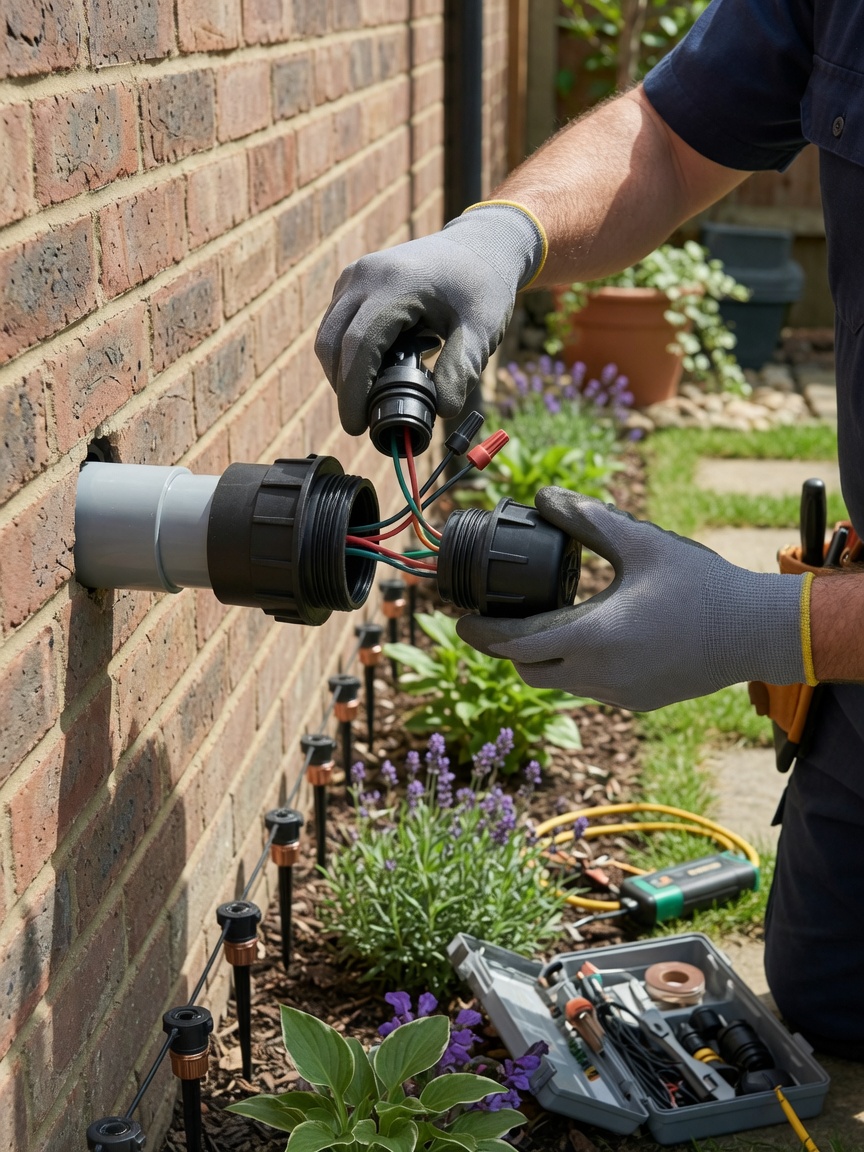
The core principle is a single sentence: never let a live connector have a chance to touch water. The IP rating marks a device’s ability to resist the ingress of solids and liquids; outdoor lamps and junction boxes must be chosen with a sufficient waterproof rating. Many outdoor accidents, traced to the root, are not the lamp’s fault but a connector that got waterlogged.
Low-voltage solutions: lowering the magnitude of the danger directly
The RCD, rain protection, and IP discussed above are all layers of defense set up under the premise that “the high-voltage mains is dangerous.” But there is a more fundamental approach: reduce the danger of the voltage itself at the source.
The greatest danger of outdoor power comes from the high-voltage mains. If a light string works within a low-voltage range such as Safety Extra-Low Voltage (SELV), then even if the insulation gets damp or a connector takes on water, the touchable voltage is held within a safe band, and the risk of a fatal shock is greatly reduced at the source.
It should be stressed that a low-voltage solution does not replace the RCD and rain protection; it adds a layer of “source-level protection” — lowering the magnitude of the danger directly and giving the other protective measures more margin. One more independent line of defense makes the whole more robust.
PowerMOS: weather-resistant pixel control born for the outdoors
Outdoor safety is the combined force of “installation-side electrical engineering” and “string-end reliability.” Leakage, rain, and RCD belong to the former; the latter is that the string itself must be weather- and surge-resistant enough.
PowerMOS pixel-control chips are designed for outdoor lighting: with surge protection, a higher outdoor operating current setting (about 7–20mA outdoors), and a single-point-failure-non-propagating architecture so a single anomaly won’t affect the whole string. They also support high-voltage AC 110/220V applications for flexible system configuration. Outdoor leakage, rain, and RCD protection are installation-side engineering; PowerMOS provides weather- and surge-resistant reliable pixel control at the string end, the two complementing each other. See the Product Center for full part numbers.
Further reading: for outdoor waterproof ratings, see The IP Waterproof Rating of Outdoor LEDs; for surge and ESD reliability, see The EMC, ESD, and Surge Reliability of LED Lighting.
References and standards
- IEC 61008-1, Residual current operated circuit-breakers without integral overcurrent protection for household and similar uses (RCCBs) — Part 1: General rules. International Electrotechnical Commission (IEC).
- IEC 60364-7-714, Low-voltage electrical installations — Part 7-714: Requirements for special installations or locations — External lighting installations. International Electrotechnical Commission (IEC).
- IEC 60364-4-41, Low-voltage electrical installations — Part 4-41: Protection for safety — Protection against electric shock. International Electrotechnical Commission (IEC).
This article is an educational overview of outdoor electrical safety. The names of the cited standards can be verified in the IEC official catalog. PowerMOS pixel-control chips use a proprietary carrier protocol optimized for LED pixel control.
FAQ
What is an RCD, and why is it a must outdoors?
An RCD (Residual Current Device, also called a leakage circuit breaker) continuously compares the current in the live and neutral wires; the moment a difference appears — meaning current is leaking away elsewhere, for instance through a human body or damp ground — it cuts the power within tens of milliseconds. IEC 61008-1 governs this kind of RCCB without integral overcurrent protection. Outdoor environments are damp with many contact opportunities, so leakage risk is far higher than indoors; the RCD is the key baseline that turns 'fatal leakage' into 'a tripped breaker,' and must be fitted for outdoor power.
What is the IEC 60364-7-714 standard?
IEC 60364-7-714 is the special-location section for 'external lighting installations' within the IEC 60364 series of standards for low-voltage electrical installations. It covers the selection and installation requirements for outdoor fixed lighting — roads, parks, gardens, public places, sports grounds, floodlighting of monuments, advertising signs, and so on — with provisions for protection rating (IP), isolation, and additional protection. It is one of the core references for judging whether outdoor lighting power is compliant.
What should you watch for with outdoor sockets and extension leads?
Outdoor sockets should have rain protection and an appropriate IP rating, and be connected preferentially to an RCD-protected circuit; extension leads should be outdoor-grade, kept from having connectors soaked in standing water or lying directly on wet ground, with joints raised and waterproofed. The core principle is: never let a live connector have a chance to touch water. Temporary event lighting is especially prone to error here — a run of cable is convenient for the moment, but the connector plants a hazard.
Why do low-voltage solutions fundamentally cut outdoor electrical risk?
The greatest danger of outdoor power comes from the high-voltage mains itself. If a light string works within a low-voltage range such as Safety Extra-Low Voltage (SELV), then even if the insulation gets damp or a connector takes on water, the touchable voltage is held within a safe band, and the risk of a fatal shock is greatly reduced at the source. A low-voltage solution doesn't replace the RCD and rain protection; it adds a layer of 'source-level protection' — lowering the magnitude of the danger directly and giving the other protective measures more margin.
How does the PowerMOS solution address outdoor electrical safety?
PowerMOS pixel-control chips are designed for outdoor lighting, with surge protection and a higher outdoor operating current setting (about 7–20mA outdoors), and a single-point-failure-non-propagating architecture so a single anomaly won't affect the whole string. They also support high-voltage AC 110/220V applications for flexible system configuration. Leakage, rain, and RCD protection for outdoor installation are installation-side electrical engineering; PowerMOS provides weather- and surge-resistant reliable pixel control at the string end, the two complementing each other. See the Product Center for full part numbers.
Upgrading your string lights to full pixel control?
Power MOS Electronics delivers the complete stack — driver ICs, addressing equipment, controllers and apps. Tell us about your product and our engineering team will spec it with you.
Contact PowerMOS Browse products