The same Christmas lights, strung across a lawn in a North American front yard versus along the railing of a European apartment balcony, don't face the same engineering requirements. Outdoors means rain, snow, cold, and UV, and being stepped on and driven over—plus the red lines of each country's safety regulations. This article turns 'building a smart light string you can actually sell outdoors in Europe and North America' into a checklist of engineering gates to clear, from protection ratings and impact resistance to low-temperature reliability—so you nail the spec before you ever build a prototype.
- Two outdoor cultures, two product logics
- IP protection: ‘waterproof’ can’t be settled in one word
- IK impact resistance: stepped on, knocked into, hit by a snow blower
- Light strings have their own safety standard: IEC 60598-2-20
- Low-temperature reliability: passing at room temp isn’t passing winter
- High-voltage AC or a low-voltage solution?
- From spec to mass production, find the right chip partner
- References and standards
- FAQ
The same Christmas lights—strung across a lawn in a North American front yard, or along the railing of a European apartment balcony—don’t face the same engineering requirements.
Outdoors means rain, snow, cold, and UV—and it also means being stepped on, driven over, and caught in doors, plus the red lines of each country’s safety regulations. Many first-time private-label teams don’t discover that their spec wasn’t fully thought through until prototyping, or even until testing—at which point they go back to change materials, rework the structure, and re-run certification, doubling both time and cost. This article turns ‘building a smart light string you can actually sell outdoors in Europe and North America’ into a checklist of engineering gates to clear—think it through up front so you don’t pay for it later.
Two outdoor cultures, two product logics
Before we get to specs, understand one thing: outdoor Christmas in Europe and North America isn’t a single use case.
North America—suburban America especially—has a strong front-yard culture: houses have lawns, driveways, and eaves, and lighting is often laid out across large outdoor areas, with ground stakes, eave-hung lights, and trees wrapped in strands all common. The product has to cope with damp grass, sprinkler systems, snow removal, and long wiring runs.
Europe’s urban living patterns are different; the balcony and windowsill are the main stage. Apartment-balcony railings, window frames, and curtain lights at the indoor–outdoor boundary are more common—installation space is tight, wiring runs are short, and the lights sit close to the occupants. That means greater sensitivity to aesthetics, to fine wire, and to safety near the human body.
A single product line aiming at both markets has to find a workable intersection across protection, structure, wiring, and safety. Let’s take them one at a time.
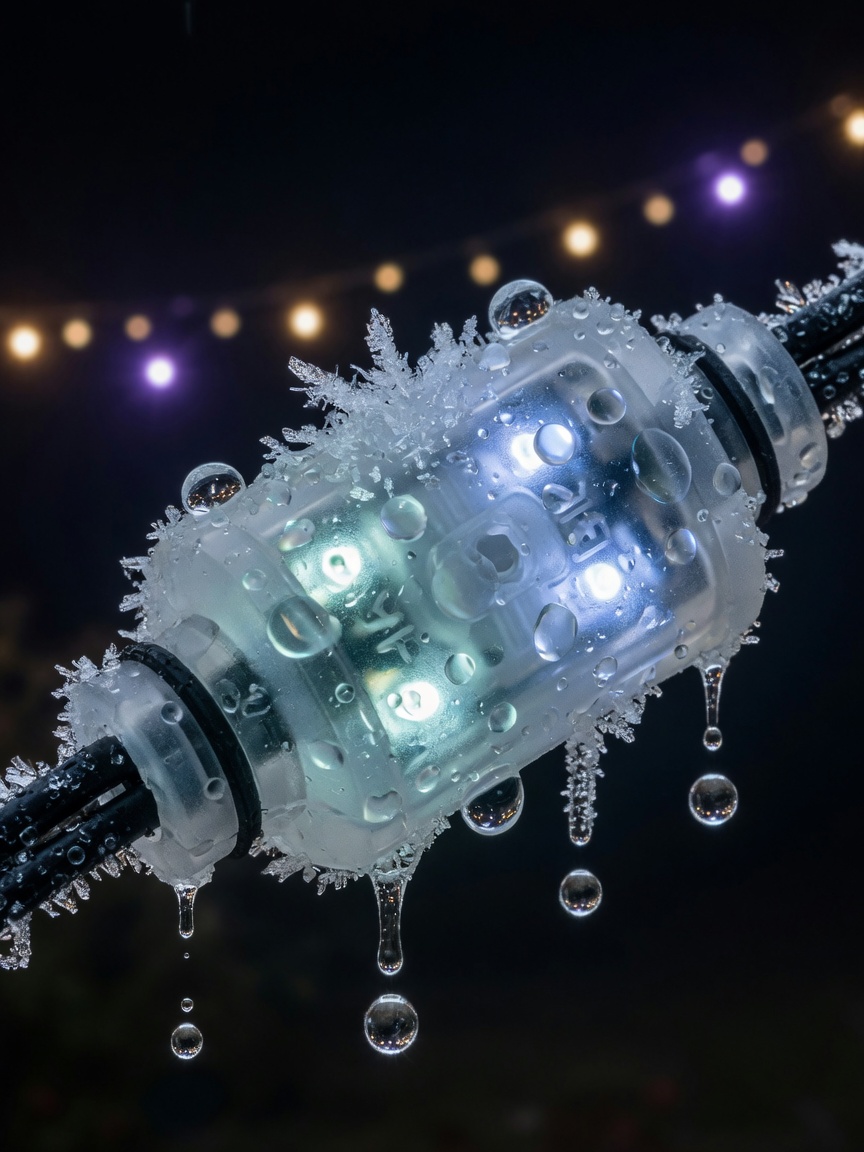
IP protection: ‘waterproof’ can’t be settled in one word
The first gate for any outdoor product is water resistance—but ‘waterproof’ is a vague marketing word. What engineering looks at is the IP rating, the protection classification defined by IEC 60529 (Degrees of protection provided by enclosures (IP Code))[1].
The two digits after ‘IP’: the first is protection against solid foreign objects (dust), on a 0–6 scale; the second is protection against water, on a 0–9 scale. For a light string in long-term outdoor use, the water digit is typically IPX4 (splashing from any direction) or higher; if the mounting location meets standing water or falls within a sprinkler system’s spray, push toward IPX5 or IPX7.
One thing worth flagging: the protection rating of the whole string is set by its weakest point. The pixel body may hit IP65, but if the power box or the male/female connector contacts aren’t protected enough, the whole product will still take on water and fail in the rain. The focus of outdoor design is often not the pixel but the protection and drainage design of the connectors—the contacts must resist splashing and also let any water that gets in drain out rather than pool.
IK impact resistance: stepped on, knocked into, hit by a snow blower
Beyond water, the outdoors brings mechanical impact. IEC 62262 (degrees of protection provided by enclosures for electrical equipment against external mechanical impacts (IK code)) uses the IK rating to describe an enclosure’s resistance to impact[2], from IK00 to IK10—the higher the number, the greater the impact energy it can withstand; the test applies impacts of fixed energy to multiple faces of the enclosure.
For outdoor Christmas products, the IK rating matters because décor mounted low gets stepped on, caught in doors, and scraped by snow-clearing tools. Ground-staked front-yard lights, walkway edge lights, and decorations around a doorway can all take unexpected mechanical stress. If the enclosure and pixel encapsulation aren’t tough enough, one winter is all it takes for cracks, water ingress, and open circuits to appear. The lower the mounting position and the closer to a path of traffic, the more IK belongs in the design brief.
Light strings have their own safety standard: IEC 60598-2-20
People tend to assume a light is a light, but light strings are treated as their own category in the safety standards. IEC 60598-2-20 (Luminaires — Part 2-20: Particular requirements — Lighting chains) is the part of the luminaire standards dedicated specifically to ‘lighting chains’[3].
This standard covers chained luminaires, indoor and outdoor, supplied at no more than 250 V, and distinguishes types such as permanent installation, temporary installation, and the temporary-protected (TPL) lighting chains added in newer editions. It sets concrete requirements for a light string’s electrical safety, mechanical structure, protection against electric shock, and wiring and connectors. For an outdoor Christmas light string there is no going around it—whatever market you target, the product’s electrical and structural design has to line up with its framework.
Low-temperature reliability: passing at room temp isn’t passing winter
Outdoor products have a dimension that’s easy to underrate: the cold.
Winters in Northern Europe and the North American interior can fall to twenty or thirty degrees below zero Celsius. Cold makes plastics brittle, stiffens wires, and shrinks potting compounds, and it also shifts the electrical characteristics of components. A product that tests beautifully in a room-temperature lab can fail on a real winter night—the enclosure cracks from embrittlement, or contacts loosen as materials expand and contract.
So validation for outdoor products must be done across the relevant temperature range, not only at room temperature. Wiring, connectors, potting, and circuitry all have to pass low-temperature testing and thermal cycling—repeated hot-cold swings accumulate stress at material interfaces and are among the most common sources of outdoor-reliability failure. For the outdoor markets of Europe and North America, low-temperature validation isn’t a bonus; it’s the threshold.
High-voltage AC or a low-voltage solution?
Last comes an architecture-level trade-off: should an outdoor light string use direct high-voltage-AC drive or a low-voltage (transformed) solution?
Direct high-voltage-AC drive (110/220 V) has the advantage of doing away with a bulky transformer and supporting long wiring runs, which is valuable for large-area layouts like a North American front yard; the price is higher demands on the chip’s voltage rating, surge immunity, and regulatory isolation. A low-voltage solution (for example, a power supply that converts to safety extra-low voltage) is more forgiving on shock safety—protection against electric shock is classified by IEC 61140 (Protection against electric shock), under which a Class III product is supplied at SELV (safety extra-low voltage) and, under normal conditions, does not cause a shock even on human contact[4]; the price is the need for power conversion and the voltage drop and cost of long-distance wiring.
There’s no absolute answer: it depends on the market, the installation scenario, and the target price. Large front-yard layouts lean toward the efficiency of direct high-voltage drive, while balconies and windowsills close to people are more sensitive to the safety margin of low voltage. The key is to settle this architecture before you prototype, because it drives chip selection, power design, and the entire safety-certification path.
From spec to mass production, find the right chip partner
Most of the checklist above is a set of product-level requirements—but they all come back, in the end, to the choice of chip and power architecture. PowerMOS provides an end-to-end solution spanning point-control chips, a two-wire power-line carrier protocol, and an automated address-writing production line: the chip supports direct high-voltage-AC drive and surge protection, outdoor pixels can operate at 7 to 20 mA, and the architecture supports single-point failures that don’t propagate and replaceable-pixel repair—especially critical for cutting the risk of whole-string failure in harsh outdoor conditions. A defect rate of around 50 PPM and cumulative shipments past 500KK make quality more predictable at the mass-production stage. See the product center for the full lineup and specifications.
Want to evaluate building your outdoor product line on PowerMOS? Write to sales-02@powermos.com to reach our engineering and business teams directly, or start with our competitive advantages and About PowerMOS.
Further reading: for outdoor protection, see IP Waterproofing and Protection for Outdoor Light Strings; for the safety-standards landscape, see Safety Certification for LED Light Strings.
References and standards
- IEC 60529, Degrees of protection provided by enclosures (IP Code). International Electrotechnical Commission (IEC).
- IEC 62262, Degrees of protection provided by enclosures for electrical equipment against external mechanical impacts (IK code). International Electrotechnical Commission (IEC).
- IEC 60598-2-20, Luminaires — Part 2-20: Particular requirements — Lighting chains. International Electrotechnical Commission (IEC).
- IEC 61140, Protection against electric shock — Common aspects for installation and equipment. International Electrotechnical Commission (IEC).
This article is an educational overview of outdoor lighting product engineering. The names of the cited standards can be verified in the official IEC catalog. PowerMOS point-control chips use a proprietary carrier protocol optimized specifically for LED point control.
FAQ
What IP rating does an outdoor Christmas light string need?
IP ratings are defined by IEC 60529: the first digit covers protection against solids (dust), the second against water. For a light string in long-term outdoor use, the water rating is typically IPX4 (splashing from any direction) or higher; if it will meet standing water or sit within a sprinkler's reach, it needs to go higher still. Connectors and power boxes are usually the weakest links, so the design must confirm the protection rating and drainage of the contacts—not just look at the pixel body.
Does the IK impact rating matter for outdoor products?
IK ratings are defined by IEC 62262 and use a scale from IK00 to IK10 to describe an enclosure's resistance to mechanical impact—the higher the number, the greater the impact energy it can withstand. For outdoor décor mounted low, where it may be stepped on, caught in a door, or knocked by snow-clearing tools, the IK rating governs the durability of the enclosure and pixel encapsulation. Ground-staked front-yard displays and walkway lighting especially need to factor this in.
Do light strings have their own safety standard?
Yes. IEC 60598-2-20 is the part of the luminaire standards dedicated specifically to 'lighting chains,' covering indoor and outdoor chained luminaires supplied at no more than 250 V and distinguishing types such as permanent and temporary installation. It sets concrete requirements for a light string's electrical safety, mechanical structure, and protection against electric shock—an unavoidable standard for outdoor Christmas light strings.
What should outdoor products watch out for in the cold?
Cold makes plastics brittle, stiffens wires, and shrinks potting compounds, and it also shifts the characteristics of electronic components. Winters in Northern Europe and the North American interior can drop to twenty or thirty degrees below zero Celsius, so a product's wiring, connectors, potting, and circuitry all need to be validated across the relevant temperature range—not just at room temperature. Mechanical embrittlement in the cold and the stress from thermal cycling are common sources of outdoor-reliability failures.
How does PowerMOS's solution address the engineering needs of outdoor products?
PowerMOS provides an end-to-end solution spanning point-control chips, a two-wire protocol, and an automated address-writing production line. The chip supports direct high-voltage-AC drive and surge protection, outdoor pixels can operate at 7 to 20 mA, and the architecture supports single-point failures that don't propagate and replaceable-pixel repair—reducing the risk of whole-string failure in harsh outdoor conditions. See the product center for the full lineup and specifications.
Upgrading your string lights to full pixel control?
Power MOS Electronics delivers the complete stack — driver ICs, addressing equipment, controllers and apps. Tell us about your product and our engineering team will spec it with you.
Contact PowerMOS Browse products