When an outdoor light string that has hung for a season or two starts to fail, the first suspect is usually the beads. But take it apart and the real culprit is often that unremarkable wire—the jacket cracked by the sun, made brittle by winter cold, and failing from the cable rather than the bead. This article is about an underrated topic: the cable and weathering engineering of outdoor light strings, and why the 'wire' often fails before the 'light.'
- The jacket: the first line facing the environment
- UV aging: how sunlight takes polymers apart
- Low-temperature embrittlement: winter’s other assault
- Artificial accelerated aging: compressing years into weeks
- Cable safety: not only weathering, but safety too
- PowerMOS: reducing cable stress from the architecture
- Reference standards and literature
- FAQ
When an outdoor light string that has hung for a season or two starts to fail, the first suspect is usually the beads.
But take it apart and the real culprit is often that unremarkable wire—the jacket cracked by the sun, made brittle by winter cold, and failing from the cable rather than the bead. This article is about an underrated topic: the cable and weathering engineering of outdoor light strings, and why the “wire” often fails before the “light.”
The jacket: the first line facing the environment
The bead has package protection and the chip is tucked inside a housing, but the cable jacket is a polymer material bare to the environment. It must endure three continuous assaults over the long term: UV, temperature cycling, and moisture.
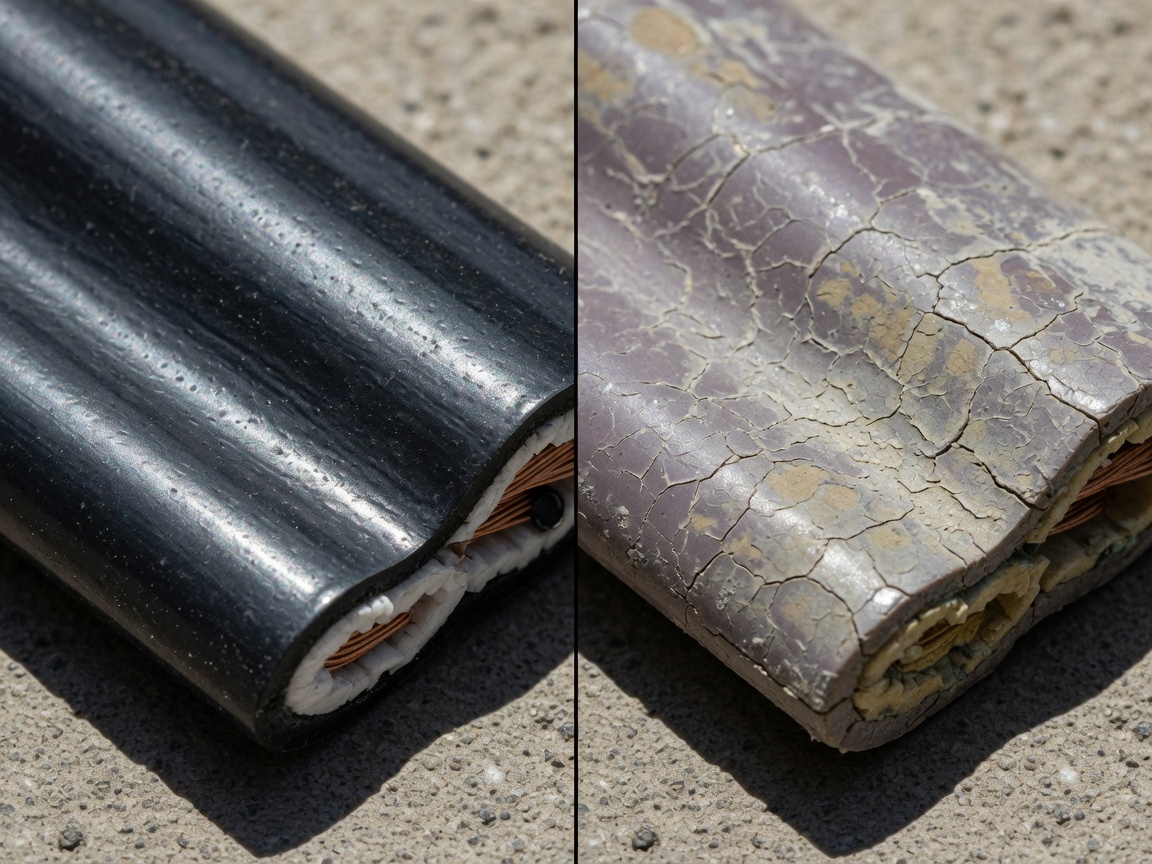
The common jacket materials for outdoor light strings are PVC (polyvinyl chloride) and rubber. They are cheap, flexible, and good insulators, but their shared weakness is that they gradually degrade under the long-term action of UV and temperature. And once degradation starts, the stress of bending and pulling concentrates at these weak spots, turning small cracks into big problems.
UV aging: how sunlight takes polymers apart
The most troublesome thing about UV is that its energy is enough to break the chemical bonds of the polymer. When the jacket material absorbs UV, it triggers a chain of photo-oxidation reactions that cut the originally long, flexible molecular chains.
The result shows in both appearance and performance:
- Surface chalking and discoloration: the jacket loses its sheen and feels powdery
- Loss of elasticity: it goes from soft to hard and brittle
- Fine cracking: cracks first hard to see, then gradually widening
Once cracks form, they open the door to a vicious cycle—moisture and oxygen intrude more easily, accelerating internal degradation and even affecting insulation. This is exactly why outdoor cable cannot simply reuse indoor cable and needs a UV-resistant formulation, such as adding carbon black or UV absorbers to shield and consume the UV energy.
Low-temperature embrittlement: winter’s other assault
If UV is the summer assault, low-temperature embrittlement is the winter one.
PVC is soft thanks to the plasticizer in its formulation. But plasticizer migrates and volatilizes over time, especially after high heat and long use. With less plasticizer, the jacket hardens; hit it with low temperature, and the material’s glass transition makes it even more brittle—at which point a single bend or knock can crack the jacket outright.
For winter outdoor applications (such as Christmas light strings and winter-market decorations), this is a very real problem: when a string is installed or stored in sub-zero conditions, an embrittled jacket is especially prone to damage. Outdoor cable therefore needs a stated temperature rating to ensure it keeps enough flexibility at the expected low temperatures.
Artificial accelerated aging: compressing years into weeks
Here is the problem: if jacket degradation takes years to show, how does a product verify its weathering before shipping? The answer is the artificial accelerated aging test.
The principle is to use a controlled light source and environment in the lab to simulate and compress the effect of outdoor exposure. For plastic materials, the ISO 4892 series specifies methods of exposure to laboratory light sources, and ISO 4892-2 addresses xenon-arc lamps—using filtered xenon-arc light together with temperature, humidity, and spray cycles to reproduce aging under sunlight (including sunlight through glass)[1].
By raising irradiance and shortening cycles, weeks of testing can correspond to years of field exposure. Its value lies not in precisely predicting “how many years it will last” but in fairly comparing which cable—which formulation, which supplier—weathers better. That is an important basis for material selection.
Cable safety: not only weathering, but safety too
Weathering is a lifespan question; safety is a safety question, and neither can be skipped. Outdoor light strings often involve mains voltage, and once cable insulation fails, the consequence is more than a light not turning on.
Cable safety covers insulation material, conductor cross-section, voltage withstand, mechanical strength, and marking. Taking the international standard system as an example:
- The IEC 60245 series specifies rubber-insulated cables, applicable up to a rated voltage of 450/750 V[2]
- The IEC 60227 series specifies polyvinyl chloride (PVC) insulated cables, likewise within a rated voltage up to 450/750 V[3]
These standards define the material, construction, and test requirements for cable. On top of this, outdoor applications must additionally consider the jacket’s weathering and temperature ratings to ensure the cable keeps its insulation and mechanical performance in real conditions (exposure, low temperature, damp). In other words, a qualified outdoor cable must pass both the “safety” and the “weathering” gates.
PowerMOS: reducing cable stress from the architecture
Cable selection is decided by the solution as a whole, but the control architecture directly affects the stress the cable bears—and this is where PowerMOS can make a difference.
PowerMOS pixel-control ICs use two-wire power-line carrier to eliminate extra signal wires, reducing the number of conductors and joints—and joints are exactly the high-risk points for outdoor water ingress and stress failure. Non-spreading single-point failure keeps a local cable or bead degradation from dragging down the whole string, minimizing the “one fails, the whole string goes dark” risk; bead-replaceable repair lets a degraded segment be handled locally rather than scrapping the whole string. Paired with surge protection, this improves the durability margin of the outdoor system against real conditions overall. Copper-wire light models (P9871/P9874/P9875) and other products suited to outdoor decoration—see the product center for the full list.
Further reading: for outdoor waterproof ratings, see IP Waterproof Ratings and Protection Design for Outdoor LEDs; for surge and reliability, see EMC, ESD, and Surge Reliability of LEDs.
Reference standards and literature
- ISO 4892-2:2013, Plastics — Methods of exposure to laboratory light sources — Part 2: Xenon-arc lamps. International Organization for Standardization (ISO).
- IEC 60245, Rubber insulated cables — Rated voltages up to and including 450/750 V. International Electrotechnical Commission (IEC).
- IEC 60227, Polyvinyl chloride insulated cables of rated voltages up to and including 450/750 V. International Electrotechnical Commission (IEC).
This article is an educational piece on outdoor cable weathering. The names of the standards cited can be verified in the official catalogs of the ISO and the IEC. PowerMOS pixel-control ICs use a proprietary carrier protocol optimized for LED pixel control.
FAQ
Why does the cable of an outdoor light string fail before the beads?
Because the cable jacket is a polymer material directly exposed to the environment, enduring UV, temperature cycling, and moisture over the long term. UV breaks polymer chains, causing embrittlement and cracking; low temperature hardens and embrittles a jacket whose plasticizer has migrated away; and bending and pulling stress concentrate at these degraded spots. The bead itself, by contrast, has package protection. So in many outdoor cases, failure begins with the jacket cracking and letting water in, not with the bead itself.
What exactly does UV aging do to a cable?
UV carries enough energy to break the chemical bonds of the polymer, triggering photo-oxidation reactions. The result is a chalked, discolored jacket surface that loses elasticity and develops fine cracks. Once cracks form, moisture and oxygen intrude more easily, accelerating degradation and possibly compromising insulation. This is why outdoor cable needs a UV-resistant formulation (such as added carbon black or UV absorbers) rather than simply reusing indoor cable.
What is an accelerated aging test?
Artificial accelerated aging uses a controlled light source and environment in the lab to simulate and compress the effect of years of outdoor exposure. For plastics, the ISO 4892 series specifies methods of exposure to laboratory light sources; its second part addresses xenon-arc lamps—using filtered xenon-arc light together with temperature, humidity, and spray cycles to reproduce aging under sunlight. By raising irradiance and cycling, weeks of testing can correspond to years of field exposure, used to compare the weathering resistance of different formulations.
What does outdoor cable safety cover?
Cable safety covers insulation material, conductor cross-section, voltage withstand, mechanical strength, marking, and more. As an example of international standards, the IEC 60245 series specifies rubber-insulated cables and the IEC 60227 series specifies polyvinyl chloride (PVC) insulated cables, both within a rated voltage up to and including 450/750 V. Outdoor applications also require additional consideration of the jacket's weathering and temperature ratings to ensure the cable keeps its insulation and mechanical performance in real conditions.
How does the PowerMOS solution reduce cable-related failure risk?
The PowerMOS pixel-control IC is itself the electronic core; cable selection is decided by the solution as a whole, but the PowerMOS architecture helps reduce cable stress: two-wire power-line carrier reduces the number of conductors and joints; non-spreading single-point failure keeps a local cable or bead failure from dragging down the whole string; and bead-replaceable repair lets a degraded segment be handled locally rather than scrapping the whole string. Paired with surge protection, this improves the durability margin of the outdoor system overall. See the product center for the full model list.
Upgrading your string lights to full pixel control?
Power MOS Electronics delivers the complete stack — driver ICs, addressing equipment, controllers and apps. Tell us about your product and our engineering team will spec it with you.
Contact PowerMOS Browse products