A lamp's datasheet says 800 lumens, 100 lm/W, 3000K, CRI 90 — the numbers look objective, but how were they measured? If two labs test the same lamp, will the numbers agree? That is exactly what LM-79 is meant to solve. It prescribes how to measure an LED product's light and electricity, so the numbers in a report carry credibility and can be compared. This article walks you through LM-79 and how to read a photometric and electrical test report.
- LM-79: first unify “how to measure”
- Why absolute photometry, not the relative method
- Integrating sphere vs. goniophotometer: the division of labor
- How to read a report: five groups of key numbers
- Three reminders for submitting light-string products
- PowerMOS: stable photometric and electrical output for reproducible measurement
- References and standards
- FAQ
A lamp’s datasheet says 800 lumens, 100 lm/W, 3000K, CRI 90 — the numbers look objective, but how were they measured?
If two labs test the same lamp, will the numbers agree? On what basis should you believe the datasheet’s claims? That is exactly what LM-79 is meant to solve. It prescribes how to measure an LED product’s light and electricity, so the numbers in a report carry credibility and can be compared. This article walks you through LM-79 and how to read a photometric and electrical test report.
LM-79: first unify “how to measure”
Before talking about numbers, you need a measurement method everyone agrees on — otherwise every lab measures differently, and no matter how pretty the numbers, they can’t be compared.
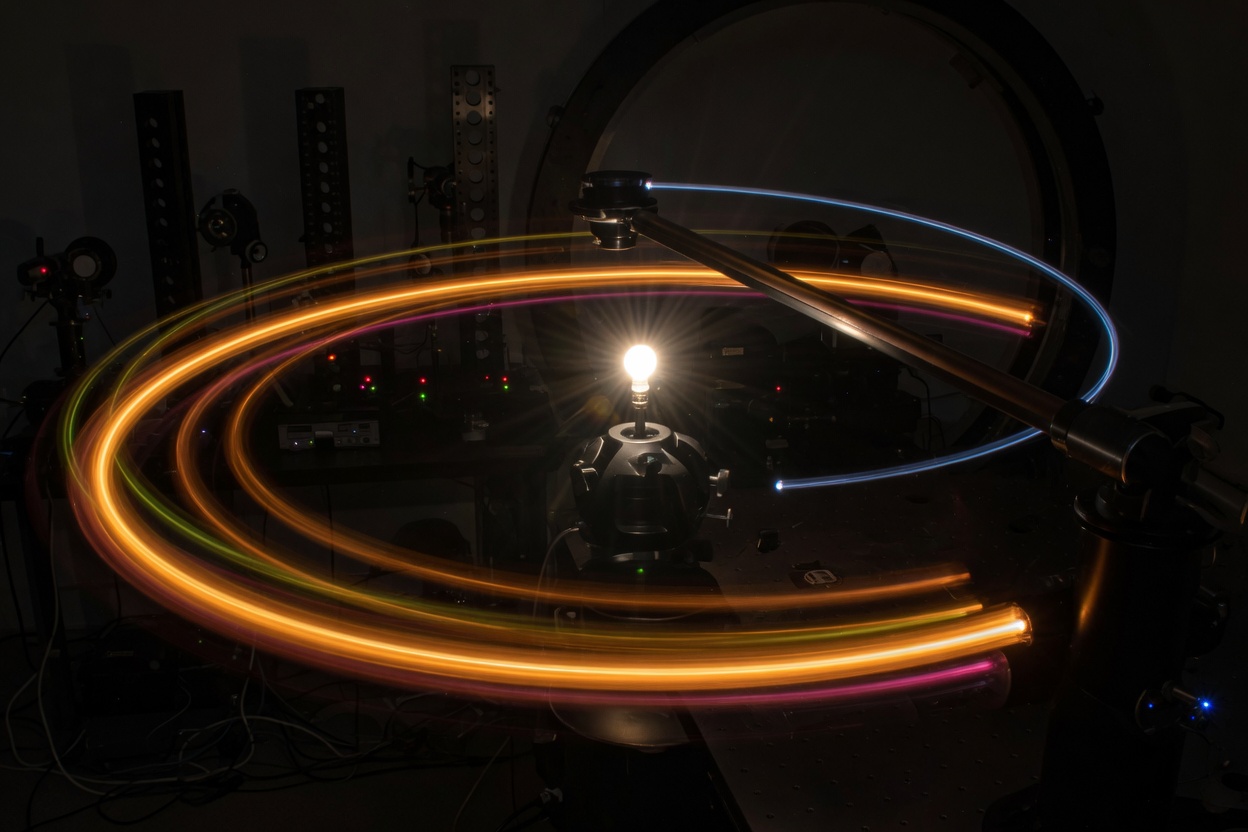
ANSI/IES LM-79 is the test method standard for the photometric and electrical measurement of LED and OLED solid-state lighting products[1]. It requires measuring a product’s optical and electrical characteristics together under controlled conditions — including total luminous flux, input power, efficacy, chromaticity coordinates, correlated color temperature, and color rendering index.
It has one key principle: measure the whole luminaire, not the bare chip. An LED’s real performance is heavily affected by its drive circuit and heat dissipation; numbers obtained from the chip alone will be distorted in the finished product. LM-79 requires measuring the driver and heat sink along with it — measuring the very product the user actually receives. With the method unified, numbers from different labs on the same product can agree, and the datasheet’s claims become traceable.
Why absolute photometry, not the relative method
One of LM-79’s often-overlooked yet central choices is adopting absolute photometry in place of the traditional relative method.
Relative photometry works by first measuring a standard lamp of known luminous flux, then comparing the test lamp against it to derive the test lamp’s flux. This method worked well in the era of traditional lighting — because traditional sources have stable output, and the bulb and luminaire can be separated, testing the bulb and then fitting it into the luminaire.
But LEDs broke both premises. First, an LED’s output is strongly tied to temperature and drive current, not the stable fixed value of a traditional lamp. Second, LED beads are often formed as one with the luminaire and heat-sink structure, impossible to take apart — there is no independently measurable “bulb.”
Absolute photometry instead directly measures the whole luminaire’s absolute luminous flux under real operating conditions, without relying on a standard-lamp comparison. This fits LED characteristics exactly: it measures this product, at this temperature, under this drive, actually emitting this much light. This is the most fundamental difference between LM-79 and traditional methods.
Integrating sphere vs. goniophotometer: the division of labor
Measuring luminous flux in practice relies mainly on two instruments; both measure light, but they excel in different directions.
The integrating sphere directs light into a sphere with a highly reflective inner wall; after the light reflects multiple times and homogenizes inside, a detector reads the total luminous flux in one shot. Its advantage is speed, suited to production sampling and total-flux measurement; its drawback is that it “scatters” the light and cannot capture the light’s spatial distribution information.
The goniophotometer takes a different route: it moves a detector around the luminaire, measuring intensity point by point at every angle. It can obtain the full luminous-intensity distribution curve and spatial intensity distribution, with high accuracy and complete information; the price is time — a full scan is far slower than the integrating sphere. Historically, the absolute determination of total luminous flux has also had corresponding measurement procedures to follow[2].
The choice is intuitive: to get the total luminous flux quickly, use the integrating sphere; to know where the light goes and what the distribution looks like, use the goniophotometer. The two divide the work complementarily in the lab.
How to read a report: five groups of key numbers
When you get an LM-79 report, which numbers should you look at? There are five key groups:
- Total luminous flux (in lumens, lm): the total light a lamp emits — the objective measure of “how bright this lamp is.”
- Efficacy (lm/W): flux divided by input power, representing energy efficiency — how much electricity for the same brightness.
- Chromaticity coordinates (such as CIE x, y): coordinates that precisely define where the light’s color falls.
- Correlated color temperature (CCT, in K): whether the light leans warm or cool — 3000K warm white, 6500K cool white.
- Color rendering index (CRI/Ra): the light’s ability to reproduce true object colors — the higher, the closer to color under natural light.
The most important discipline in reading a report is: always read it together with the measurement conditions. Under what ambient temperature and what drive current were these numbers measured? Divorced from its conditions, an isolated “800 lumens” is meaningless — change the temperature or the drive, and the number changes. A good report states these premises clearly, and the reader should actively look for them.
Three reminders for submitting light-string products
For submitting long, flexible, pixel-control products to LM-79, there are a few points to watch:
- Define the drive condition clearly: pixel-control products often have dimming and dynamic effects, so light output varies with the frame. The submission should clearly define the drive state and current during measurement — otherwise, which frame is being measured?
- Wait for thermal stabilization before measuring: LED output drifts with temperature, so measurement must be done after the product has thermally stabilized; numbers taken right after power-on don’t count.
- Plan the product form: long, flexible forms differ from standard luminaires, so the fixtures and placement for light-distribution measurement must be well designed to obtain representative results.
PowerMOS: stable photometric and electrical output for reproducible measurement
For a measurement to be accurate, the object under test must have stable output — if a bead’s brightness and color drift randomly, no instrument, however precise, can measure credible numbers.
PowerMOS pixel-control chips adopt a constant-current architecture, letting each bead work at a stable current for more consistent brightness and color output; combined with high grayscale depth and flicker-free dimming, they yield reproducible photometric and electrical data during measurement. This is especially helpful for tests like LM-79 that need rigorous condition control — a stable source is the starting point of a credible report. Flagship parts such as the P9864/P9866 (RGB three-channel) and P9865/P9873 (RGBW four-channel) all provide this stable output characteristic. See the Product Center for full part numbers, and for drive settings related to test submission contact sales-02@powermos.com.
Further reading: for grayscale and flicker-free dimming, see Grayscale, Color, and Flicker-Free Dimming Engineering for Addressable LEDs; for color and white-light reproduction, see The Color-Rendering Engineering of Full Color and White Light.
References and standards
- ANSI/IES LM-79-19, Approved Method: Optical and Electrical Measurements of Solid-State Lighting Products. Illuminating Engineering Society (IES).
- CIE 84-1989, The Measurement of Luminous Flux. International Commission on Illumination (CIE).
This article is an educational overview of photometric measurement. The names of the cited standards can be verified in the IES and CIE official catalogs. PowerMOS pixel-control chips use a proprietary carrier protocol optimized for LED pixel control.
FAQ
What is LM-79 and what does it standardize?
ANSI/IES LM-79 is the test method standard for the photometric and electrical measurement of LED and OLED solid-state lighting products. It requires measuring a product's optical and electrical characteristics together under controlled conditions — including total luminous flux, input power, efficacy, chromaticity coordinates, correlated color temperature, and color rendering index — and requires measuring the whole luminaire (driver and heat sink included) rather than just the bare chip. Its value is in unifying the method so that numbers from different labs on the same product can be compared, and so datasheet claims are traceable.
How do the integrating sphere and goniophotometer divide the work?
Both measure luminous flux, but they excel in different directions. The integrating sphere directs light into a sphere with a highly reflective inner wall and reads total luminous flux in one shot — fast, suited to production and total-flux measurement, but it cannot capture the light's spatial distribution. The goniophotometer instead moves a detector around the luminaire, measuring intensity point by point at every angle, yielding the full luminous-intensity distribution curve with high accuracy and complete information, but it is time-consuming. Choose the sphere for the total, the goniophotometer for distribution detail.
What is absolute photometry, and why did it replace the relative method?
Traditional relative photometry first measures a standard lamp of known luminous flux, then compares the test lamp against it — suited to sources with stable output that can be separated from the luminaire. But an LED's output is strongly tied to temperature and drive, and the bead is often integral with the luminaire and heat sink, hard to separate. Absolute photometry directly measures the whole luminaire's absolute luminous flux under real operating conditions, without relying on a standard-lamp comparison, better matching LED characteristics. LM-79 therefore adopts absolute photometry — the key difference from traditional methods.
How do you read the key numbers in an LM-79 report?
Focus on a few groups. Total luminous flux (in lumens, lm) is the total light a lamp emits; efficacy (lm/W) is flux divided by input power, representing energy efficiency; chromaticity coordinates (such as CIE x, y) and correlated color temperature (CCT, in K) describe the light's color; the color rendering index (CRI/Ra) describes the ability to reproduce true object colors. When reading a report, note what ambient temperature and drive condition the numbers were measured under — a single number divorced from its conditions is meaningless.
What should you watch for when submitting light-string products for LM-79 testing?
For light-string and pixel-control products, mind a few things. First, drive condition: such products often have dimming and dynamic effects, so the submission should clearly define the drive state and current during measurement. Second, heat and temperature: LED output varies with temperature, so measurement must be done after thermal stabilization. Third, product form: long, flexible products differ from standard luminaires, so the light-distribution setup and fixtures must be planned. PowerMOS pixel-control chips provide a constant-current architecture and stable grayscale output, helping obtain reproducible photometric and electrical data during measurement. See the Product Center for full part numbers.
Upgrading your string lights to full pixel control?
Power MOS Electronics delivers the complete stack — driver ICs, addressing equipment, controllers and apps. Tell us about your product and our engineering team will spec it with you.
Contact PowerMOS Browse products