Step into a serious themed restaurant and the ceiling is a whole field of slowly drifting stars, the light warms quietly with the rhythm of each course, and a private room switches from forest to ocean at a single touch. Immersive dining turns 'a meal' into an experience, and lighting is the director of that experience. But dining lighting has three details that are easily overlooked yet decide success or failure: no flicker banding when a guest lifts a phone to photograph the dish, beautiful color rendering of the food under the light, and—however strong the atmosphere—no harsh glare that steals the scene. This article is about those three things.
Step into a serious themed restaurant and the ceiling is a whole field of slowly drifting stars, the light warms quietly with the rhythm of each course, and a private room switches from forest to ocean at a single touch.
Immersive dining turns “a meal” into an experience, and lighting is the director of that experience. But dining lighting has three details that are easily overlooked yet decide success or failure: no flicker banding when a guest lifts a phone to photograph the dish, beautiful color rendering of the food under the light, and—however strong the atmosphere—no harsh glare that steals the scene. This article is about those three things.
First thing: photos can’t have flicker banding
In today’s restaurants, the moment a dish arrives, guests photograph it. If the picture comes out with horizontal bands of light and dark, half the experience is ruined—and that is not a broken camera, it is the light’s flicker being captured.
LEDs are often dimmed with pulse-width modulation (PWM): rapid switching, with the on-time fraction controlling brightness. If that switching frequency is too low, a phone’s rolling shutter captures “part bright, part dark” in a single frame, forming bands. In video it is even more obvious—the whole frame flickers as it flows.
IEEE 1789-2015 provides a risk framework for this: it quantifies the effect of modulation frequency and flicker depth on health and vision[1]. The rough pattern is that low frequencies (below 90 Hz) carry high risk, mid frequencies (about 90 to 1250 Hz) depend on flicker depth, and high frequencies (above roughly 1250 Hz) are generally considered safe[1]. For a restaurant where everyone photographs their food—and food bloggers shoot video—high-frequency, flicker-free dimming is not a bonus, it is the baseline.
Second thing: making food look good
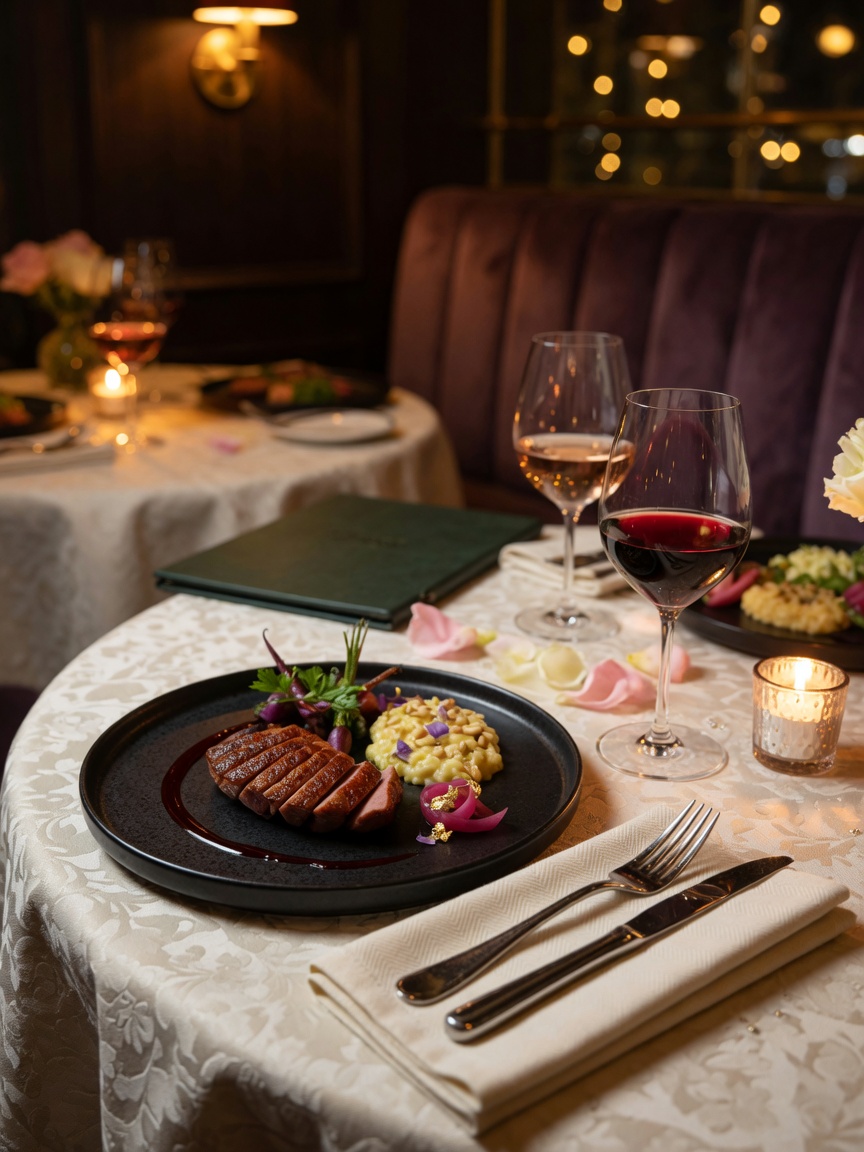
The same dish can look very different under different lights. Some lights make a steak look dull and a tomato look brown; others make the same plate red and fresh, green and crisp. The difference is color-rendering quality.
People used to look only at CRI (the color rendering index), but a single number is not enough to describe whether food looks good. TM-30-20 is a more complete method for evaluating color rendition, describing a light source with two metrics[2]:
- Rf (Fidelity): how accurately colors are reproduced, on a scale of 0 to 100—the higher the closer to the true colors under the reference light.
- Rg (Gamut): whether overall saturation is compressed or boosted relative to the reference light.
For dining, each metric has its use: accurate reds (good Rf performance) make meat, tomatoes, and strawberries look fresh and real; while a modest boost in saturation (an Rg slightly above 100) makes the whole table more tempting and appetizing[2]. TM-30’s two metrics better match the real need—“food that looks good both in the lens and to the eye”—than CRI alone.
Third thing: the atmosphere should set off, not steal
The easiest mistake in immersive lighting is overdoing it. Stars too bright drown the table, scene light too strong makes people squint, theme effects steal attention from the food and companions—the job of atmospheric light is to set off, not to be the lead.
The root of stealing the scene is often glare: too much contrast between source and background, and the eyes are uncomfortable. EN 12464-1 is the standard for indoor lighting, defining glare upper limits for different spaces via UGR (Unified Glare Rating)[3]. A dining space is not a precision workplace and need not apply the strictest figures, but an immersive experience needs a soft, low-contrast luminance distribution all the more—because guests come to relax and enjoy, and any harsh spot pulls them out of the scene.
This is exactly the stage for addressable lighting: per-pixel brightness control lets you soften the lights facing guests’ eyes while keeping the background and accent lights bright, actively controlling contrast so the atmosphere “has presence without being harsh.”
Why star ceilings and scene light are made for addressable
Look again at the three signature effects of immersive dining, and their common essence is—many light points, each different, all coordinated in change:
- Star ceilings: hundreds or thousands of independent, randomly twinkling stars.
- Scene light: color temperature and brightness that gradate slowly as a whole with the rhythm of the meal.
- Private-room theme switching: changing the whole room from one theme to another at a touch.
All of these need per-pixel, zone-addressable point control, the core capability of addressable lighting. Traditional strings that turn on and off as a whole cannot achieve this finesse and coordination.
How PowerMOS addresses immersive dining lighting
PowerMOS addressable control ICs offer high grayscale depth and a constant-current architecture, so the brightness of every light can be adjusted finely and stably—the foundation for flicker-free dimming and a soft luminance distribution, meeting the needs of photography and video settings in restaurants and letting the atmosphere set off without harshness.
For realizing effects, per-pixel addressing creates the independent stars of a star ceiling and the whole-scene gradation of scene light; two-section addressing and 512-code address depth support zoned control of large numbers of light points, making one-touch private-room theme switching possible. Indoor scenes correspond to a drive current of 3.5–7 mA. It should be noted that the final color-rendering performance depends on the spectrum of the chosen LED pixels; what PowerMOS provides is the point-control IC that makes every light precisely, stably, and flicker-free controllable. See the product center for the full model list.
Further reading: for the principles of flicker-free dimming, see Grayscale, Color, and Flicker-Free Dimming Engineering for Addressable LEDs; for hospitality atmosphere applications, see Ambient Lighting for Hotels and Hospitality.
Reference standards and literature
- IEEE Std 1789-2015, IEEE Recommended Practices for Modulating Current in High-Brightness LEDs for Mitigating Health Risks to Viewers. IEEE Standards Association.
- ANSI/IES TM-30-20, IES Method for Evaluating Light Source Color Rendition. Illuminating Engineering Society (IES).
- EN 12464-1, Light and lighting — Lighting of work places — Part 1: Indoor work places. European Committee for Standardization (CEN).
This article is an educational piece on dining lighting. The names of the standards cited can be verified in the official catalogs of the IEEE, IES, and CEN. PowerMOS addressable control ICs use a proprietary carrier protocol optimized for LED pixel control.
FAQ
Why do restaurant photos come out with stripes?
That is flicker being captured by the camera. LEDs are often dimmed with pulse-width modulation (PWM), and if the modulation frequency is too low, a phone's rolling shutter records the light-dark variation as horizontal bands. IEEE 1789-2015 provides a framework relating modulation frequency and flicker depth to health risk: low frequencies (below 90 Hz) carry high risk, while high frequencies (above roughly 1250 Hz) are generally considered safe. In a restaurant where everyone photographs their food, choosing high-frequency, flicker-free dimming matters especially.
How do you make food look more appetizing under the light?
The key is color-rendering quality. TM-30-20 is a method for evaluating light-source color rendition, described by two metrics: Rf (fidelity) tells you how accurately colors are reproduced, and Rg (gamut) tells you whether saturation is compressed or boosted relative to the reference. For food, accurate reds make meat, tomatoes, and strawberries look fresh; a modest boost in saturation (a slightly high Rg) makes dishes more tempting. The traditional single CRI number is not enough—TM-30's two metrics better capture whether food looks good.
Will scene lighting be too harsh and steal the scene from the meal?
It will, if glare is not controlled. The point of atmospheric light is to set off, not to steal. Glare comes from excessive contrast between source and background—EN 12464-1 defines UGR (Unified Glare Rating) upper limits for different indoor spaces. A dining space is not a precision workplace, but an immersive experience needs a soft, low-contrast luminance distribution all the more. The per-pixel brightness control of addressable lighting softens exactly the lights facing guests, avoiding harshness.
Why do star ceilings and scene light suit an addressable solution?
Because their essence is 'many light points, each different, all coordinated in change.' A star ceiling is hundreds or thousands of independently twinkling stars, scene light gradates as a whole with the rhythm of the meal, and private-room theme switching changes the whole room at a touch—all of which need per-pixel, zone-addressable point control, the core capability of addressable lighting. Traditional strings that turn on and off as a whole cannot achieve this finesse.
How does the PowerMOS solution address immersive dining lighting?
PowerMOS addressable control ICs offer high grayscale depth and a constant-current architecture, so the brightness of every light can be adjusted finely and stably; combined with a flicker-free dimming design, they meet the needs of photography and video settings. Per-pixel addressing enables star ceilings, scene gradation, and private-room theme switching. Two-section addressing and 512-code address depth support zoned control of large numbers of light points. Indoor models correspond to 3.5–7 mA of current. See the product center for the full model list.
Upgrading your string lights to full pixel control?
Power MOS Electronics delivers the complete stack — driver ICs, addressing equipment, controllers and apps. Tell us about your product and our engineering team will spec it with you.
Contact PowerMOS Browse products