Twenty years ago, a single pixel-controllable light was a luxury; today, a whole string in which every bead independently changes color is affordable enough for the family Christmas tree. What happened in between? The answer lies in a rule of thumb called Haitz's Law, which describes how LEDs get brighter and cheaper every decade. This article is about that cost curve, and how it pushed lights step by step from 'just light up' toward 'every bead controllable.'
Twenty years ago, a single independently pixel-controllable light was a luxury; today, a whole string in which every bead independently changes color is affordable enough for the family Christmas tree.
What happened in between? The answer lies in a rule of thumb called Haitz’s Law, which describes how LEDs get brighter and cheaper every decade. This article is about that cost curve, and how it pushed lights step by step from “just light up” toward “every bead controllable.”
Haitz’s Law: Moore’s Law for the LED world
The semiconductor industry has a famous rule everyone has heard of—Moore’s Law, which says transistor density doubles at regular intervals. The LED world has a similar rule of thumb: Haitz’s Law.
Proposed by solid-state lighting pioneer Roland Haitz, it has two core observations: the cost per lumen falls to roughly one-tenth every decade, while the luminous flux per package rises about 20x every decade[1]. In other words, the same dollar buys more than ten times the brightness a decade later.
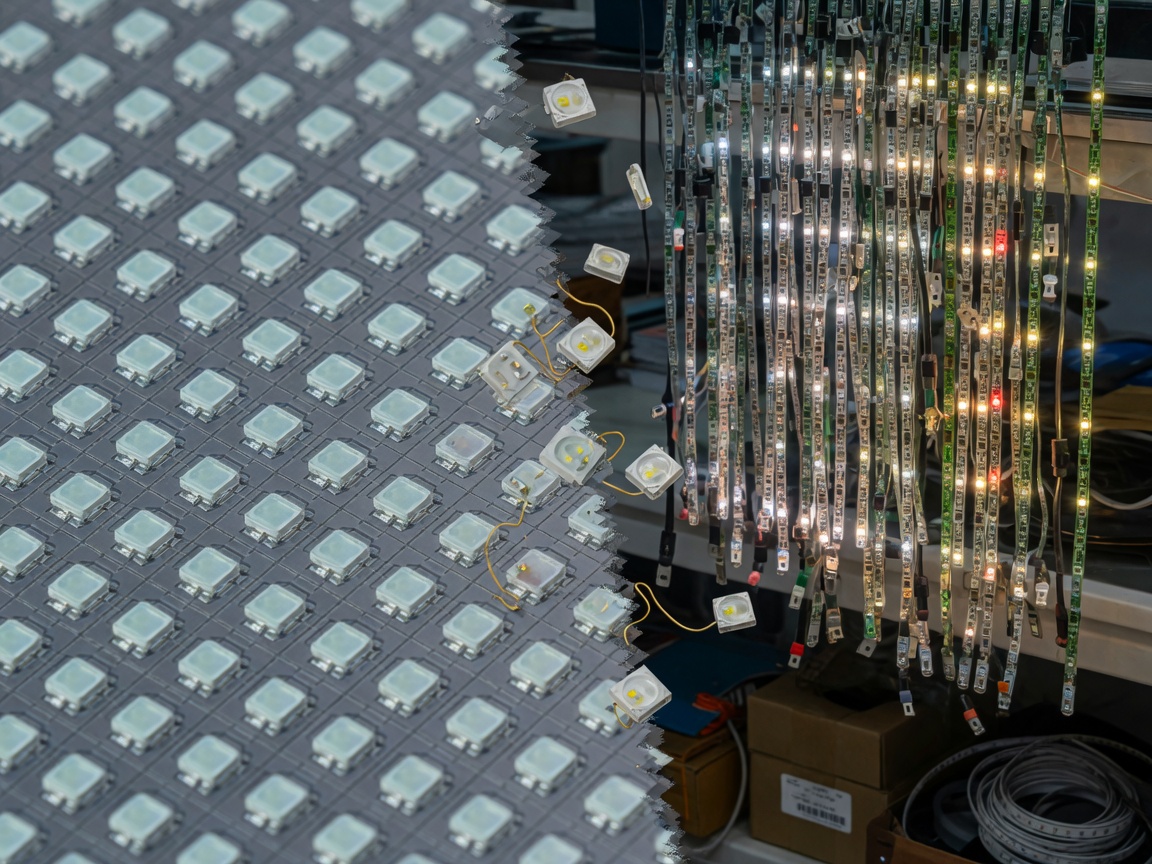
Note that Haitz’s Law is not a law of physics but a generalization from decades of industry data. It reflects continual improvement in epitaxy quality, packaging efficiency, phosphors, and manufacturing scale, accumulating into a long-term downward cost trend line. Like Moore’s Law, it is not guaranteed to hold forever, but for a very long stretch it described the LED trajectory quite accurately.
Looking back a decade later: where did the curve go?
About ten years after the original argument, Haitz and Tsao revisited the progress of solid-state lighting, examining the gap between the initial predictions and actual development[1]. The importance of this review lies in turning “will the trend materialize?” from optimistic imagination into a record you can check against.
The conclusion, broadly, is that the long-term direction of luminous efficacy and cost did unfold as expected, even if the slope wobbled from year to year. For the lighting industry, this means several things happened at once:
- LEDs gradually replaced traditional light sources and became mainstream for general lighting
- The price per unit of brightness kept falling, letting LEDs enter more and more settings that once couldn’t afford them
- The emitting portion was no longer the absolute bulk of the cost, and the surrounding control, drive, and structure gradually became the point of differentiation
That last point is exactly where the change in the decorative-lighting industry begins.
When emitting gets cheap, the cost structure flips
The cost of a light string can be roughly broken into a few pieces: emitters, control IC, wire, assembly, and protective and structural parts. In the era when LEDs were still expensive, the emitters were the absolute bulk of the cost, and every design revolved around “how to use fewer, how to share them”—so a whole segment of lights got a single control signal, lighting up and dimming together.
Once Haitz’s Law drove the lumen cost of the emitters down, the cost structure flipped. The emitting portion’s share of total cost shrank, and the relative share of the control IC became acceptable. The significance of this is enormous: “a control IC for every light,” once unthinkable on cost, became a reasonable design option.
So we see the evolution of the light string:
- Fixed brightness: one signal for a segment, only the whole string can be switched
- Fixed code / segmented control: dividing lights into a few segments or fixed roles, capable of simple chase effects
- Full pixel control (bead-by-bead addressing): every light has its own address and can change color and dim independently
Behind this path from “just light up” to “every bead controllable” is the cost curve—once the marginal cost of control drops low enough, maxing out control capability becomes a worthwhile investment.
A cost dividend is not license to cut corners
Does a downward cost curve mean the product necessarily gets worse? This is a common misconception.
The main drivers of the falling cost are process efficiency and scale, not cutting corners. What really opens up a quality gap is the engineering detail of the control solution. Two strings that both offer “every bead controllable” can differ enormously in reliability, and the difference is in:
- Whether addressing is stable: do addresses drift or clash during shipping or after power-on
- Whether a single-point failure spreads: when one light fails, does it drag down the whole segment behind it
- Surge protection and weathering: can it withstand outdoor lightning surges and temperature-humidity cycling
- Repairability: can a dead bead be replaced individually, rather than scrapping the whole string
In other words, Haitz’s Law handed the whole industry a cost dividend, but turning that dividend into a reliable product relies on the engineering of control and protection. Cheap emitters paired with a solid solution are the right way to use it.
PowerMOS: making “every bead controllable” scalable
PowerMOS pixel-control ICs take exactly the road this cost curve points to—making every light independently controllable—and do it at a scale ready for mass production.
On the cost side, PowerMOS uses two-wire power-line carrier to eliminate extra signal wires, and automated in-line address writing together with dual-layer addressing (laser metal fuse plus in-line rewritable silicon fuse) to raise addressing and line efficiency, pushing the assembly cost of per-bead pixel control down to a scalable level. On the reliability side, it ensures the falling cost does not sacrifice durability through non-spreading single-point failure, surge protection, and bead-replaceable repair—precisely answering the earlier point about “don’t use the cost dividend to cut corners.” The main models cover RGB three-channel (P9864/P9866), RGBW four-channel (P9865/P9873), and copper-wire lights (P9871/P9874/P9875); see the product center for the full list.
Further reading: for a comparison of pixel control and various solutions, see A Comparison of Technical Routes for Addressable LED Pixel-Control ICs; for the principles of two-wire carrier, see The Engineering of Two-Wire Addressable Lighting.
Reference standards and literature
- R. Haitz & J. Y. Tsao, Solid-state lighting: 'The case' 10 years after and future prospects. physica status solidi (a), Vol. 208, No. 1 (2011), pp. 17–29. DOI: 10.1002/pssa.201026349.
This article is an educational piece on LED industry trends. The source of the literature cited can be verified in academic databases such as the Wiley Online Library. PowerMOS pixel-control ICs use a proprietary carrier protocol optimized for LED pixel control.
FAQ
What is Haitz's Law?
Haitz's Law is a rule of thumb describing the long-term development trend of LEDs, proposed by Roland Haitz as an analog to Moore's Law in semiconductors. Its core observation is that the cost per lumen of an LED falls to roughly one-tenth every decade, while the luminous flux per package rises about 20x every decade. It is not a law of physics but a generalization from decades of industry data, used to predict where the price-performance of LED lighting is headed.
How is Haitz's Law related to Moore's Law?
Both are rules of thumb describing the long-term exponential progress of semiconductor technology. Moore's Law is about transistor density; Haitz's Law is about the lumen cost and luminous flux of LEDs. The shared logic is that continual improvement in process and materials drives the cost per unit of function down exponentially. The difference is that LEDs also involve optoelectronic-specific steps like epitaxy, packaging, and phosphors, so the slope of the curve is not exactly the same as Moore's Law.
Why does cheaper LED make 'pixel control' widespread?
The cost of a light string is made up of the emitters, the control IC, the wire, assembly, and so on. When the lumen cost of the LED itself drops sharply, the emitting portion's share of total cost shrinks, and the relative share of the control IC becomes acceptable. This turns 'a pixel-control IC for every light' from a luxury design into a reasonable option—strings that once could only offer fixed brightness can now be addressed bead by bead and change color independently.
Does falling cost mean quality is compromised too?
Not necessarily. The main drivers of the falling cost curve are process efficiency and scale, not cutting corners. What really opens up a quality gap is the engineering detail of the control solution: whether addressing is stable, whether a single-point failure spreads, and whether surge protection and weathering are up to par. Cheap emitters paired with solid control and protection design are the right way to turn the cost dividend into a reliable product.
How does the PowerMOS solution map to this cost curve?
PowerMOS pixel-control ICs take exactly the road of 'making every bead controllable.' Through two-wire power-line carrier, dual-layer addressing (laser metal fuse plus in-line rewritable silicon fuse), and automated in-line address writing, they push the assembly and mass-production cost of per-bead pixel control down to a scalable level; at the same time, non-spreading single-point failure, surge protection, and bead-replaceable repair ensure that the falling cost does not sacrifice reliability. See the product center for the full model list.
Upgrading your string lights to full pixel control?
Power MOS Electronics delivers the complete stack — driver ICs, addressing equipment, controllers and apps. Tell us about your product and our engineering team will spec it with you.
Contact PowerMOS Browse products