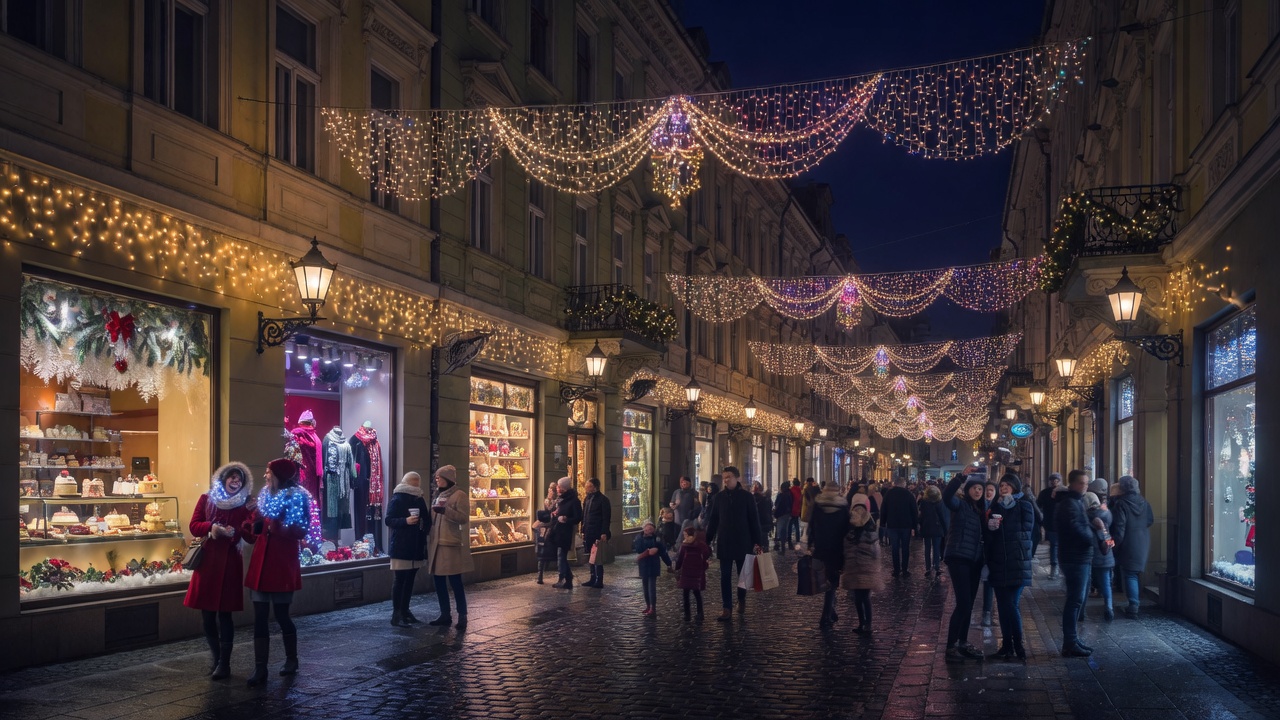
A festive high street strung with cross-street decorations, a retail window that tells a story. The festive lighting of commercial spaces is the stage where addressable LEDs come closest to foot traffic and spending. Its engineering demands sit between home decoration and urban illumination: bright and dynamic enough to catch the eye, yet reliable and easy to maintain enough to last the whole festive run.
A festive high street strung with cross-street decorations, a retail window that tells a story. The festive lighting of commercial spaces is the stage where addressable LEDs come closest to foot traffic and spending.
Its engineering demands sit right between home decoration and urban illumination: bright and dynamic enough to catch the eye, yet reliable and easy to maintain enough to last the whole festive run. This article covers the three engineering priorities of commercial festive lighting.
Motion: turning a street into a visual whole
Traditional festive street lights are mostly fixed patterns, each hung on its own; addressable LEDs let cross-street curtains, street trees, and streetscape outlines play coordinated flowing waves of light — a whole street changing color, an entire row of curtains running a wave together, becoming a choreographable visual whole.
This “unified motion across a whole street” is an appeal fixed patterns cannot match, and a practical means of lifting a district’s festive atmosphere and foot traffic. Oxford-Street-style cross-street canopy curtains are the classic example — PowerMOS demonstrates this kind of cross-street decoration in an Oxford Street style in the 3D Christmas Town.
Precision: brand-grade presentation in retail windows
A retail window is a prime visual, demanding motion, precision, and frequently swapped content. Addressable LEDs can play patterns, text, brand colors, and festive themes point by point, and change them quickly by season.
For commercial spaces, two display-quality details matter especially: color accuracy (faithful reproduction of brand colors) and flicker-free operation (comfortable over long display hours — following the dimming-frequency recommendations of IEEE 1789[1]). These are the distance between a window that “lights up” and one with “brand quality.” For a deeper look, see Grayscale, Color, and Flicker-Free Dimming Engineering for Addressable LEDs.
Reliability and maintenance: lasting the whole run
Festive lighting has a defined run, and a mid-run failure directly loses commercial exposure. Two engineering choices decide presentation quality across the run:
- Architectural fault tolerance — with an architecture using independent address codes, a single failed LED won’t cut off the whole string the way a shift register does (three-wire), and the failure stays confined to one point.
- Outdoor interference immunity — outdoor street decorations must withstand surges and environmental stress, and anti-interference design can follow the surge and ESD immunity requirements of the IEC 61000 series[2].
As for power: cross-street decorations run long wiring distances, and using high-voltage AC110/220V with high voltage and low current in series-parallel reduces wire gauge and count and lowers wiring cost, with two-wire carrier simplifying wiring further.
Choosing parts for your commercial space
PowerMOS provides the addressable LEDs, AC110/220V high-voltage solutions, multi-channel sub-control, and carrier-conversion controllers for commercial festive lighting, suited to cross-street decorations, street trees, windows, mall atriums, and similar commercial spaces. See the full lineup in the Product Center. City festival contractors, retail-visual and commercial-space design teams are welcome to discuss with their site scale and run requirements.
Reference Standards and Literature
- IEEE Std 1789-2015, IEEE Recommended Practices for Modulating Current in High-Brightness LEDs for Mitigating Health Risks to Viewers. IEEE Standards Association.
- IEC 61000-4-5, Electromagnetic compatibility (EMC) — Surge immunity test; IEC 61000-4-2, Electrostatic discharge immunity test. International Electrotechnical Commission.
- ANSI E1.11 (DMX512-A), Asynchronous Serial Digital Data Transmission Standard for Controlling Lighting Equipment and Accessories. ESTA — a control-standard reference for commercial and architectural lighting.
This article is an educational piece on application engineering. The names of the cited standards can be verified in the official catalogs of IEEE Standards Association, IEC, and ESTA. PowerMOS pixel-control chips use a proprietary carrier protocol optimized specifically for LED pixel control.
FAQ
Why are addressable LEDs well suited to festive street decoration?
Traditional festive street lights are mostly fixed patterns; addressable LEDs let cross-street curtains, street trees, and streetscape outlines play flowing waves of light, change color, and even coordinate into a unified motion across an entire street. Each LED is independently addressable, turning a street into a choreographable visual whole, an appeal fixed patterns cannot match and a means of lifting a district's festive atmosphere and foot traffic.
What does a retail window's dynamic display demand of lighting?
A window is retail's prime visual, needing motion, precision, and frequently swapped content. Addressable LEDs can play patterns, text, brand colors, and festive themes point by point, and change them quickly by season. For commercial spaces, color accuracy (faithful brand-color reproduction) and flicker-free operation (comfortable over long display hours, per IEEE 1789) are part of the quality of experience.
Why do reliability and maintenance matter for commercial festive lighting?
Festive lighting has a defined run, and a mid-run failure means direct loss of commercial exposure. With an architecture using independent address codes, a single failed LED won't cut off the whole string the way a shift register does, and the failure stays confined to one point. Outdoor street decorations must also withstand surges and environmental stress, and anti-interference design can follow the IEC 61000 series. Reliability directly determines presentation quality and maintenance cost across the run.
How do large-span installations like cross-street decorations get powered and wired?
Cross-street decorations run long wiring distances, and low-voltage DC drops badly. Using high-voltage AC110/220V in series-parallel, with high voltage and low current, reduces wire gauge and count and lowers wiring cost. Two-wire carrier, carrying power and data together, simplifies wiring further. PowerMOS offers AC110/220V high-voltage carrier pixel-control solutions for these large-span commercial installations.
How can city festival contractors or retail brands get a solution?
PowerMOS provides the addressable LEDs, AC110/220V high-voltage solutions, multi-channel sub-control, and carrier-conversion controllers (accepting standard signals) for commercial festive lighting. Suited to cross-street decorations, street trees, windows, mall atriums, and similar commercial spaces. City festival contractors, retail-visual and commercial-space design teams are welcome to discuss solutions with their site scale and run requirements.
Upgrading your string lights to full pixel control?
Power MOS Electronics delivers the complete stack — driver ICs, addressing equipment, controllers and apps. Tell us about your product and our engineering team will spec it with you.
Contact PowerMOS Browse products