'A defect rate of 200 PPM' sounds like an abstract number engineers fuss over, with little bearing on a brand manager's world. But follow it all the way down—multiply it by shipment volume, add the logistics and labor of every return, then multiply by what a single bad review does to future sales—and it becomes a very concrete, very painful bill. Failure rate was never just a technical metric; it is brand economics. This article walks through how that bill adds up, and how one choice in product architecture fundamentally changes the fate of your aftermarket.
- What PPM is, and how it becomes money
- One dead pixel kills the string vs. failures that don’t propagate
- Review scores: the most invisible, most expensive line item
- Lifetime is a kind of failure too: lumen maintenance and L70
- Replaceable-pixel repair: the aftermarket logic of the professional market
- PowerMOS: writing aftermarket risk into the design
- References and standards
- FAQ
‘A defect rate of 200 PPM’ sounds like an abstract number engineers obsess over—one with little bearing on a brand manager’s world.
But follow it all the way down—multiply it by shipment volume, add the logistics and labor of every return, then multiply by what a single bad review does to future sales—and it becomes a very concrete, very painful bill. Failure rate was never merely a technical metric; it is brand economics. This article walks through how that bill adds up, and how a single choice in product architecture fundamentally changes the fate of your aftermarket.
What PPM is, and how it becomes money
First, let’s be clear on the unit. PPM (parts per million) is a defect rate in millionths; 200 PPM is about 200 defective units per million, or 0.02% in percentage terms.
That looks tiny—but the light-string category comes with two amplifiers. First, a single string holds hundreds of pixels; second, a single batch ships in the millions. Multiply PPM by those two numbers and the abstract ratio instantly becomes a concrete count of dead pixels. More important is the downstream cost: every pixel that fails in a customer’s hands can trigger a return—and the cost of a return is far more than the pixel itself. It includes reverse logistics, customer-service labor, inspection and rework, repackaging, and the priciest item of all: that customer, and the review they leave behind.
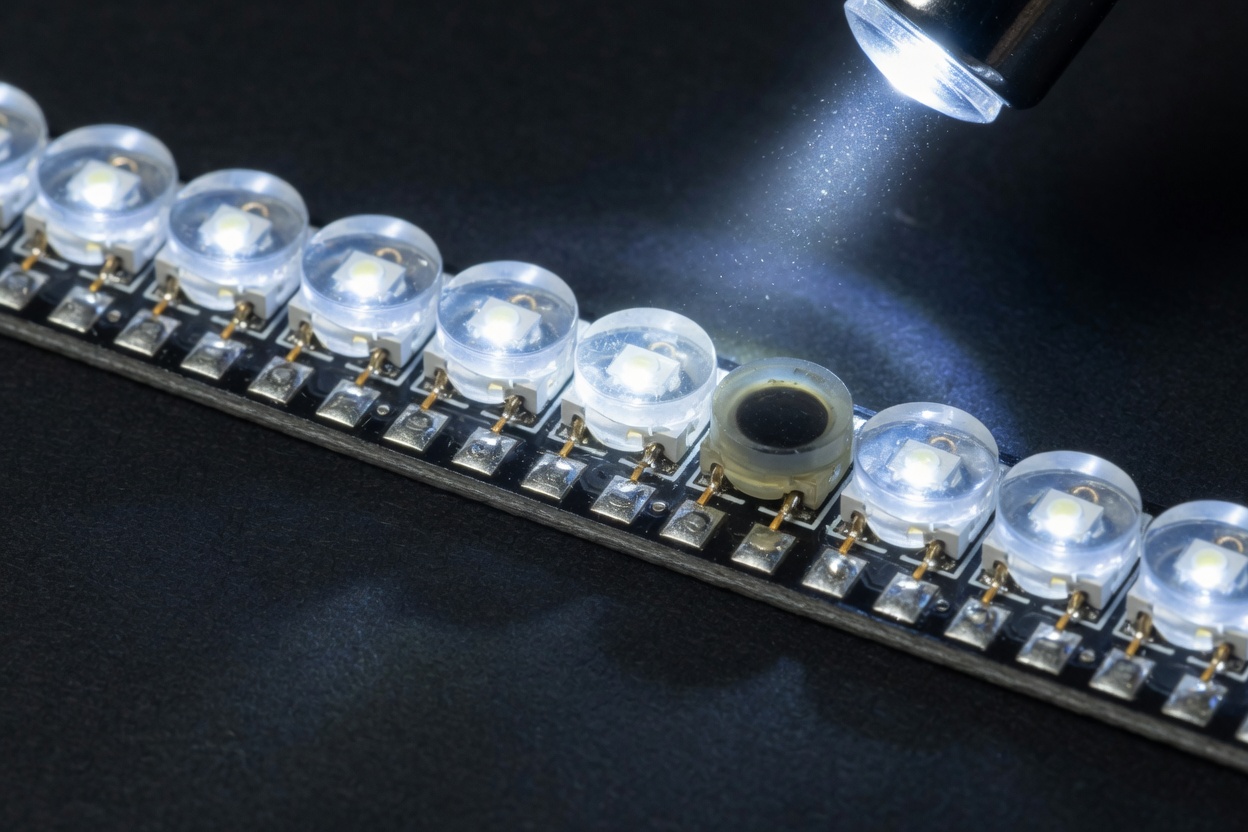
One dead pixel kills the string vs. failures that don’t propagate
The same pixel failure rate can end in wildly different return rates—and the difference lies not in the pixel, but in the architecture.
In a serially dependent design, any pixel that fails in the middle can leave everything after it—or the entire string—dark. To the user, that reads as ‘the whole light is broken,’ and a return is all but inevitable. A pixel with a 0.02% chance of failing has been amplified by the architecture into a 100% product failure.
Flip it around: in an architecture where a single-point failure doesn’t propagate outward—one dead pixel simply goes dark, the rest stay lit, the overall effect survives—the customer’s experience is entirely different. They may not even notice; and if they do, they shrug it off, and the incentive to return falls away. Same pixel quality, different architecture, an entirely different aftermarket curve. This is settled at the design stage and is almost impossible to fix after the fact.
Review scores: the most invisible, most expensive line item
In online retail, failure rate has one more, unseen transmission path: star ratings.
Purchase decisions lean heavily on ratings and reviews. When a dead pixel takes out the whole string, the customer’s move is usually ‘return it and leave one star.’ That review drags down the item’s average rating, which in turn hits search ranking, organic traffic, and conversion. So a seemingly minor failure rate is amplified nonlinearly into lost sales: you lose not just this order, but the many later orders that never closed because your rating slipped. This bill is hard to see in real time, yet it is the most expensive part of failure rate. It is also why the value of ‘failures that don’t propagate’ far exceeds the handful of returns it avoids—what it really protects is your rating.
Lifetime is a kind of failure too: lumen maintenance and L70
Failure isn’t always ‘everything out at once.’ The more common LED failure is brightness fading slowly to an unacceptable level—a matter of lumen maintenance. A string that is ‘still lit, but visibly dimmed and yellowed’ is, to a brand, just as much a failure.
The good news is that this is quantifiable. The industry uses IES LM-80 to measure the lumen maintenance of an LED package over time, with testing that typically runs at least 6,000 hours[2]; then IES TM-21 extrapolates that data by a standard method into lifetime projections such as L70 (the time for luminous flux to decay to 70% of its initial value)[3]. IEC 62717, meanwhile, sets the performance requirements—covering lumen maintenance and lifetime—for LED modules in general lighting[1]. Together these methods turn ‘will it dim too fast?’ from a vague worry into a metric you can quantify, write into a spec, and commit to a customer.
Replaceable-pixel repair: the aftermarket logic of the professional market
When a consumer-grade festive light fails, it usually just gets thrown out. But in the professional and commercial markets—architectural outline lighting, campuses, malls, long-term installed décor—the logic is entirely different.
Here the lights are assets, not consumables. Scrapping an entire string and re-running the wiring over a single dead pixel is unacceptably expensive. What has real value here is replaceable-pixel repair: a fault can be swapped out at a single point rather than discarding the whole string, and the system still works correctly afterward. For professional customers that means lower maintenance costs and longer asset life—and it makes your product more persuasive in tenders and long-term contracts. Replaceable pixels, paired with ‘failures that don’t propagate,’ form the aftermarket promise the professional market actually cares about.
PowerMOS: writing aftermarket risk into the design
Every one of the bills above comes back to two questions: are the pixels good enough, and how painful is it when one fails? PowerMOS has invested in both.
On quality, PowerMOS controls consistency with a defect rate of around 50 PPM, two-layer addressing, and single-reel assembly—driving down the odds of a bad pixel at the source. On architecture, PowerMOS supports single-point failures that don’t propagate, so one failed pixel doesn’t drag the whole string down—directly improving real return rates and reviews; and it supports replaceable-pixel repair, so a fault can be swapped at a single point rather than scrapping the string, matching the professional market’s ‘lights are assets’ logic. Add a production record of more than 500KK chips shipped in total (incl. the P9864 and P9831/P9832 series), plus the protection of 18 US and European patents (7 owned + 11 formally licensed), and what the customer receives is a solution that writes aftermarket risk into the design from the very start. See the product center for the relevant point-control chip models and solutions.
Want to evaluate building a more durable, lower-aftermarket-cost product line on PowerMOS? Write to sales-02@powermos.com to reach our engineering and business teams directly. You’re also welcome to start with About PowerMOS and our competitive advantages.
Further reading: for lifetime and lumen maintenance, see LED Lifetime and Lumen Maintenance; for reliability and surge protection, see EMC, ESD, and Surge Reliability for Addressable LEDs.
References and standards
- IEC 62717, LED modules for general lighting — Performance requirements. International Electrotechnical Commission (IEC).
- IES LM-80, Approved Method: Measuring Luminous Flux and Color Maintenance of LED Packages, Arrays and Modules. Illuminating Engineering Society (IES).
- IES TM-21, Projecting Long Term Lumen Maintenance of LED Light Sources. Illuminating Engineering Society (IES).
This article is an educational overview of LED string failure rate and aftermarket economics. The names of the cited standards can be verified in the official IEC and IES catalogs. PowerMOS point-control chips use a proprietary carrier protocol optimized specifically for LED point control.
FAQ
What is PPM, and what level does 200 PPM represent?
PPM is parts per million—a defect rate expressed in millionths. 200 PPM means roughly 200 defective units per million, or 0.02%. For a product like a light string, where a single string carries hundreds of pixels and a single batch ships in the millions, every order-of-magnitude change in PPM scales up the final count of dead pixels, the return volume, and the rework cost proportionally. That makes it a key metric for gauging quality and aftermarket risk.
Why does failure rate directly affect a brand's review scores?
Because online-retail purchase decisions lean heavily on star ratings and reviews. When one dead pixel takes out the whole string, the shopper's first move is usually to return the product and leave a one-star review; that review drags down the item's average rating, which directly hits organic traffic and conversion. So a seemingly tiny failure rate gets amplified into lost sales through the review system—the most invisible, and most expensive, cost of failure rate.
What is the difference between 'one dead pixel, the whole string goes dark' and 'a single-point failure that doesn't propagate'?
It comes down to how severe the aftermarket problem becomes. In a serially dependent architecture, a single failed pixel in the middle can take out everything after it—or the entire string. To the user, 'the whole thing is broken,' and a return is all but guaranteed. In an architecture where a single-point failure doesn't propagate, one dead pixel just means one dark pixel; the overall effect holds, acceptance stays high, and the incentive to return drops sharply. With the same pixel failure rate, the two architectures can produce wildly different real-world return rates.
Does lumen depreciation count as failure? How is it quantified?
Yes. LEDs rarely go out all at once; more often brightness fades slowly to an unacceptable level—a lumen-maintenance problem. The industry uses IES LM-80 to measure the lumen maintenance of an LED package over time (typically at least 6,000 hours), then IES TM-21 to extrapolate that data into lifetime projections such as L70; IEC 62717 sets the performance requirements (including lumen maintenance and lifetime) for LED modules. Together these methods turn 'will it fade too fast?' into a metric you can quantify and commit to.
How does PowerMOS's solution lower failure rate and aftermarket cost?
PowerMOS controls quality with a defect rate of around 50 PPM, two-layer addressing, and single-reel assembly; architecturally it supports single-point failures that don't propagate, so one dead pixel doesn't take down the string; and it supports replaceable-pixel repair, so a fault can be fixed at a single point rather than scrapping the whole string—which matters especially in the professional market, where asset lifetime is prized. See the product center for the relevant point-control chip models and solutions.
Upgrading your string lights to full pixel control?
Power MOS Electronics delivers the complete stack — driver ICs, addressing equipment, controllers and apps. Tell us about your product and our engineering team will spec it with you.
Contact PowerMOS Browse products