Hook an LED light string up to that ten-year-old knob dimmer on the wall, and the trouble starts: the lights flicker nonstop, drop out halfway through the dial, cut off entirely at the low end, or the dimmer emits a faint buzz. It is not that you bought bad lights—it is a mismatch between a 'dimmer designed for incandescent' and an 'electronically driven LED.' This article is about how phase-cut dimming works, why compatibility is so hard, and how smart pixel control simply sidesteps the whole problem.
Hook an LED light string up to that ten-year-old knob dimmer on the wall, and the trouble starts: the lights flicker nonstop, drop out halfway through the dial, cut off entirely at the low end, or the dimmer emits a faint buzz.
It is not that you bought bad lights—it is a mismatch between a “dimmer designed for incandescent” and an “electronically driven LED.” This article is about how phase-cut dimming works, why compatibility is so hard, and how smart pixel control simply sidesteps the whole problem.
Phase-cut dimming: how that knob on the wall works
The most common dimmer on a residential wall uses phase-cut dimming. The principle is actually intuitive: in each AC cycle, “cut off” part of the waveform and let only the rest through, thereby lowering the average power delivered to the fixture—cut off more, and the light gets dimmer.
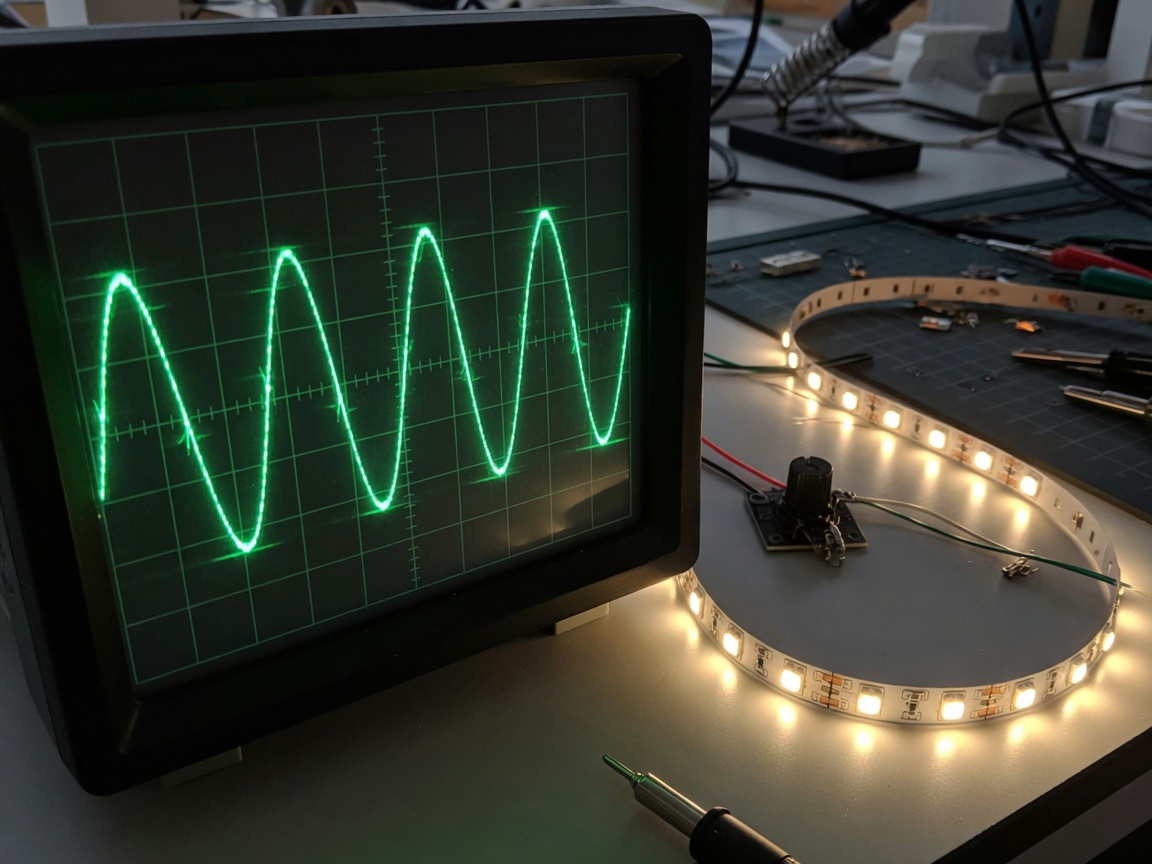
Depending on whether the front or the back of the waveform is cut, phase-cut dimming divides into two types. It was originally designed for resistive loads like incandescent lamps—an incandescent lamp is just a resistive filament, so as the power drops it dims evenly; dimming is smooth and the dimmer is cheap, which is why it became the mainstream for residential wall dimming. The problem is, an LED is not a filament.
Leading edge and trailing edge: two ways to cut, two temperaments
The two types of phase-cut dimming have very different temperaments, and you must tell them apart when choosing an LED solution.
- Leading-edge (TRIAC): cuts a segment at the start of each half cycle. Low-cost and most widespread, but the cut happens at an abrupt voltage transition, which is less friendly to electronic loads and prone to surge and compatibility issues. Common with incandescent and some LED dimming.
- Trailing-edge (ELV): cuts a segment at the end of each half cycle. Smoother conduction and friendlier to electronic drivers, usually with better dimming quality, but the dimmer costs more.
This leads to a practical key point: the fixture’s and the dimmer’s phase-cut types must match. Connect an LED marked trailing-edge compatible only to a leading-edge phase-cut dimmer, and flicker and jitter are very likely the beginning.
Why LEDs are so hard to handle
Even with the right phase-cut type, LEDs on phase-cut dimming still often act up. The root cause is that an LED is an electronically driven load that behaves very differently from an incandescent lamp:
- Low power, small current: a phase-cut dimmer needs enough load current to conduct stably and detect the AC zero crossing. An LED’s current is too small, easily causing the dimmer to misjudge and misbehave—hence flicker, jitter, or cutting off at the low end.
- The abrupt leading-edge transition: leading-edge phase cutting cuts in at the instant of an abrupt voltage transition, inducing ringing and current spikes at the LED driver input, affecting stability.
- Differences in driver response: different LED drivers interpret the chopped waveform differently, so the same dimmer runs smoothly with brand A’s light and flickers with brand B’s.
It is worth stressing that this is usually not a one-sided quality problem of the light or the dimmer, but a mismatch of load characteristics. And precisely because responsibility is hard to assign, this chaos has plagued the industry for years—until a common compatibility standard appeared.
NEMA SSL 7A: drawing a line under the chaos
To clean up the compatibility chaos of “LEDs with phase-cut dimming,” the National Electrical Manufacturers Association (NEMA) published NEMA SSL 7A, titled Phase-Cut Dimming for Solid State Lighting: Basic Compatibility, released in 2015 (and reaffirmed in 2021)[1].
Its purpose is to define basic compatibility requirements between phase-cut dimmers and LED fixtures: when an SSL 7A-compliant dimmer and fixture are paired, they should give predictable dimming performance rather than a roll of the dice. This gives manufacturers a common design target and gives buyers a screening basis for “at least it won’t flicker randomly.”
Worth mentioning: dimming quality is not only about “whether it can dim” but also about whether it flickers while dimmed. On the effect of flicker on people and dimming-frequency recommendations, the industry has IEEE 1789, a recommended practice for modulating current in high-brightness LEDs, to refer to[2]—good dimming both dims and avoids introducing harmful flicker.
PowerMOS: no waveform chopping, sidestepping the problem at the root
Looking back, all the trouble with phase-cut dimming essentially stems from the same thing: adjusting brightness by altering the power waveform. That being so, the most thorough fix is simply—don’t do that.
PowerMOS pixel-control ICs take a completely different road. Brightness is digitally regulated inside the chip in a high-grayscale, constant-current way, meaning every light has “built-in dimming” and does not rely on a wall dimmer to chop the waveform. This brings three direct benefits:
- No dependence on the dimmer’s mood: no phase-cut compatibility, no leading-edge/trailing-edge matching, because there is no phase cutting at all
- Independent, smooth, per-bead: every light can dim independently and smoothly, rather than a whole string being at the mercy of one wall knob
- Flicker-free: with constant-current, high-grayscale digital dimming, it aligns with the flicker-free spirit of IEEE 1789
In other words, PowerMOS does not “solve” phase-cut compatibility—it sidesteps the entire problem at the architectural level. Paired with high-voltage AC110/220V application capability, it can be deployed directly in a mains environment. The main models cover RGB (P9864/P9866), RGBW (P9865/P9873), and the copper-wire light series; see the product center for the full list.
Further reading: for the principles of grayscale and flicker-free dimming, see The Grayscale, Color, and Flicker-Free Dimming Engineering of Addressable LEDs; for the constant-current architecture, see The Efficiency Engineering of Constant-Current Drive.
Reference standards and literature
- NEMA SSL 7A-2015 (R2021), Phase-Cut Dimming for Solid State Lighting: Basic Compatibility. National Electrical Manufacturers Association (NEMA).
- IEEE Std 1789-2015, IEEE Recommended Practices for Modulating Current in High-Brightness LEDs for Mitigating Health Risks to Viewers. IEEE Standards Association.
This article is an educational piece on LED dimming compatibility. The names of the standards cited can be verified in the official catalogs of NEMA and the IEEE. PowerMOS pixel-control ICs use a proprietary carrier protocol optimized for LED pixel control, with brightness digitally regulated by the chip’s built-in high-grayscale constant-current dimming.
FAQ
What is phase-cut dimming?
Phase-cut dimming is the most common wall dimming method; its principle is to 'cut off' part of the waveform in each AC cycle, letting only the rest through, thereby lowering the average power delivered to the fixture. Depending on whether the front or the back of the waveform is cut, it divides into leading-edge (TRIAC) and trailing-edge (ELV). It was originally designed for resistive loads like incandescent lamps—smooth to dim and cheap—which is why it became the mainstream for residential wall dimming.
Why do LEDs flicker or refuse to dim on a phase-cut dimmer?
Because an LED is an electronically driven load and behaves very differently from an incandescent lamp. A phase-cut dimmer needs enough load current to conduct stably and detect the zero crossing, but LEDs are low in power and small in current, easily causing the dimmer to misbehave—flicker, jitter, or cut off at the low end. Leading-edge phase cutting's abrupt transition also induces ringing and compatibility issues at the LED driver input. This is a mismatch of load characteristics, not necessarily a one-sided quality problem of the light or the dimmer.
What is the difference between leading-edge and trailing-edge phase cutting?
Leading-edge (TRIAC) cuts a segment at the start of each half cycle—low-cost and most widespread, but less friendly to electronic loads and prone to surge and compatibility issues, common with incandescent and some LEDs. Trailing-edge (ELV) cuts a segment at the end of each half cycle—smoother conduction and friendlier to electronic drivers, usually with better dimming quality but higher cost. When choosing an LED dimming solution, confirm that the fixture's and the dimmer's phase-cut types match.
What is the NEMA SSL 7A standard?
NEMA SSL 7A is a compatibility standard published by the National Electrical Manufacturers Association (NEMA), titled Phase-Cut Dimming for Solid State Lighting: Basic Compatibility, released in 2015 (and reaffirmed in 2021). It defines basic compatibility requirements between phase-cut dimmers and LED fixtures so that compliant dimmers and fixtures paired together give predictable dimming performance—an important industry consensus for resolving the chaos of 'LEDs with phase-cut dimming.'
How does PowerMOS's smart pixel control sidestep the phase-cut dimming problem?
All the trouble with phase-cut dimming essentially stems from 'adjusting brightness by altering the power waveform.' PowerMOS pixel-control ICs take a completely different road: brightness is digitally regulated inside the chip in a high-grayscale, constant-current way—that is, 'built-in dimming'—without relying on a wall dimmer chopping the waveform. This lets every light dim independently, smoothly, and flicker-free (in line with the IEEE 1789 flicker-free recommendation), sidestepping the entire phase-cut compatibility problem at the root. See the product center for the full model list.
Upgrading your string lights to full pixel control?
Power MOS Electronics delivers the complete stack — driver ICs, addressing equipment, controllers and apps. Tell us about your product and our engineering team will spec it with you.
Contact PowerMOS Browse products