Two chips sit side by side—same package, same silkscreen, same pinout, indistinguishable to the eye. But one is genuine and new, and the other may be recycled, refurbished, sanded down and re-marked—the silicon inside is another matter entirely. This is not rare in the decorative lighting market, and the cost usually surfaces only after the lights are up on the wall and in the customer's hands. This piece is about the supply-chain risk of counterfeit components, and how a brand can defend against it.
Two chips sit side by side—same package, same silkscreen, same pinout, indistinguishable to the eye.
But one is genuine and new, and the other may be a recycled, refurbished, sanded-down and re-marked counterfeit—the silicon inside is another matter entirely. This is far from rare in the decorative lighting market, and the cost usually surfaces only after the lights are up on the wall and sold to the customer: an abnormal failure rate across the whole batch, an after-sales phone that never stops ringing, a brand’s reputation dented. This piece is about the supply-chain risk of counterfeit components, and how a brand can defend against it.
‘Same shell, different silicon’: the invisible mess in decorative lighting
There is a phrase in the supply chain that gives buyers the worst headaches: ‘same shell, different silicon.’
It describes a component whose exterior—package, silkscreen, pinout—is almost identical to the genuine part, but whose internal die is of unknown origin or fails to meet spec. It may be recycled and refurbished old stock, a sanded-down and re-marked lower grade, or even an entirely different low-end chip masquerading as a premium genuine part. The outer shell can be made convincing enough to fool anyone; the silicon inside is another story.
Why is decorative lighting such a hotspot? Three factors stack up: high volume (a single string carries dozens to hundreds of chips, an enticing procurement scale), heavy cost pressure (price-cutting competition creates a market for cheap parts), and an end user who cannot verify (a consumer buying a light string is never going to test the chips for authenticity). Together these leave the door open for counterfeits, and the problem usually surfaces only after the lights are installed in quantity, concentrated in the form of a high failure rate.
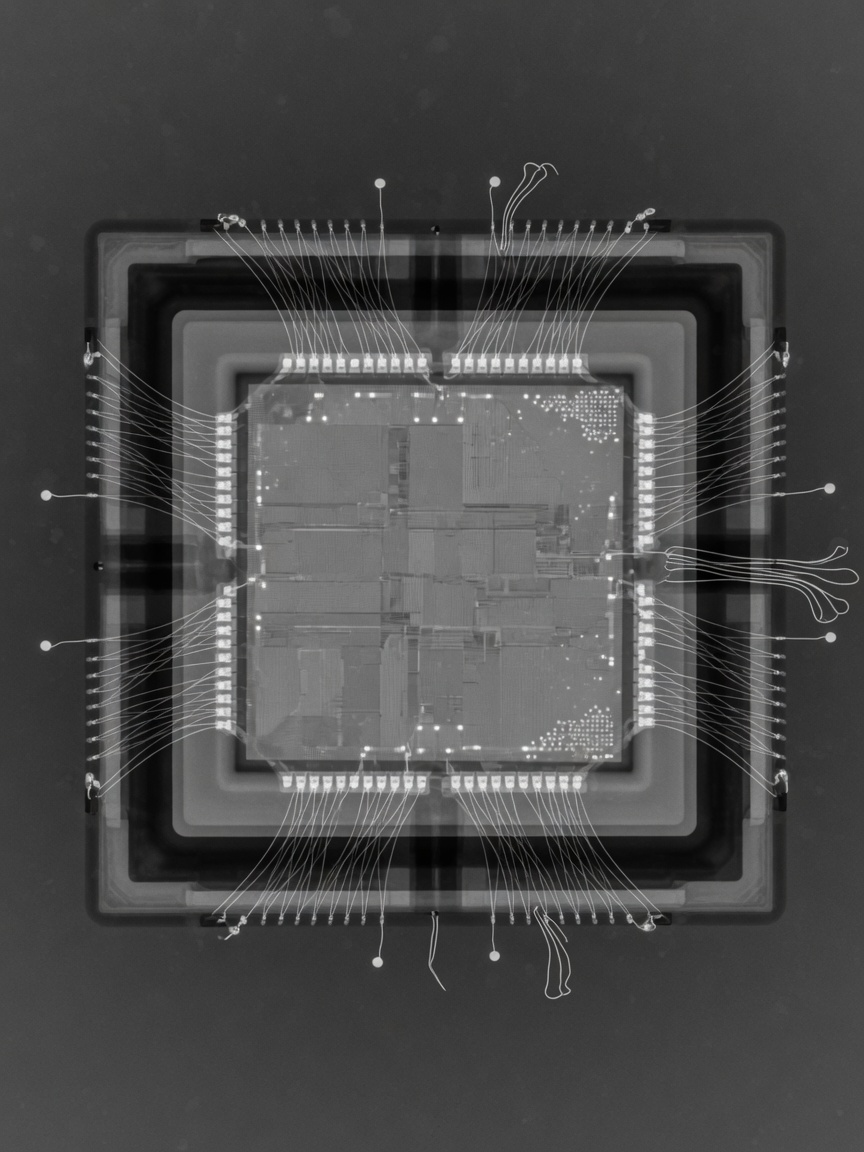
How to catch a counterfeit chip
Against a convincing exterior, detection has to cross-check in layers—no single method is enough.
- Visual layer: inspect the silkscreen font, the crispness of the laser marking, and the signs of sanding and re-marking on the package surface. Refurbished parts often bear tells left by secondary processing.
- Structural layer: use X-ray to see through to the internal bond wires and die outline and compare against the genuine internal structure; or decapsulate (decap) to examine the die and manufacturer’s mark directly, to see whether the silicon really is what it claims to be.
- Electrical layer: measure the key parameters, build an ‘electrical fingerprint’ and compare against the genuine part to find performance drift and anomalies—the aging of recycled stock and the parameter wander of a lower grade both give themselves away here.
Standards aimed at open-market procurement, such as SAE AS6081, systematically codify these detection and judgment methods[3]. But note: testing is ‘remediation after the fact’—costly, and even the most rigorous sampling can let something slip through. The truly clever line of defense sits further upstream.
The real answer: work the process and the source
The mature international standards for guarding against counterfeit components share a single spirit: rather than test after the fact, block it at the source.
SAE AS5553 establishes management requirements for the ‘avoidance, detection, mitigation and disposition’ of counterfeit electronic parts, born of the aerospace and high-reliability industries’ need for supply-chain integrity[1]. It governs not just ‘how to test’ but a whole process of ‘how to buy, how to trace, and how to handle a problem once found.’
IEC 62668-1 is the counterfeit-prevention process standard for avionics, focused on avoiding the use of counterfeit, fraudulent and recycled electronic components[2]. It, too, puts its weight on process management and supply-chain control.
Though these standards come from the extreme rigor of aerospace and avionics, the principle they reveal applies just as well to decorative lighting: counterfeiting is a supply-chain management problem, not merely a quality-control testing problem. You cannot verify every chip through end-of-line sampling; what you can rely on is choosing the right source from the outset.
The authorized channel: the cheapest line of defense
Following that logic, the most effective anti-counterfeit measure is also the plainest: buy direct from the maker or through authorized distribution.
Counterfeit components most easily enter through the open market of unknown origin (gray channels). Buying direct from the manufacturer and through authorized distribution gives you a traceable supply chain—where the goods came from and whose hands they passed through is all on record. The reason this ‘authorized channel’ is the most effective, lowest-cost line of defense is that it cuts off the chance of counterfeits slipping in at the source, far more reliable than patching things up afterward with X-ray and decap.
For a brand’s risk management, the advice is direct:
- Give priority to direct-from-maker or authorized distribution, and treat traceability as a hard procurement metric
- Stay wary of low-priced parts of unknown origin—a price that is abnormally cheap usually has a reason
- Keep batch traceability for critical components, so that if a problem appears you can pin down its scope fast
Spend a little more on the proper channel, and what you save is the failure risk of an entire batch—and your brand’s reputation.
PowerMOS: the integrity guarantee of buying direct
Supply-chain integrity is the invisible foundation of decorative lighting quality—unremarkable, yet it decides whether an entire batch succeeds or fails.
PowerMOS is the maker of the pixel-control IC, providing a traceable component source through its own design and supply system, fundamentally avoiding the ‘same shell, different silicon’ risk. The chip itself uses a proprietary carrier protocol and a two-layer addressing architecture (laser metal fuse plus in-line silicon-fuse rewrite), a technical barrier that is hard to counterfeit; paired with direct-from-maker authorized channels, every part a brand receives is the genuine article. See the full model range at the product center.
Further reading: for verifying chip reliability, see EMC, ESD and Surge Reliability in LED Lighting; for the full picture of the decorative lighting market, see A Guide to the Decorative Lighting Market.
References and standards
- SAE AS5553, Counterfeit Electronic Parts; Avoidance, Detection, Mitigation, and Disposition. SAE International.
- IEC 62668-1, Process management for avionics — Counterfeit prevention — Part 1: Avoiding the use of counterfeit, fraudulent and recycled electronic components. International Electrotechnical Commission (IEC).
- SAE AS6081, Fraudulent/Counterfeit Electronic Parts: Avoidance, Detection, Mitigation, and Disposition — Distributors. SAE International.
This article is an educational piece on supply-chain risk. The names of the cited standards can be verified in the official catalogs of SAE International and the IEC. PowerMOS pixel-control ICs use a proprietary carrier protocol optimized for LED pixel control.
FAQ
What does 'same shell, different silicon' mean, and why is decorative lighting a hotspot?
'Same shell, different silicon' describes a component whose exterior—package, silkscreen, pinout—is almost identical to the genuine part, but whose internal die is of unknown origin or does not meet spec. It may be recycled and refurbished, sanded down and re-marked, a lower-grade part passed off as genuine, or even an entirely different low-end chip. Decorative lighting becomes a hotspot for three reasons: high volumes, heavy cost pressure, and end customers who cannot verify a chip's authenticity—which leaves the door open for counterfeits. The problem usually surfaces only after the lights are installed in quantity, as an abnormal failure rate.
How can counterfeit chips be detected and identified?
Detection works in layers. At the visual level, you examine silkscreen fonts, laser marking, and signs of package sanding and re-marking. At the structural level, X-ray reveals the internal bond wires and die outline, or decapsulation (decap) exposes the die and manufacturer's mark directly. At the electrical level, you measure parameters, build an 'electrical fingerprint' and compare against the genuine part to find performance drift. Standards such as SAE AS6081 codify detection and judgment methods aimed at open-market procurement. Only cross-checking across several layers makes identification reliable.
What are SAE AS5553 and IEC 62668-1?
Both are process standards for guarding against counterfeit electronic parts. SAE AS5553 establishes management requirements for the 'avoidance, detection, mitigation and disposition' of counterfeit electronic parts, born of the aerospace and high-reliability industries' need for supply-chain integrity. IEC 62668-1 is the counterfeit-prevention process standard for avionics, focused on avoiding the use of counterfeit, fraudulent and recycled electronic components. Their shared spirit is this: rather than test after the fact, keep counterfeits out through sourcing and process management from the start.
Why do direct-from-maker supply and authorized distribution matter?
Counterfeit components most easily enter through the open market (gray channels) of unknown origin. Buying direct from the manufacturer and through authorized distribution gives you a traceable supply chain—where the goods came from and whose hands they passed through is all on record. This 'authorized channel' is the most effective and lowest-cost line of defense, because it cuts off the chance of counterfeits slipping in at the source—far more reliable than trying to catch them afterward with testing. Spending a little more on the proper channel saves you the failure risk of an entire batch.
How does PowerMOS ensure the integrity of its supply?
PowerMOS is the maker of the pixel-control IC, providing a traceable component source through its own design and supply system to avoid the 'same shell, different silicon' risk. The chip itself uses a proprietary carrier protocol and a two-layer addressing architecture (laser metal fuse plus silicon fuse), a technical barrier that is hard to counterfeit; paired with direct-from-maker authorized channels, every part a brand receives is the genuine article. Supply-chain integrity is the invisible foundation of decorative lighting quality. See the product center for the full model range.
Upgrading your string lights to full pixel control?
Power MOS Electronics delivers the complete stack — driver ICs, addressing equipment, controllers and apps. Tell us about your product and our engineering team will spec it with you.
Contact PowerMOS Browse products