A corded light string relies on insulation and surge protection for safety; but for a copper-wire light or wearable light with no power cord, all the energy comes from a single battery, and the center of gravity of safety shifts entirely. Will the battery overheat, swell or even catch fire? Will it clear customs by air or sea? Will the runtime hold up? Behind these questions sits a whole set of battery-safety standards and low-voltage power-saving circuit design. This article discusses the safety engineering of battery-powered decorative lights.
- No power cord, so the risk concentrates on the battery
- IEC 62133-2: the safety threshold for rechargeable lithium batteries
- UN 38.3: whether a lithium battery can fly or sail
- Runtime is part of safety too: low-voltage power-saving design
- The PowerMOS low-voltage version: born for battery applications
- References and standards
- FAQ
A corded light string relies on insulation and surge protection for safety; but for a copper-wire light or wearable light with no power cord, all the energy comes from a single battery, and the center of gravity of safety shifts entirely.
Will the battery overheat, swell or even catch fire? Will it clear customs by air or sea? Will the runtime hold up? Behind these questions sits a whole set of battery-safety standards and low-voltage power-saving circuit design. This article discusses the safety engineering of battery-powered decorative lights—from the safety of the battery itself, to the drive design that lets a battery ‘last longer and stay safer.‘
No power cord, so the risk concentrates on the battery
A wall-plugged string draws energy from steady mains power, and its designer has to guard against high voltage, leakage and surge. But a battery-powered copper-wire or wearable light compresses all its energy density into one small cell—and the risk concentrates there too.
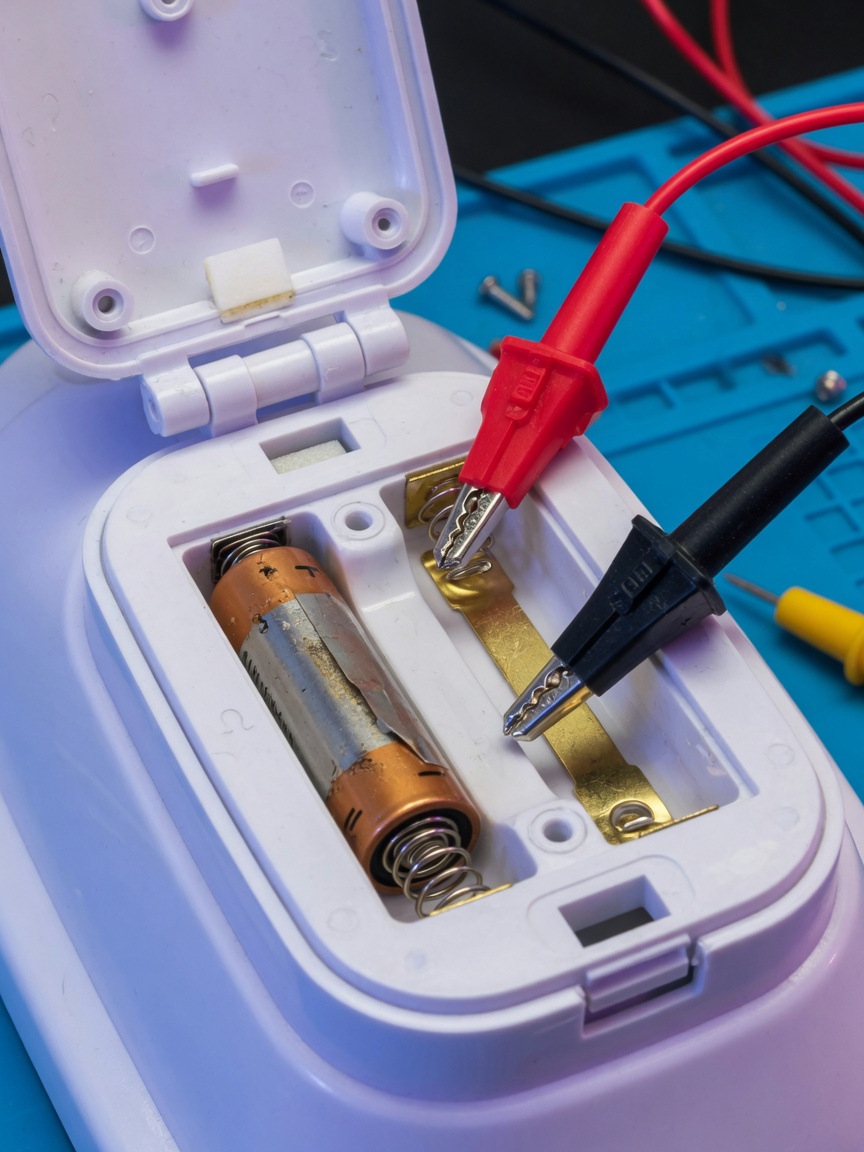
Decorative lights commonly use two kinds of battery scheme. One is the alkaline battery box (say 3 AA cells or button cells), cheap and easy to source, whose main risk is corrosive leakage after over-discharge. The other is the rechargeable lithium battery (lithium-ion or lithium-polymer), with high energy density and repeated recharging, but which—if subjected to overcharge, external short circuit, crushing or high temperature—can enter thermal runaway: a violent internal chain reaction of heat release, leading to swelling, leakage or even fire.
A wearable light presses this risk right up against the person: the light is worn directly on the head or the body, and the battery’s safety level cannot be discounted. So the first step in the safety of a battery-powered decorative light is to choose a safety-certified battery and add the necessary protection circuit.
IEC 62133-2: the safety threshold for rechargeable lithium batteries
To judge whether a lithium cell is ‘safe enough,’ the industry has a clear standard basis. IEC 62133-2 is the safety standard for portable sealed secondary (rechargeable) lithium-system batteries[1].
The positioning of this standard is worth spelling out. Its full scope is the safety requirements for ‘secondary cells and batteries containing alkaline or other non-acid electrolytes,’ and the 2017 version split it into two parts: Part 1 for nickel systems and Part 2 for lithium systems. So for rechargeable lithium batteries, the one that applies is IEC 62133-2[1]. It requires cells to be safe under both normal use and reasonably foreseeable misuse, covering a series of tests:
- Electrical: external short circuit, overcharge, forced discharge
- Mechanical: vibration, shock, crush
- Environmental: temperature cycling, high-temperature storage
Passing these tests means the battery, when dropped, crushed, short-circuited or overcharged—the situations that really happen in the world—will not escalate into fire or explosion. For a decorative-light brand and its procurement, requiring the battery supplier to provide an IEC 62133-2 test report is the most direct checkpoint for controlling battery safety.
UN 38.3: whether a lithium battery can fly or sail
Battery safety concerns not only use but transport. Lithium batteries are classified as Class 9 dangerous goods in transport because of the potential fire risk—which is also why you hear the announcement that ‘power banks cannot be checked’ on a plane.
To ship a product containing lithium batteries legally, it must pass UN 38.3. It is a series of tests specified in Part III, sub-section 38.3 of the UN Manual of Tests and Criteria[2], simulating the harsh conditions a battery encounters during transport—eight in all (commonly labeled T1 to T8):
- T1 altitude simulation, T2 thermal test, T3 vibration, T4 shock
- T5 external short circuit, T6 impact/crush, T7 overcharge, T8 forced discharge
The basic pass criteria are strict: after testing the battery must show no fire, no rupture, no leakage, no venting, no disassembly and no significant mass loss. Only by passing all of them can a product be shipped legally by air, sea, rail or road[2]. For a decorative-light maker in the export business, this is an unavoidable gate—without a UN 38.3 test summary, the goods cannot enter international logistics.
Runtime is part of safety too: low-voltage power-saving design
Beyond ‘safety,’ a battery-powered light has a practical issue: runtime. And on the circuit-design level these two are actually linked.
The key lies in the battery’s discharge curve. A battery’s output voltage falls as its charge drops—a fully charged 3.0V cell may have only 2.5V or 2.3V left in the latter half. If the IC driving the LEDs needs a relatively high operating voltage, then the battery may still hold plenty of charge while the voltage is already insufficient to drive it, and the light will dim, flicker or go out prematurely. That charge is wasted.
Worse, without proper low-charge management, the circuit may keep drawing power and push the battery into deep discharge—one of the main causes of alkaline leakage and lithium-cell damage.
The answer is a design for low-voltage detection and operation. If the driver IC can still detect signals reliably and maintain pixel control at very low voltage (say 2.5V), it can:
- Squeeze out more usable charge, extending the lit time
- Avoid over-discharging the battery, protecting it and lowering the risk of leakage and damage
- Keep the light stable and flicker-free in the latter half of the charge, rather than fluctuating
In other words, a driver IC optimized for low-voltage applications improves both runtime and safety at once.
The PowerMOS low-voltage version: born for battery applications
Portable decorative lights like copper-wire and wearable lights are exactly where low-voltage power-saving design shows its worth. Besides the version for high-voltage AC110/220V applications, PowerMOS pixel-control ICs also have a low-voltage version optimized for battery applications—for example, a battery-application copper-wire-light IC model that maintains stable two-wire pixel control and addressing at lower battery voltages, extending the battery’s usable range and suiting battery-box-powered copper-wire and wearable lights.
Paired with a constant-current architecture, LED brightness stays stable and flicker-free even as the battery voltage changes through discharge, without fluctuating as the charge drops. Add the two-power-line carrier pixel-control architecture, and even a portable light can produce per-LED addressable full-color effects. See the full model range and parameters at the product center.
Further reading: for the application design of copper-wire and wearable lights, see Copper-Wire and Wearable Decorative Lighting; for the overall framework of product safety certification, see Safety Certification for LED Decorative Lighting.
References and standards
- IEC 62133-2:2017, Secondary cells and batteries containing alkaline or other non-acid electrolytes — Safety requirements for portable sealed secondary lithium cells, and for batteries made from them, for use in portable applications — Part 2: Lithium systems. International Electrotechnical Commission (IEC).
- United Nations, Manual of Tests and Criteria, Part III, sub-section 38.3: Lithium metal and lithium ion batteries. United Nations (UN).
This article is an educational piece on battery safety. The names of the cited standards can be verified in the official catalogs of the IEC and the United Nations (UNECE). PowerMOS pixel-control ICs use a proprietary carrier protocol optimized for LED pixel control.
FAQ
What are the main safety risks of a battery-powered decorative light?
The core risk concentrates on the battery itself. A lithium cell subjected to overcharge, external short circuit, crushing or high temperature can enter thermal runaway, leading to swelling, leakage or even fire; an alkaline cell has to be protected against corrosive leakage after over-discharge. So the safety of a battery-powered decorative light comes down to choosing a safety-certified battery, adding a protection circuit, and letting the drive circuit still operate safely at low voltage to avoid deep discharge.
What does IEC 62133-2 cover?
IEC 62133-2:2017 is the safety standard for portable sealed secondary (rechargeable) lithium-system batteries. It is Part 2 (lithium systems) of the series on 'secondary cells and batteries containing alkaline or other non-acid electrolytes,' with nickel systems in Part 1. It sets electrical, mechanical and environmental tests for cells under normal use and reasonably foreseeable misuse—external short circuit, crush, vibration, shock and temperature cycling—and is an important threshold for rechargeable lithium batteries entering the global market.
Why must products containing lithium batteries undergo UN 38.3 testing before shipping?
Lithium batteries are classified as Class 9 dangerous goods in transport because of the potential fire risk. UN 38.3 is a series of tests specified in Part III, sub-section 38.3 of the UN Manual of Tests and Criteria—eight in all (T1 to T8): altitude simulation, thermal test, vibration, shock, external short circuit, impact/crush, overcharge and forced discharge. A battery must pass all of them (no fire, no rupture, no leakage, etc.) to be shipped legally by air, sea, rail or road.
How does low-voltage detection design help a battery-powered light?
A battery's output voltage falls as its charge drops. If the driver IC needs a relatively high operating voltage, the light will dim or flicker prematurely while the battery still has charge but insufficient voltage—runtime is wasted; worse, it may push the battery into deep discharge. An IC that can still detect and operate reliably at very low voltage can squeeze out more usable charge and extend the lit time, while avoiding over-discharge—balancing runtime and safety.
How does the PowerMOS solution address low-voltage battery applications?
Besides high-voltage AC versions, PowerMOS pixel-control ICs also have low-voltage versions optimized for battery applications—for example, battery-application copper-wire-light IC models that maintain stable pixel control and addressing at lower battery voltages, extending the battery's usable range and suiting portable decorative applications such as copper-wire and wearable lights. Paired with a constant-current architecture for stable, flicker-free brightness. See the product center for the full model range and parameters.
Upgrading your string lights to full pixel control?
Power MOS Electronics delivers the complete stack — driver ICs, addressing equipment, controllers and apps. Tell us about your product and our engineering team will spec it with you.
Contact PowerMOS Browse products