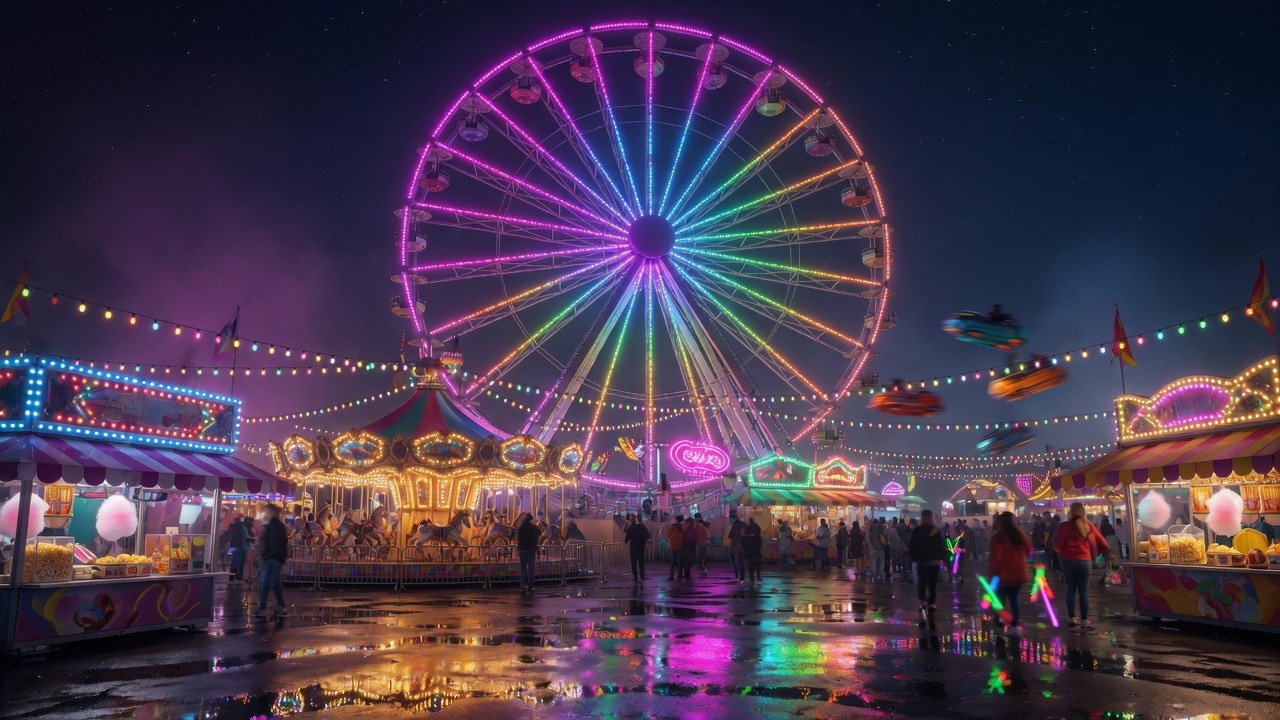
After dark, an amusement park becomes another world — color flows around the outline of the Ferris wheel, spinning rides trail ribbons of light through the night, and the whole park feels like a carnival that never ends. These glowing, dancing rides rely on addressable LEDs traced along their outlines. They turn cold steel machinery into light sculptures that breathe and dance at night. This article is about amusement park lighting engineering.
After dark, an amusement park becomes another world — color flows around the outline of the Ferris wheel, spinning rides trail ribbons of light through the night, and the whole park feels like a carnival that never ends.
These glowing, dancing rides rely on addressable LEDs traced along their outlines. They turn cold steel machinery into light sculptures that breathe and dance at night. This article is about amusement park lighting engineering — the union of motion, synchronization, and outdoor reliability.
Outline pixelation: turning steel into light sculpture
Amusement park rides have a natural advantage — strong geometric outlines. The circle of a Ferris wheel, the arms of a thrill ride, the track of a roller coaster are all natural “canvas edges.”
By placing addressable LEDs along the outline, with every bead individually controllable, you can make the outline flow, change color, trail, and sync with the rotation. This turns a static steel structure into a dynamic light sculpture. It is the core of a nighttime park’s appeal and recognizability — you can spot that glowing Ferris wheel from far away, and it is itself the park’s landmark and signboard.
Syncing with motion and music: making light an extension of movement
The most captivating thing about amusement park lighting is its synchronization with the ride’s motion.
A ride’s lighting can sync with its motion rhythm and background music — the light trails speed up as the ride accelerates, and the whole ride bursts at the music’s climax. Per-bead control and real-time signal driving make the light an extension of the ride’s motion rather than an added decoration. Going further, multiple rides can be coordinated into a park-wide light show through unified control, performing together at set times (the top of the hour, before closing) — turning the entire park into one synchronized world of light.
Outdoors and in motion: demanding reliability
The reliability demands of amusement park lighting are harsher than most applications, because it faces three challenges at once:
- Outdoor environment — sun and rain, with waterproofing chosen by IP rating per the environment (IEC 60529[1]).
- Motion and vibration — some lights move or vibrate at high speed with the ride, so connections must be vibration-resistant.
- Long run times — long daily operation, where repairs require downtime that hits revenue.
For outdoor surges, refer to the IEC 61000 series[2], and the architecture uses address-code fault tolerance so a single failure does not spread. A ride’s reliability is not only about presentation, but also about operating efficiency and safety.
Park-level management: coordinating many rides
A large park has many rides and decorations that need unified coordination. Through networked lighting control standards such as sACN and multi-channel sub-control[3], each ride can be brought into a single control system — able to run on its own or perform park-wide in sync.
The PowerMOS carrier-conversion controller connects to the standard signal ecosystem, making park-level lighting management possible. This shares the same thread as the scaled management discussed in Theme Parks and Immersive Spaces, only the stage is an entire open-air park.
Selecting parts for your park
PowerMOS offers addressable beads, carrier-conversion controllers, and multi-channel sub-control. The two-wire cabling suits ride outlines and shaped installations, and outdoor part numbers handle harsh environments — a fit for Ferris wheels, thrill rides, park decorations, and carnival lighting. See the full solution at the Product Center. Theme park, carnival, and ride teams are welcome to bring their rides and park scale to PowerMOS.
References and standards
- IEC 60529, Degrees of protection provided by enclosures (IP Code). International Electrotechnical Commission.
- IEC 61000-4-5, Electromagnetic compatibility (EMC) — Surge immunity test. IEC.
- ANSI E1.31-2018 (sACN), Lightweight streaming protocol for transport of DMX512 using ACN. ESTA.
This article is an educational overview of an application scene. The names of the cited standards can be verified in the IEC and ESTA official catalogs. PowerMOS pixel-control chips use a proprietary carrier protocol optimized for LED pixel control.
FAQ
Why are amusement park rides well suited to addressable LED outline lighting?
Ferris wheels and thrill rides have strong geometric outlines. By placing addressable LEDs along the outline, with every bead individually controllable, you can make the outline flow, change color, trail, and sync with the ride's rotation. This turns a static steel structure into a dynamic light sculpture — the core of a nighttime park's appeal and recognizability. You can spot that glowing Ferris wheel from far away.
How does ride lighting sync with the motion and the music?
A ride's lighting can sync with its motion rhythm and background music — the light trails speed up as the ride accelerates, the whole ride bursts at the music's climax. Per-bead control and real-time signal driving make the light an extension of the ride's motion. Multiple rides can also be coordinated into a park-wide light show through unified control, performing together at set times such as the top of the hour or before closing.
What does the outdoor environment demand of amusement park lighting reliability?
Park rides are outdoors, run long hours, and some move or vibrate at high speed with the ride. Choose an IP rating (IEC 60529) for waterproofing per the environment; vibration environments need vibration-resistant connections; for outdoor surges refer to the IEC 61000 series; and the architecture uses address-code fault tolerance so a single failure does not spread. Rides operate long hours daily and repairs require downtime, so reliability directly affects operations and safety.
How is lighting managed uniformly across a large park with many rides?
A large park has many rides and decorations that need unified coordination. Through networked lighting control standards such as sACN and multi-channel sub-control, each ride can be brought into a single control system — able to run on its own or perform park-wide in sync. The PowerMOS carrier-conversion controller connects to the standard signal ecosystem, making park-level lighting management possible.
How can a theme park or ride team obtain a solution?
PowerMOS offers addressable beads, carrier-conversion controllers, and multi-channel sub-control. The two-wire cabling suits ride outlines and shaped installations, and outdoor part numbers handle harsh environments. It fits Ferris wheels, thrill rides, park decorations, and carnival lighting. Theme park, carnival, and ride teams are welcome to discuss their rides and park scale with us.
Upgrading your string lights to full pixel control?
Power MOS Electronics delivers the complete stack — driver ICs, addressing equipment, controllers and apps. Tell us about your product and our engineering team will spec it with you.
Contact PowerMOS Browse products