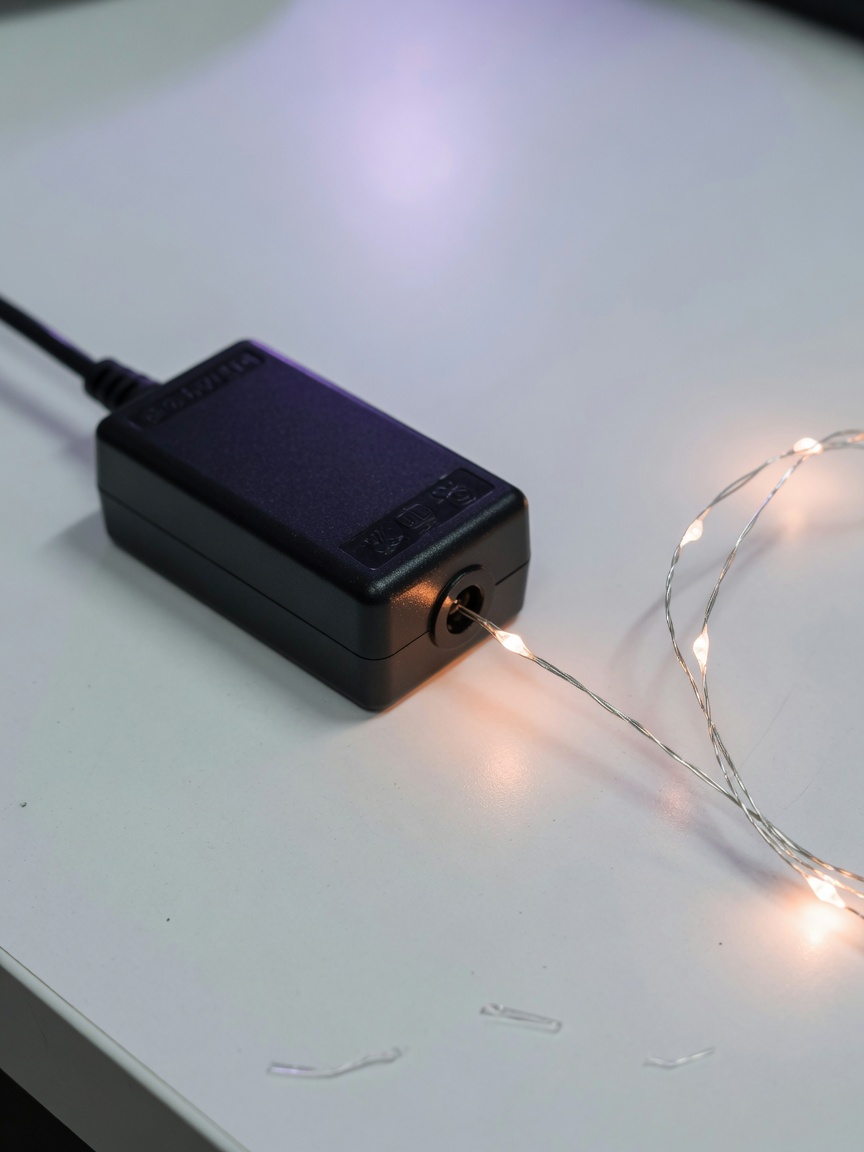
Open up a set of Christmas lights and you'll usually find a black transformer behind the plug, stepping your home's 110V or 220V down to a low voltage before it reaches the string. This isn't about saving energy — it's about safety, so that touching a light won't give you a shock. Behind this 'extra-low-voltage' route lies a whole system of shock-protection classes and standards. This article covers SELV, the protection classes, and a different approach taken by high-voltage designs.
- Why step down: making the voltage itself safe
- SELV: not just low voltage, but safe isolation
- Protection classes: Class 0 to Class III
- The safety isolating transformer: the physical basis of SELV
- Another road: the insulation strategy of high-voltage AC designs
- The PowerMOS approach: covering both architectures
- Reference Standards and Literature
- FAQ
Open up a set of Christmas lights and you’ll usually find a black transformer behind the plug, stepping your home’s 110V or 220V down to a low voltage before it reaches the string.
This isn’t about saving energy — it’s about safety, so that touching a bulb or an exposed contact won’t give you a shock. Behind this “extra-low-voltage” route lies a whole system of shock-protection classes and standards. This article looks at what SELV is, how the protection classes are divided, and the different road taken by PowerMOS’s high-voltage AC designs.
Why step down: making the voltage itself safe
How badly a shock harms you depends on the current passing through the body, and that current is tied to voltage. There are two basic approaches to shock protection: one is to isolate the hazardous voltage (through insulation and grounding); the other is to keep the voltage low enough for the body to tolerate. Christmas light strings overwhelmingly take the latter.
Under IEC 61140 (the common classification standard for protection against electric shock), extra-low voltage (ELV) is capped at no more than 50V AC (RMS) or 120V DC (ripple-free)[1]. Within this range, the current under normal conditions isn’t enough to be dangerous. That’s the fundamental reason consumer light strings favor low voltage — building safety into the voltage itself, rather than relying entirely on users never touching anything.
SELV: not just low voltage, but safe isolation
But “low voltage” alone isn’t enough. If a low-voltage circuit is secretly connected to the mains, a fault could let hazardous voltage break through. So genuine safety requires SELV (Safety Extra-Low Voltage).
In IEC 61140, SELV is defined as a secondary circuit designed and protected so that its voltage never exceeds safe limits under normal or single-fault conditions[1]. The key phrase is “safe separation”: a SELV circuit must be electrically separated from hazardous voltage, so that even under a single fault the low-voltage side won’t suddenly rise to the mains’ dangerous potential. Low voltage, plus isolation — that’s what makes true SELV.
Protection classes: Class 0 to Class III
IEC 61140 divides equipment into several classes by method of shock protection, and understanding them helps make sense of where a light string sits on safety[1]:
- Class 0: relies on basic insulation only, with no additional protection (now phased out in most markets)
- Class I: basic insulation + grounding, with fault current carried away via the earth connection
- Class II: double or reinforced insulation, without relying on grounding
- Class III: powered by SELV, where the voltage is already low enough to be safe and needs no further insulation or grounding for shock protection
Most transformer-powered low-voltage light strings are Class III. Its logic is the most intuitive: since the voltage entering the string is already within the safe range, there’s no need to stack complex insulation or grounding at the string end.
The safety isolating transformer: the physical basis of SELV
The transformer that makes Class III possible isn’t an ordinary one — it’s a safety isolating transformer, designed to the requirements of IEC 61558-2-6[2].
It does two things: steps down the voltage, and provides electrical isolation through reinforced insulation between the primary and secondary windings. That isolation ensures the secondary’s low-voltage circuit is “electrically separated” from the mains’ hazardous voltage — so even if someone touches the secondary, there’s no path back through the transformer to the mains to form a shock. This is the physical basis of SELV: not “low voltage” alone, but a transformer that keeps the hazard outside the door.
The string itself, as a lighting chain, is governed by dedicated standards such as IEC 60598-2-20 for its construction and safety requirements, which apply to indoor and outdoor lighting chains with a supply voltage not exceeding 250V[3].
Another road: the insulation strategy of high-voltage AC designs
PowerMOS’s high-voltage AC110/220V designs take a different road — rather than stepping down, they protect through thorough insulation design, surge protection, and packaging isolation in engineered settings, an approach closer to the double/reinforced insulation of Class II, keeping the hazardous voltage safely out of users’ reach.
An honest distinction is in order: neither route replaces the other — they suit different scenarios. The extra-low-voltage route is about “the voltage itself is safe,” well suited to household strings within easy reach of ordinary consumers. The high-voltage direct-drive approach is about “insulation keeps the hazard away,” suited to professional installations beyond ordinary consumer reach — it does away with the high-power transformer and offers wiring and efficiency advantages across long distances and large-scale deployments.
The PowerMOS approach: covering both architectures
PowerMOS addressable-control ICs support both architectures: they work in extra-low-voltage strings downstream of a transformer, fitting the Class III / SELV consumer scenario; and they offer a high-voltage AC110/220V direct-drive option with surge protection and a single-fault-contained design that suits the insulation strategy of professional engineering settings. The right choice depends on the safety positioning of the application — consumer products go low-voltage, while large engineered installations can evaluate high-voltage direct drive. See the product center for the full lineup.
Further reading: for the safety-certification landscape, see Safety Certification for LED Light Strings: From CE and UL to Each Market’s Entry Ticket; for surge and reliability, see EMC, ESD, and Surge Reliability Engineering for LED Light Strings.
Reference Standards and Literature
- IEC 61140, Protection against electric shock — Common aspects for installation and equipment. International Electrotechnical Commission (IEC).
- IEC 61558-2-6, Safety of transformers, reactors, power supply units and combinations thereof — Part 2-6: Particular requirements and tests for safety isolating transformers and power supply units incorporating safety isolating transformers. International Electrotechnical Commission (IEC).
- IEC 60598-2-20, Luminaires — Part 2-20: Particular requirements — Lighting chains. International Electrotechnical Commission (IEC).
This article is an educational overview of electrical safety. The names of the standards cited can be verified in the official IEC catalog. PowerMOS addressable-control ICs use a proprietary carrier protocol optimized for LED pixel control.
FAQ
What is extra-low-voltage SELV?
SELV (Safety Extra-Low Voltage) refers to a circuit that is safely isolated and whose voltage is limited to a range the human body can tolerate. Under IEC 61140, extra-low voltage (ELV) is capped at no more than 50V AC (RMS) or 120V DC (ripple-free). SELV goes further and requires safe separation between the circuit and any hazardous voltage, so the voltage stays within safe limits under both normal and single-fault conditions — meaning contact won't cause a shock.
How are the protection classes of IEC 61140 divided?
IEC 61140 is the common classification standard for protection against electric shock, grading equipment by method of protection: Class 0 relies on basic insulation only (now largely phased out); Class I relies on basic insulation plus grounding; Class II relies on double or reinforced insulation without depending on grounding; Class III relies on a SELV supply, whose voltage is already low enough to be safe and needs neither insulation nor grounding for shock protection. Most low-voltage light strings are Class III.
What role does the safety isolating transformer play?
The safety isolating transformer (per IEC 61558-2-6) is the key to the extra-low-voltage route. As it steps mains down, it also provides electrical isolation through reinforced insulation between the primary and secondary windings, ensuring the low-voltage secondary circuit is 'electrically separated' from the mains' hazardous voltage. This way, even if someone touches the secondary circuit, there's no path back through the transformer to the mains to form a shock — the physical basis on which SELV rests.
So how do PowerMOS's high-voltage AC designs ensure safety?
PowerMOS's high-voltage AC110/220V designs take a different road — rather than stepping down, they protect through thorough insulation design, surge protection, and packaging isolation in engineered settings, an approach closer to the double/reinforced insulation of Class II. Such designs are typically used in professional installations, in places beyond the reach of ordinary consumers. Each route has its place: extra-low voltage is about 'the voltage itself being safe,' while high-voltage designs are about 'insulation keeping the hazard apart.'
Which safety route do PowerMOS's solutions correspond to?
PowerMOS addressable-control ICs support both architectures: they can be used in extra-low-voltage strings downstream of a transformer, and they also offer a high-voltage AC110/220V direct-drive option. The high-voltage option pairs surge protection with a single-fault-contained design, suiting the insulation strategy of professional engineering settings; low-voltage applications fit the Class III / SELV consumer strings. The actual choice depends on the safety positioning of the application — see the product center for the full lineup.
Upgrading your string lights to full pixel control?
Power MOS Electronics delivers the complete stack — driver ICs, addressing equipment, controllers and apps. Tell us about your product and our engineering team will spec it with you.
Contact PowerMOS Browse products