Modern retail is no longer just a place to buy things — it's a place for experience. A mall's atrium ceiling, a brand store's facade, a window's dynamic display — light is the key medium that turns a shopper's journey into an experience. Addressable LEDs let commercial spaces change their look in real time with the season, the hour, and the event, turning 'coming to shop' into 'coming for the experience.' This article covers the lighting engineering of retail spaces and its commercial value.
Modern retail is no longer just a place to buy things — it’s a place for experience.
A mall’s atrium ceiling, a brand store’s facade, a window’s dynamic display — light is the key medium that turns a shopper’s journey into an experience. Addressable LEDs let commercial spaces change their look in real time with the season, the hour, and the event, turning “coming to shop” into “coming for the experience.” This article covers the lighting engineering of retail spaces and the commercial value behind it.
Turning the journey into an experience: a mall’s dynamic visuals
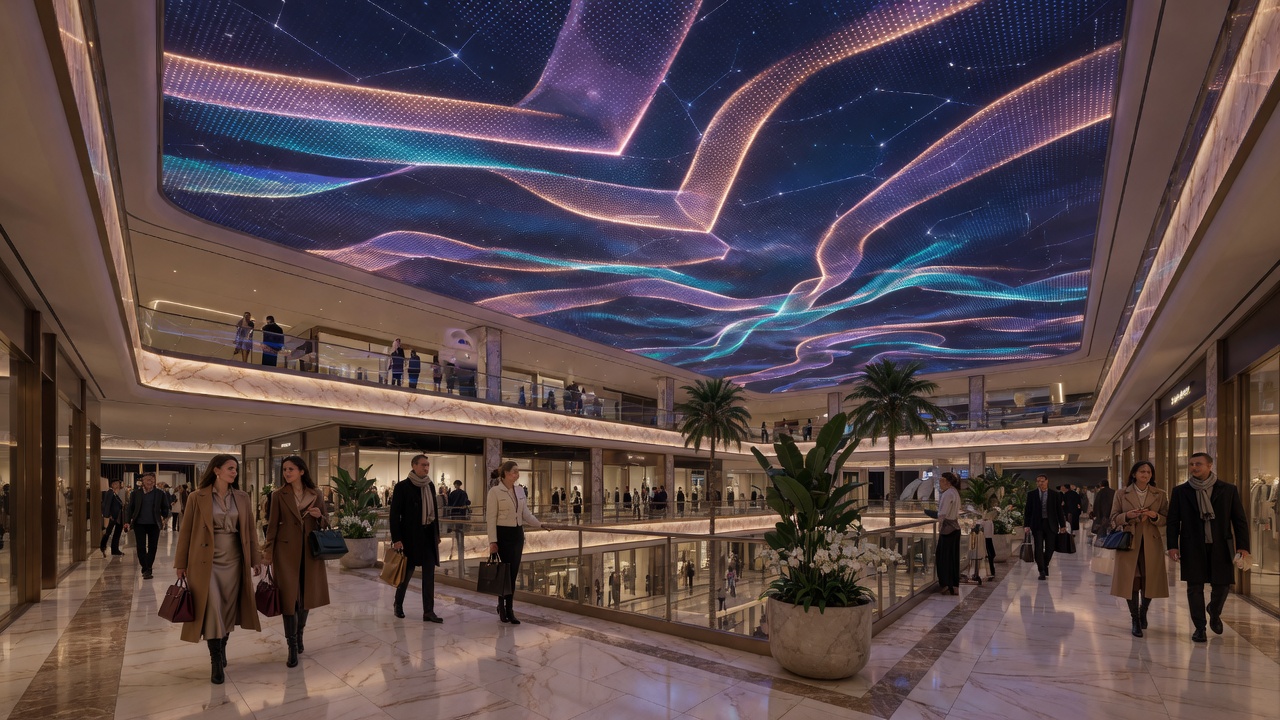
The essence of mall competition is experience and foot traffic. Addressable LEDs let atrium ceilings, columns, and facades play dynamic light that changes with the campaign, the hour, and the event — Christmas, New Year, and anniversary sales each have their theme, and weekdays and weekends carry different moods.
This real-time, changeable dynamic visual brings concrete commercial benefits: attracting foot traffic, extending dwell time, and creating photo-worthy spots and social-media reach. An atrium ceiling that changes with the seasons is itself a differentiating asset for a mall.
Brand spaces: turning the facade into a brand canvas
A flagship store has a more precise need — conveying brand identity.
Addressable LEDs can accurately reproduce brand colors, play brand motion visuals, and quickly swap content with new-product launches and events. Per-pixel control turns facades and windows into a programmable brand canvas; here color accuracy (faithful reproduction of the brand color) is the key quality — see How Full-Color Pixel Control Mixes Good White Light and Grayscale, Color, and Flicker-Free Dimming Engineering for Addressable LEDs. The physical space thus becomes part of the brand’s storytelling.
Build once, change content often
The greatest advantage model for a commercial space is “build once, change content often.”
Commercial spaces update content often (campaigns, events, new products). Through a controller and host software, addressable LEDs can swap lighting programs as quickly as editing digital content, with no hardware changes. This keeps the visual investment producing fresh appeal, amortizing the one-time hardware cost across content value that keeps renewing over the long term — the core economics of adopting addressable lighting in a commercial space.
Reliability: the baseline for business image
Malls operate long hours daily, and a lighting failure directly hurts the business image. With an architecture where each pixel has its own address, a single bead failing won’t cut off the whole string — the fault stays confined to one point, easing repair; paired with reasonable current and thermal design to extend life (see LED Thermal and Heat Management). For prominent installations like a large atrium ceiling, the fault tolerance of “one bead dies, but the section doesn’t go dark” is especially important — no one wants the thing customers remember to be that broken light wall.
Choosing for your commercial space
PowerMOS offers addressable beads, controllers, and carrier-conversion solutions that connect to the standard signal ecosystem and host software, with two-wire runs well suited to large-area installations across atriums, columns, and facades, and a constant-current version that ensures uniform color over large areas. See the product center for the full lineup. Mall operators, brand-space, and retail design teams are welcome to bring their space’s scale and brand requirements to talk with PowerMOS.
Reference Standards and Literature
- ANSI E1.31-2018 (sACN), Lightweight streaming protocol for transport of DMX512 using ACN. ESTA — reference for large-scale content distribution.
- CIE 15, Colorimetry. International Commission on Illumination — the colorimetric basis for brand-color reproduction.
This article is an educational overview of an application scenario. PowerMOS addressable-control ICs use a proprietary carrier protocol optimized for LED pixel control, bridging to the standard signal and host-software ecosystem through a controller.
FAQ
Why should retail malls use addressable LEDs?
Malls compete on experience and foot traffic. Addressable LEDs let atrium ceilings, columns, and facades play dynamic light that changes with the campaign, the hour, and the event — Christmas, New Year, and anniversary sales each have their theme, and weekdays and weekends carry different moods. This real-time, changeable dynamic visual is a way to attract foot traffic, extend dwell time, and create photo-worthy spots — and a way for a mall to differentiate itself.
How can a flagship store use addressable lighting to strengthen its brand?
A brand space needs to convey its brand identity precisely. Addressable LEDs can accurately reproduce brand colors, play brand motion visuals, and quickly swap content with new-product launches and events. Per-pixel control turns facades and windows into a programmable brand canvas; color accuracy (brand-color reproduction) is the key quality here. This makes the physical space part of the brand's storytelling.
Commercial spaces need to change content frequently — how is that done?
Commercial spaces update content often (campaigns, events, new products). Through a controller and host software, addressable LEDs can swap lighting programs as quickly as editing digital content, with no hardware changes. This 'build once, change content often' model keeps a commercial space's visual investment producing fresh appeal over time, amortizing the long-term cost.
What reliability does a long-hours space like a mall demand from its lighting?
Malls operate long hours daily, and a lighting failure hurts the business image. With an architecture where each pixel has its own address, a single bead failing won't cut off the whole string — the fault stays confined to one point, easing repair; paired with reasonable current and thermal design to extend life. For prominent installations like a large atrium ceiling, the fault tolerance of 'one bead dies, but the section doesn't go dark' is especially important.
How can mall operators or brand-space teams get the solution?
PowerMOS offers addressable beads, controllers, and carrier-conversion solutions that connect to the standard signal ecosystem and host software, with two-wire runs well suited to large-area installations across atriums, columns, and facades. The constant-current version ensures uniform color over large areas. Mall operators, brand-space, and retail design teams are welcome to bring their space's scale and brand requirements for a conversation.
Upgrading your string lights to full pixel control?
Power MOS Electronics delivers the complete stack — driver ICs, addressing equipment, controllers and apps. Tell us about your product and our engineering team will spec it with you.
Contact PowerMOS Browse products