In a smart building, the most expensive and troublesome part often isn't the lights themselves but the wiring — one run for power, another for control signals, walls packed full of cable. What if a single network cable, one we already know well, could carry both the power and the data? That's what PoE answers. As its power capability reaches 90W, low-voltage DC lighting has begun to open up new possibilities — though it has boundaries of its own.
In a smart building, the most expensive and troublesome part often isn’t the lights themselves but the wiring.
One run for power, another for control signals, packed densely through walls and ceilings. What if a single network cable, one we already know well, could carry both the power and the data? That’s exactly what PoE sets out to do. As its power capability has grown all the way to 90W, low-voltage DC lighting has begun to open up new possibilities — but it has clear boundaries of its own.
What PoE is: making the network cable carry power too
The core idea of PoE (Power over Ethernet) is simple: since a network cable contains several pairs of copper wires, why not let it carry power while it transmits data? That way, IP cameras, wireless access points, access control, and even LED luminaires can all run on a single network cable, without hunting for an outlet on site.
This is governed by the IEEE 802.3 family of standards, with capability rising version by version:
- IEEE 802.3af-2003 (Type 1): about 15.4W per port at the source, about 12.95W at the powered device[2].
- IEEE 802.3at-2009 (Type 2, PoE+): about 30W at the source[2].
- IEEE 802.3bt-2018 (Type 3/4, PoE++): uses all four pairs, with Type 4 delivering up to about 90W at the source and about 71.3W at the powered device[1].
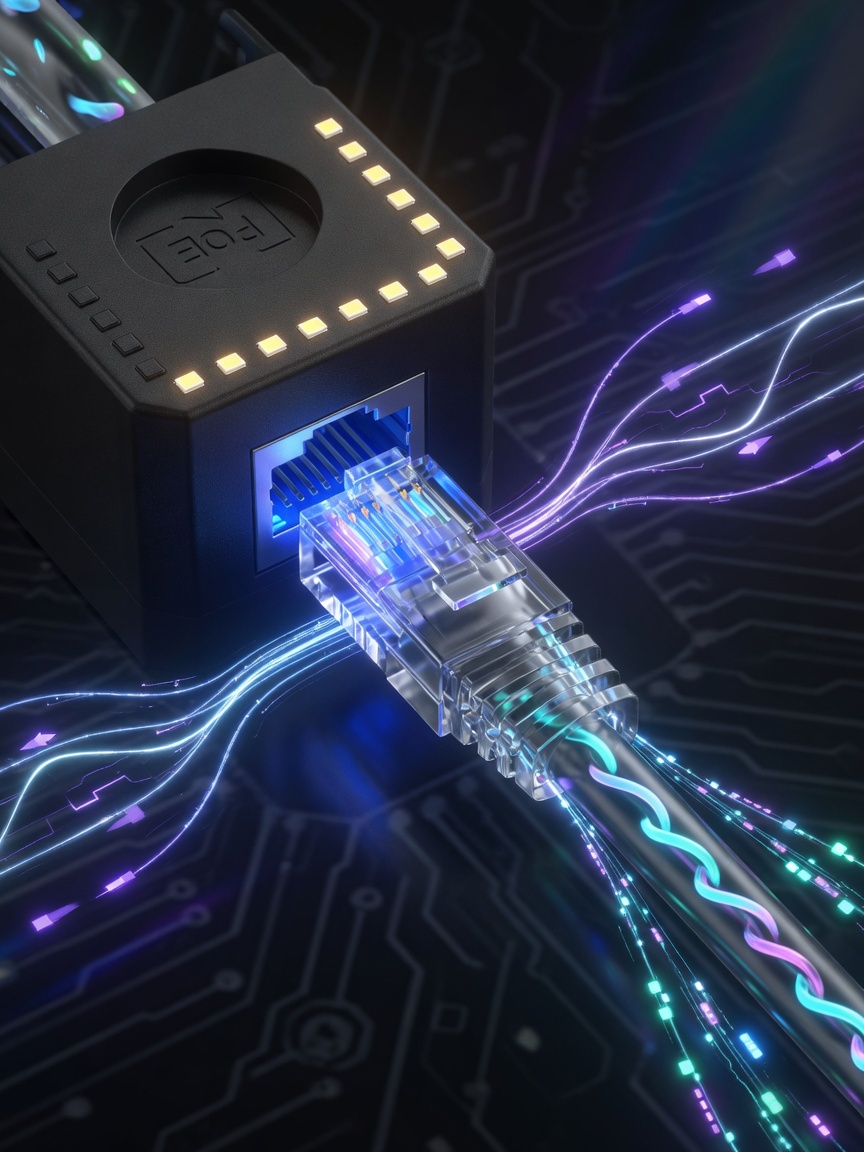
What 90W can — and can’t — do
IEEE 802.3bt-2018 pushed per-port power up to 90W (at the source, the PSE), leaving about 71.3W usable at the powered device (PD) after line losses[1]. For lighting, that’s enough to drive quite a few small-to-medium-power LED luminaires, and it makes “lighting as a network node” possible — every light can be addressed, monitored, and scheduled.
But 90W also draws two boundaries:
- Power ceiling: large-area, high-brightness lighting (such as floodlighting or large facades) easily exceeds a single port’s capacity and still needs conventional mains power.
- Distance limit: Ethernet’s cabling distance is about 100 meters; beyond that you need a repeater or a different architecture.
So PoE lighting’s sweet spot is clear: small-to-medium-power indoor scenarios with controllable cabling distances, such as controllable lighting in offices, corridors, and meeting rooms.
The same spirit: less wiring
Seen in a larger context, PoE actually shares its thinking with two-wire power-line carrier — both answer the same question: can one set of conductors carry power and information at once, doing away with that separate control line?
The difference lies in the “level”:
- PoE operates at the building-infrastructure level, using a network cable to deliver power and data “to a light or a zone.”
- Two-wire power-line carrier operates inside the string, using the power line itself to deliver pixel-control commands “to each individual bead.”
One is a merger at the network-node level, the other at the bead level. They address wiring problems at different depths within a lighting system.
A division of labor, not a replacement
Once you understand the difference in level, it becomes clear that the relationship between PoE and bead-level pixel control is a division of labor, not a replacement.
PoE excels at delivering power and coarse-grained control signals cleanly to a luminaire or zone. But it isn’t responsible for the addressing and pixel control among the hundreds or thousands of beads within a decorative string — that’s bead-level work. If a string needs per-bead color changes and animations, it still needs a pixel-control protocol inside the string to handle each bead’s address and brightness.
The common architecture in practice is: upstream, PoE, low-voltage DC, or mains delivers power and overall control to the luminaire; inside the string, a dedicated pixel-control IC handles per-bead addressing over the power line. Each doing its own job is what makes a complete, maintainable lighting system.
Where PowerMOS sits in the low-voltage DC lighting architecture
PowerMOS addressable-control ICs solve addressing and pixel control at the bead level. Whether the upstream is PoE, low-voltage DC, or high-voltage mains (supporting AC110/220V applications), once power reaches the string, the PowerMOS two-wire power-line carrier solution can perform per-bead addressing and brightness control over the same power line — 3.5–7mA indoors and 7–20mA outdoors, supporting a 512-code address depth and in-line addressing, with a single-fault-contained and bead-replaceable repair design. It complements PoE: PoE delivers power and coarse control to the luminaire, PowerMOS builds pixel control into each individual bead. See the product center for the full lineup.
Further reading: for how two-wire carrier works, see Two-Wire Addressable Lighting: How One Power Line Both Powers and Addresses; for signal integrity, see Core technology.
Reference Standards and Literature
- IEEE Std 802.3bt-2018, IEEE Standard for Ethernet — Amendment 2: Physical Layer and Management Parameters for Power over Ethernet over 4 Pairs. IEEE Standards Association.
- IEEE Std 802.3af-2003 & IEEE Std 802.3at-2009, Data Terminal Equipment (DTE) Power via Media Dependent Interface (MDI). IEEE Standards Association.
This article is an educational overview of lighting power architecture. The names of the standards cited can be verified in the official IEEE Standards Association catalog. PowerMOS addressable-control ICs use a proprietary carrier protocol optimized for LED pixel control, forming a lighting architecture complementary to PoE.
FAQ
What is PoE (Power over Ethernet)?
PoE (Power over Ethernet) is a technology that carries both data and power over a network cable, so devices don't need a separate power outlet. It's defined by the IEEE 802.3 family of standards: the earliest, IEEE 802.3af-2003 (Type 1), delivers about 15.4W per port; IEEE 802.3at-2009 (Type 2, commonly called PoE+) about 30W; and the latest, IEEE 802.3bt-2018 (Type 3/4), reaches up to 90W at the source. Its uses extend from IP cameras and wireless access points to LED lighting.
How many lights can 90W of PoE drive? What are the limits?
IEEE 802.3bt-2018 Type 4 delivers up to about 90W at the source (PSE), leaving about 71.3W at the powered device (PD) after line losses. That's enough to drive quite a few LED luminaires, but there are two main boundaries: first, total power is capped, so large-area, high-brightness lighting exceeds a single port's capacity; second, Ethernet's 100-meter cabling-distance limit. So PoE lighting suits small-to-medium-power indoor scenarios where the cabling distance is under control.
How does PoE lighting relate to 'two-wire power-line carrier'?
Both share the spirit of 'less wiring' — using one set of conductors to carry power and information together, sparing a separate control line. The difference is one of level: PoE uses a network cable to power and transmit data at the luminaire/zone level, as part of the building's network infrastructure; two-wire power-line carrier works inside the string, at the per-bead level, using the power line itself to convey pixel-control commands. The former reaches the luminaire, the latter goes all the way to each individual bead.
Is PoE lighting suited to decorative, per-bead pixel-control scenarios?
Not entirely. PoE excels at delivering power and data 'to a light or a zone,' but it isn't responsible for the addressing and pixel control among the hundreds or thousands of beads within a single string. If decorative lighting needs per-bead color changes and animations, it still needs a pixel-control protocol inside the string to handle bead-level addressing. The common division of labor in practice is: PoE or mains delivers power and coarse-grained control to the luminaire, while bead-level pixel control is handed to a dedicated carrier IC.
What role do PowerMOS's solutions play in the low-voltage DC lighting architecture?
PowerMOS addressable-control ICs solve addressing and pixel control at the 'bead level.' Whether the upstream is PoE, low-voltage DC, or high-voltage mains, once power reaches the string, the PowerMOS two-wire power-line carrier solution can perform per-bead addressing and brightness control over the same power line — 3.5–7mA indoors and 7–20mA outdoors — and supports a 512-code address depth and in-line addressing. It complements PoE rather than replacing it. See the product center for the full lineup.
Upgrading your string lights to full pixel control?
Power MOS Electronics delivers the complete stack — driver ICs, addressing equipment, controllers and apps. Tell us about your product and our engineering team will spec it with you.
Contact PowerMOS Browse products