You often see the claim online that 'LED blue light harms your eyes.' It sounds alarming, but the truth is more nuanced than the headline. Light's potential harm to the eye can be measured and graded — the lighting industry has a standard called IEC 62471 that sorts luminaires into four risk levels. This article covers what blue-light hazard actually is, which level decorative lighting falls into, and what to watch for with children's toy lights and close-range viewing.
- Photobiological safety: a complete assessment from UV to IR
- What blue-light hazard actually is
- The four risk groups: RG0 to RG3
- From component to finished product: IEC TR 62778
- Practical cautions for decorative and toy lighting
- The PowerMOS approach: brightness control at the driver
- Reference Standards and Literature
- FAQ
You often see the claim online that “LED blue light harms your eyes.” It sounds alarming, but the truth is far more nuanced than the headline.
Light’s potential harm to the eye can be measured and graded. The lighting industry doesn’t talk about safety by gut feel — it has an objective standard that sorts luminaires into four levels by degree of risk. This article covers what blue-light hazard actually is, which level decorative lighting usually falls into, and what to watch for with children’s toy lights and close-range viewing.
Photobiological safety: a complete assessment from UV to IR
Mention “the hazards of light” and many people think only of blue light, but light’s effects on the body span the entire spectrum. IEC 62471 (photobiological safety of lamps and lamp systems) is the international standard that systematizes this, assessing a luminaire’s potential hazards to the eyes and skin across the full band from ultraviolet (UV) to infrared (IR)[1].
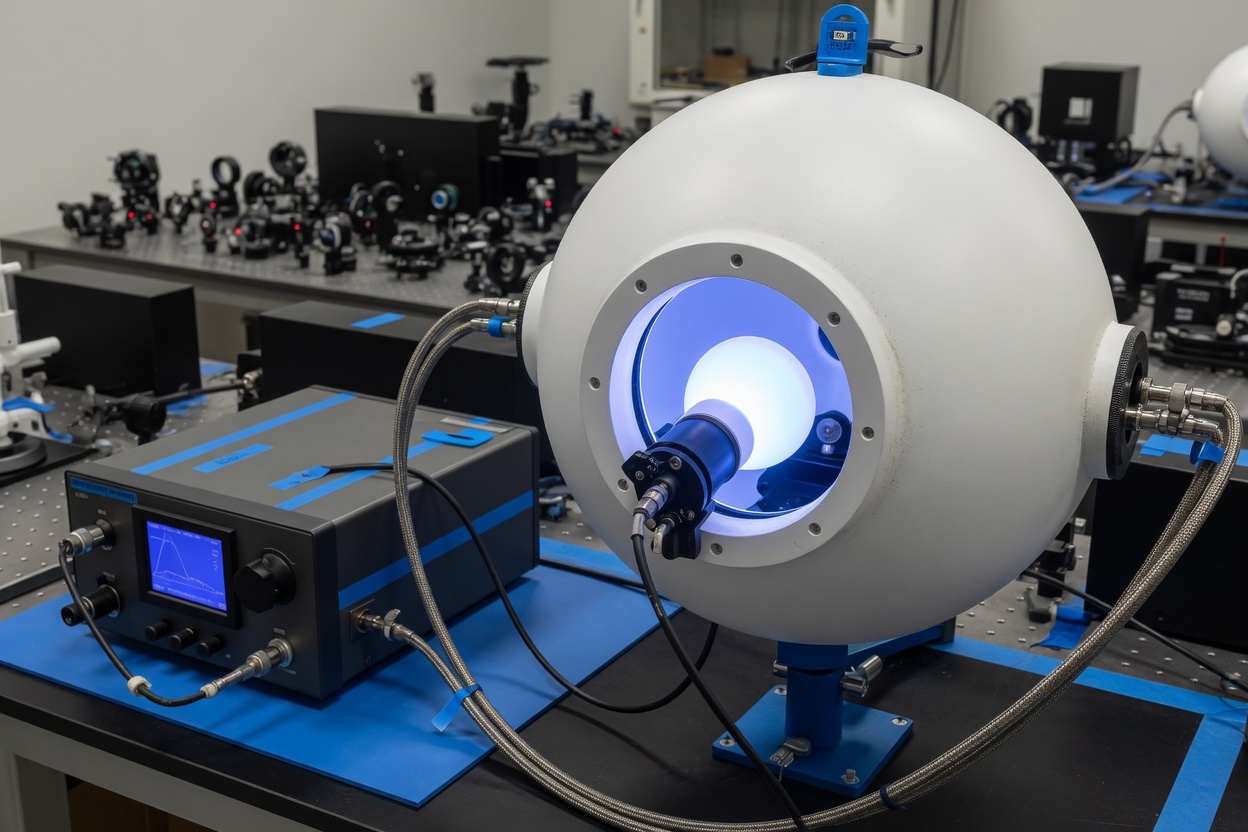
It assesses more than one kind of hazard, including UV hazard, blue-light hazard, retinal thermal hazard, and infrared hazard. Each has its own measurement method and exposure limit. In other words, “is this light safe?” isn’t a one-line answer but a set of measured assessment results.
What blue-light hazard actually is
Among these hazards, blue-light hazard has drawn the most attention in recent years. It refers to the photochemical damage that blue light of roughly 400–500nm may cause to the retina under high-intensity, prolonged exposure.
The key point is that this is a photochemical effect, not a purely thermal one — the mechanism differs from “staring at the sun burns your retina,” being instead the cumulative action of photons in the blue band. It’s worth emphasizing: the blue-light intensity of everyday lighting is mostly well below the hazard threshold. What truly warrants caution is high-brightness sources that can be stared at for long periods. IEC 62471 lists blue-light hazard as a formal assessment item, turning “hazard” from a panic word into a quantifiable rating.
The four risk groups: RG0 to RG3
The core output of IEC 62471 is sorting light sources into four risk groups[1]:
- RG0 (exempt group): poses no photobiological hazard under normal use
- RG1 (low risk): poses no hazard under ordinary behavior and exposure conditions
- RG2 (moderate risk): relies on the human aversion response to bright light (blinking, turning away, pupil contraction) for protection
- RG3 (high risk): may cause harm even on brief exposure
Understanding the logic of RG2 matters: it’s not “absolutely safe,” but rather assumes people will instinctively look away from glaring light. Most general and decorative lighting falls into RG0 or RG1, meaning no additional protection is needed under normal viewing.
From component to finished product: IEC TR 62778
There’s a practical question too: can the rating measured on a single LED package directly represent the whole luminaire built from it? This is exactly what IEC TR 62778 sets out to solve.
It’s a technical report that specifically explains how to apply IEC 62471 to assess blue-light hazard, with the band focused on visible light (380–780nm)[2]. Its most practical contribution is a method for soundly carrying the hazard rating from the component (LED package, module) up to the finished luminaire — sparing manufacturers from re-measuring at every layer and greatly simplifying the industry’s assessment workflow. For makers of decorative lighting, this is the go-to guide for handling blue-light safety in practice.
Practical cautions for decorative and toy lighting
For decorative lighting, landing in RG0/RG1 is the norm, but two scenarios deserve special attention:
- Children’s toy lights: children may stare at a light source for long periods at close range, lacking an adult’s aversion instinct. So lighting aimed at children should be designed to control brightness and blue-light content more conservatively.
- Close-range viewing: risk-group assessment is tied to viewing distance, so applications close to the eye (such as wearables and near-field desktop decoration) should be assessed under stricter distance conditions.
In other words, the same bead may be entirely safe in distant ambient lighting yet warrant a fresh review when used at close range in scenarios aimed at children.
The PowerMOS approach: brightness control at the driver
An honest note: photobiological safety depends mainly on the spectrum and intensity of the bead itself, which falls within the measurement scope of luminaires and modules; the driver IC is not a subject of assessment under IEC 62471.
But the driver determines how brightness is controlled. The high grayscale depth and constant-current architecture of PowerMOS addressable-control ICs let each bead’s brightness be adjusted stably and linearly, helping a product keep its output within a reasonable range by design and avoid unnecessary over-brightness — a practical tool for keeping brightness within a safety margin in applications aimed at children or viewed at close range. As for certifying the spectrum and hazard rating, that still comes back to formal measurement of the bead and finished product. See the product center for the full lineup.
Further reading: for the safety-certification landscape, see Safety Certification for LED Light Strings: From CE and UL to Each Market’s Entry Ticket; for grayscale and dimming, see Grayscale, Color, and Flicker-Free Dimming Engineering for Addressable LEDs.
Reference Standards and Literature
- IEC 62471, Photobiological safety of lamps and lamp systems. International Electrotechnical Commission (IEC).
- IEC TR 62778, Application of IEC 62471 for the assessment of blue light hazard to light sources and luminaires. International Electrotechnical Commission (IEC).
This article is an educational overview of photobiological safety. The names of the standards cited can be verified in the official IEC catalog. PowerMOS addressable-control ICs use a proprietary carrier protocol optimized for LED pixel control.
FAQ
What is IEC 62471?
IEC 62471 is the international standard for the photobiological safety of lamps and lamp systems. It assesses a luminaire's potential photobiological hazards to the eyes and skin, covering the bands from ultraviolet (UV) to infrared (IR). It sorts light sources into four risk groups (RG0 to RG3) by degree of hazard, and specifies the measurement methods and exposure limits for each type of hazard — the primary basis for evaluating light safety in lighting products.
What is blue-light hazard?
Blue-light hazard refers to the photochemical damage that blue light of roughly 400–500nm may cause to the retina under high-intensity, prolonged exposure. It's a photochemical effect rather than a purely thermal one. IEC 62471 lists it as one of its assessment items. The blue-light intensity of everyday lighting is mostly well below the hazard threshold, but high-brightness, direct-view sources still need to be assessed and graded per the standard.
What do the risk groups RG0 to RG3 each represent?
Under IEC 62471, RG0 (exempt group) poses no photobiological hazard under normal use; RG1 (low risk) poses no hazard under ordinary behavior and exposure; RG2 (moderate risk) relies on the human aversion response to bright light (such as blinking and turning away) for protection; RG3 (high risk) may be harmful even on brief exposure. Most general and decorative lighting falls into RG0 or RG1.
And what does IEC TR 62778 do?
IEC TR 62778 is a technical report that specifically explains how to apply IEC 62471 to assess a product's blue-light hazard, with the band focused on visible light (380–780nm). Its important contribution is a sound way to carry the hazard rating from a 'component' (such as an LED package or module) up to the 'finished luminaire,' so manufacturers don't have to re-test at every stage — a common industry-practice guide for assessing blue light.
How do PowerMOS's solutions relate to photobiological safety?
Photobiological safety depends mainly on the spectrum and intensity of the bead itself, which falls within the measurement scope of luminaires and modules; the driver IC is not its subject of assessment. But the driver determines how brightness is controlled — the high grayscale depth and constant-current architecture of PowerMOS addressable-control ICs let brightness be adjusted stably and linearly, helping a product keep its output within a reasonable range by design and avoid unnecessary over-brightness. See the product center for the full lineup.
Upgrading your string lights to full pixel control?
Power MOS Electronics delivers the complete stack — driver ICs, addressing equipment, controllers and apps. Tell us about your product and our engineering team will spec it with you.
Contact PowerMOS Browse products