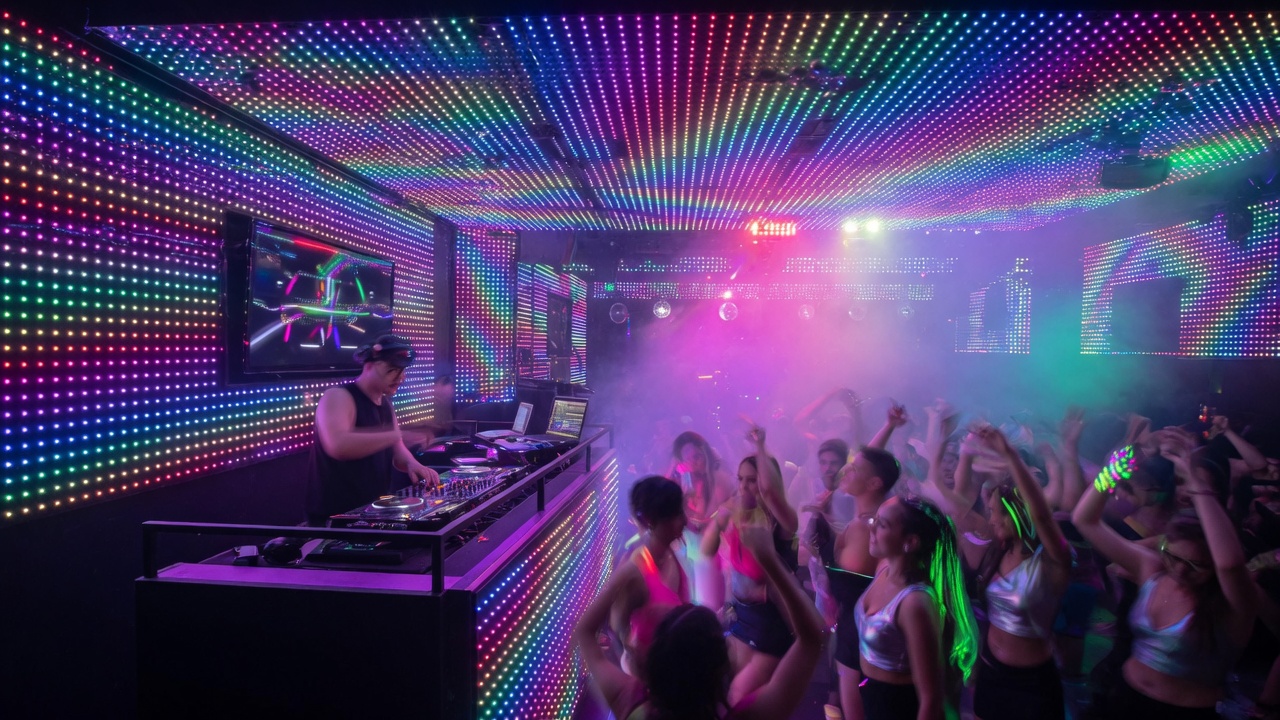
Walk into a great nightclub and the whole space breathes with the beat — walls pulsing, ceilings streaming with light, the wall behind the bar bursting with the bass. Lighting in a nightlife venue is all about making the space itself part of the music. Addressable LEDs turn walls, ceilings, and the bar into a light surface that dances to the music in real time. This article covers the lighting engineering of nightlife venues.
Walk into a great nightclub and the whole space breathes with the beat — walls pulsing, ceilings streaming with light, the wall behind the bar bursting with the bass.
Lighting in a nightlife venue is all about making the space itself part of the music. Addressable LEDs turn walls, ceilings, and the bar into a light surface that dances to the music in real time. This article covers the lighting engineering of nightlife venues — written for the people who bring the night to life.
The core: making the space react to the music
At its core, nightlife lighting comes down to one thing: reacting to the music. Walls, ceilings, and the bar pulse, shift color, and burst to the beat, making guests feel they’re inside the music.
This takes two capabilities: per-pixel control (each position changing independently to create flowing, chasing, and bursting effects) and real-time sync (following whatever is playing now, not a pre-recorded program). Addressable LEDs deliver exactly this — every pixel is independently controllable in real time, turning the whole space into a light surface that dances to the music. That’s an immersion whole-strip color-changing strips can’t offer.
Real-time sync with the music and the DJ
The soul of nightclub lighting is its real-time sync with the music. Engineering uses two paths together:
- Audio-reactive — the system analyzes the audio’s spectrum, beat, and energy in real time into control parameters, mapping them to each pixel’s color, brightness, and motion.
- DJ/VJ triggering — a DJ or VJ manually triggers scenes and effects from a console.
The key metric here is latency. People are extremely sensitive to audio-visual sync, so end-to-end latency has to stay within tens of milliseconds — otherwise the reaction lags “half a beat behind” and the immersion collapses. Addressable pixels can write analyzed results into every bead in real time, the prerequisite for precise audio reactivity — the same thread as the real-time lighting discussed in Large-Scale Concert LED Walls, just at a more intimate scale and a more immersive mood.
Scene switching: the emotional arc of a night
A night has its own rhythm — the mellow warm-up, the peak-hour frenzy, the late-night haze. Nightclub lighting has to switch between these moods while staying reactive to whatever is playing.
The per-pixel control of addressable LEDs lets scene presets and live reactivity coexist: presets define the overall mood (warm tones for the warm-up, intense colors for the peak), while audio reactivity fills in the detail in real time (pulsing with the bass, flickering with the beat). Layer the two, and the space takes on a breathing life of its own.
Reliability: a nightclub’s operational must
Nightclubs run long, intense hours every night, so reliability is an operational must — a section going dark mid-business is the most embarrassing failure there is.
With an architecture where each pixel has its own address, a single bead failing won’t cut off the whole string the way a shift-register chain would — the fault stays confined to one point; paired with sound drive current and thermal design to extend life. Address-based fault tolerance means “one bead dies, but the section doesn’t go dark,” a real operational safeguard for venues that can’t shut down partway through the night. See How Long Do LED Beads Last for more.
Choosing for your space
PowerMOS offers addressable beads, controllers, and carrier-conversion solutions that connect to standard show-control signals and audio-reactive systems, with two-wire runs well suited to sculptural installations on walls, ceilings, and bars. See the product center for the full lineup. The concert scene video on the homepage and the performance scenes in the 3D Christmas Town world offer a visual demonstration. Nightclub, bar, live-house, and entertainment-venue design teams are welcome to bring their space’s scale and mood requirements to talk with PowerMOS.
Reference Standards and Literature
- ANSI E1.11 (DMX512-A), Asynchronous Serial Digital Data Transmission Standard for Controlling Lighting Equipment and Accessories. ESTA — entertainment lighting control standard.
- ANSI E1.31-2018 (sACN), Lightweight streaming protocol for transport of DMX512 using ACN. ESTA — networked lighting distribution.
- Wright, M. (2005). Open Sound Control: an enabling technology for musical networking. Organised Sound, 10(3). CNMAT, UC Berkeley — music synchronization control.
This article is an educational overview of an application scenario. The names of the standards cited can be verified in the official ESTA catalog. PowerMOS addressable-control ICs use a proprietary carrier protocol optimized for LED pixel control, bridging to the audio-reactive and show-control ecosystem through a controller.
FAQ
Why are addressable LEDs a good fit for nightclub and bar lighting?
Nightlife lighting is all about being reactive to the music — walls, ceilings, and the bar pulsing, shifting color, and bursting to the beat. Addressable LEDs give each pixel independent, real-time control, so the whole space can become a light surface that dances to the music, producing flowing, chasing, and bursting effects. That's an immersion whole-strip color-changing strips can't deliver.
How does the lighting sync with the music and the DJ in real time?
An audio-reactive system analyzes the audio's spectrum, beat, and energy in real time into control parameters, mapping them to each pixel's color, brightness, and motion; a DJ or VJ can also trigger scenes manually from a console. People are highly sensitive to audio-visual sync, so end-to-end latency has to stay within tens of milliseconds. Addressable pixels can write the analyzed results into every bead in real time — the prerequisite for precise audio reactivity.
What scene changes does nightlife lighting need?
A night has several movements — the mellow warm-up, the peak-hour frenzy, the late-night haze. Nightclub lighting needs to switch between these moods while staying reactive to whatever is playing. The per-pixel control of addressable LEDs lets scene presets and live reactivity coexist: presets define the overall mood while audio reactivity fills in the detail in real time.
Nightclubs run long and hard — how is lighting reliability guaranteed?
Nightclubs run long, intense hours every night, so reliability is an operational must. With an architecture where each pixel has its own address, a single bead failing won't cut off the whole string — the fault stays confined to one point; paired with sound drive current and thermal design to extend life. Address-based fault tolerance means 'one bead dies, but the section doesn't go dark,' avoiding embarrassment mid-business.
How can nightclub, bar, or venue design teams get the solution?
PowerMOS offers addressable beads, controllers, and carrier-conversion solutions that connect to standard show-control signals and audio-reactive systems, with two-wire runs well suited to sculptural installations on walls, ceilings, and bars. Nightclub, bar, live-house, and entertainment-venue design teams are welcome to bring their space's scale and mood requirements to discuss bead selection and solutions.
Upgrading your string lights to full pixel control?
Power MOS Electronics delivers the complete stack — driver ICs, addressing equipment, controllers and apps. Tell us about your product and our engineering team will spec it with you.
Contact PowerMOS Browse products