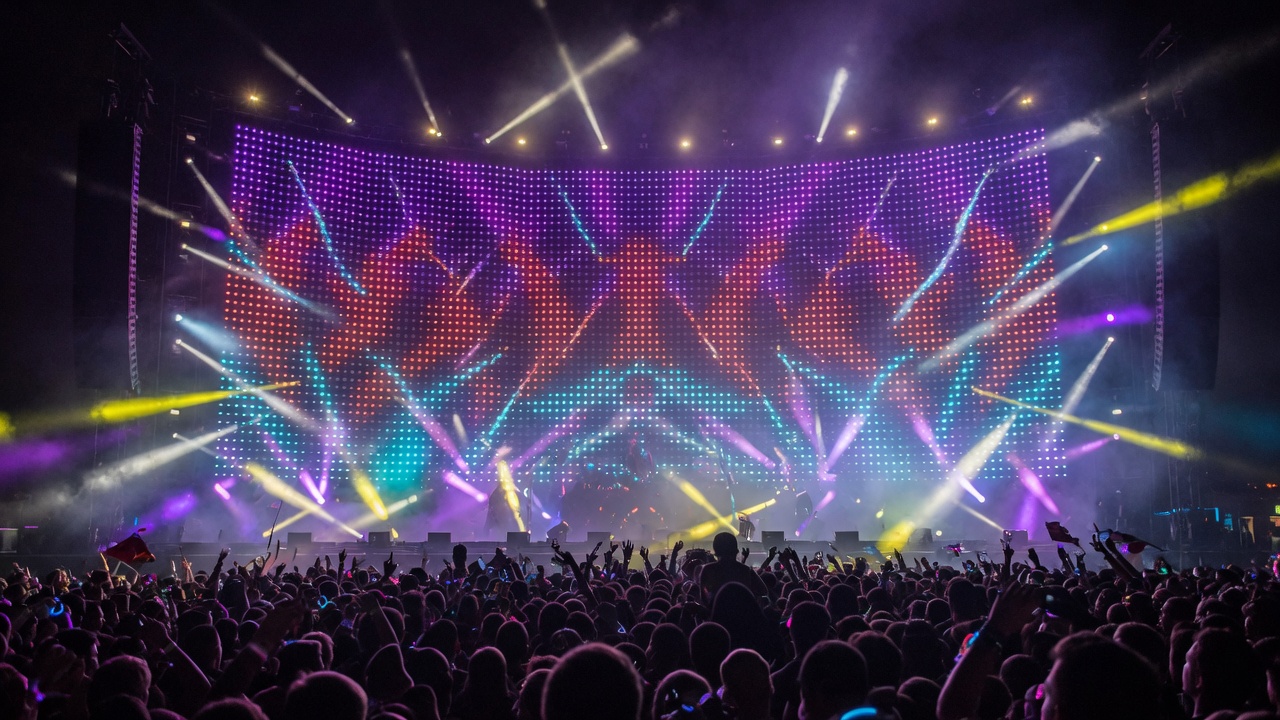
The visual memory of a big show often comes from that wall of breathing light — tens of thousands of beads pulsing with the music, changing color with each section, bursting on the chorus. Making so many beads dance in precise unison, as if a single body, takes a mature, scaled lighting engineering behind the scenes, and every LED bead being independently addressable.
The visual memory a big show leaves in an audience’s mind often comes from that wall of breathing light — tens of thousands of beads pulsing with the music, changing color with each section, the whole panel bursting on the chorus.
Making so many beads dance in precise unison, as if a single body, takes a mature, scaled lighting engineering behind the scenes. This article unpacks its two cores: how content is distributed to tens of thousands of beads, and how light dances with the music in real time — and explains the irreplaceable place of addressable LED beads within it.
The scale challenge: distributing content to tens of thousands of beads
The first challenge of a large show is pure scale. Visual content is edited on a media server with pixel-mapping software — mapping a piece of video or graphic to the position of every bead in physical space, so that a wall, tree, or 3D structure made of beads can play patterns and video.
The edited content is distributed via two real networked lighting-control standards:
- sACN (Streaming ACN, ANSI E1.31-2018) — the standard from ESTA, transmitting DMX512 data over Ethernet via IP multicast, supporting up to 63,999 universes and over thirty million channels, with built-in priority management. It was born exactly for ultra-large installations like concert tours, theme parks, and broadcast studios.
- Art-Net — Artistic Licence’s DMX-over-Ethernet protocol, with a mature ecosystem and wide device support.
Touring teams prefer these open standards for a reason: shows are built and struck repeatedly at different venues, so equipment must interoperate and content must be reusable across venues. If addressable beads can join this ecosystem through a conversion solution, a team can keep using the consoles, media servers, and workflows it already knows.
The PowerMOS role here is to bridge: the carrier-conversion controller converts standard signals (SPI / DMX512) into a power-line carrier protocol; one sub-control board can drive thousands of beads, and multi-board cascading with video splitting multiplies that further. And the two-wire power-and-signal trait keeps large-area cabling simpler and the wire gauge thinner — paired with the high-voltage series-parallel scheme, it markedly lowers the total cabling cost of large installations.
Audio-reactive: letting light dance with the sound
The second core is audio-reactive lighting. The system analyzes the audio’s spectrum, beat, and energy into control parameters in real time, then maps them to the beads’ color, brightness, and motion — the whole wall breathing on the bass pulse, changing color as the beat drops, the whole panel bursting when the chorus energy peaks.
The most sensitive metric here is latency. People’s tolerance for a mismatch between light and sound is extremely low; end-to-end latency is best kept within tens of milliseconds, or the audiovisual disconnect is noticed instantly. Addressable beads can write the analysis results to each bead in real time — the prerequisite for precise audio-reactive effects.
The engineering trade-offs of a scaled show
- Bead count vs. refresh rate: an addressable bead’s single-channel bead count is inversely proportional to FPS. A large wall must be split across multi-channel sub-control to keep a smooth frame update at the scale of tens of thousands of beads.
- Cabling cost: the cabling of a large installation is a hidden bulk cost. Two-wire carrier + high-voltage series-parallel reduces wire gauge and count, a considerable saving at the scale of tens of thousands of beads.
- Reliability: a long show cannot go dark midway. Address-code fault tolerance (a single failure not spreading) is the reliability foundation of a large installation.
Planning a light wall for your show
Whether it is a concert tour, a festival main stage, or an immersive show space, PowerMOS provides the core components — from addressable beads and carrier-conversion controllers to multi-channel sub-control. The concert scene video on the homepage and the “performance stage” scene of the Christmas Town 3D World offer a visual demonstration. Bring your show scale and visual needs to PowerMOS, and we will help you complete bead selection and scaled sub-control planning.
Further reading: for other scenes of real-time interactive lighting (motion capture, esports), see Technical Insights; for the technical context of addressable lighting, see The Two-Wire Debate in Addressable Lighting.
References and standards
- ANSI E1.31-2018 (sACN), Entertainment Technology — Lightweight streaming protocol for transport of DMX512 using ACN. ESTA (Entertainment Services and Technology Association).
- Art-Net 4, DMX-over-Ethernet protocol specification. Artistic Licence.
- ANSI E1.11 (DMX512-A), USITT DMX512-A, Asynchronous Serial Digital Data Transmission Standard for Controlling Lighting Equipment and Accessories. ESTA.
This article is an educational overview of application engineering. PowerMOS pixel-control chips bridge to the standard show-signal ecosystem through a carrier-conversion controller, while themselves using a proprietary carrier protocol optimized for LED pixel control.
FAQ
How does a large concert drive tens of thousands of addressable LED beads?
Visual content is edited on a media server with pixel-mapping software, then distributed over an IP network as thousands of DMX universes via DMX-over-Ethernet protocols such as sACN (ANSI E1.31-2018) or Art-Net to the nodes. sACN supports up to 63,999 universes and over thirty million channels — designed exactly for ultra-large installations like concert tours and theme parks. The PowerMOS carrier-conversion controller converts such standard signals into a power-line carrier protocol, letting two-wire addressable beads join the existing professional show ecosystem.
What is pixel mapping?
Pixel mapping is the process of mapping a piece of video or graphic content to the position of every LED bead in physical space — letting a wall, tree, or 3D structure made of beads play patterns and video. It requires each bead to have a known spatial position and an independent address, so that 'this cell of the image' can be mapped to 'that bead in space.' Addressable beads are the physical prerequisite for pixel mapping.
How is audio-reactive lighting done?
Audio-reactive lighting analyzes the audio's spectrum, beat, and energy into control parameters in real time, then maps them to the beads' color, brightness, and motion. People have very low tolerance for a mismatch between light and sound, so end-to-end latency is best kept within tens of milliseconds, or the audiovisual disconnect becomes obvious. Addressable beads can write the analysis results to each bead in real time, producing effects that pulse with the bass and change color on the beat.
Why do touring lighting systems prefer standard protocols?
Touring means repeatedly building and tearing down quickly at different venues, so equipment must interoperate. sACN and Art-Net are open standards widely adopted in the entertainment industry, letting consoles, media servers, and nodes from different brands work together and letting content be reused across venues. If addressable beads can join this standard ecosystem through a conversion solution, a touring team can keep using the tools and workflows it already knows.
Who supplies the addressable beads and solution for a show?
PowerMOS supplies the addressable LED beads (with built-in power-line carrier driver chips) that large shows need, carrier-conversion controllers (connecting to standard sACN / Art-Net / SPI signals), and multi-channel sub-control boards. Two-wire power-and-signal keeps large-area cabling simpler and the wire gauge thinner, and the high-voltage series-parallel scheme lowers total cabling cost. You are welcome to discuss your show scale and visual needs with us.
Upgrading your string lights to full pixel control?
Power MOS Electronics delivers the complete stack — driver ICs, addressing equipment, controllers and apps. Tell us about your product and our engineering team will spec it with you.
Contact PowerMOS Browse products