At a lighting fair, insiders and outsiders ask different questions. The outsider asks 'how much is this, can it be cheaper'; the insider asks 'which station on your line writes the address, what's your PPM, whose patent is it.' The former gets a quote; the latter sees through to whether the solution provider is any good. This article is a hands-on fair guide: which sourcing hubs Asia has, which ten questions to ask a provider at the booth, and how to evaluate the samples you bring home.
- Asia’s sourcing hubs: Hong Kong and Guangzhou
- The positioning of the two fairs shapes your strategy
- Ten questions to ask a solution provider at the booth
- Post-fair samples: turning impressions into data
- PowerMOS: turning “the questions to ask” into deliverable answers
- Reference standards and literature
- FAQ
At a lighting fair, insiders and outsiders ask different questions.
The outsider asks “how much is this, can it be cheaper”; the insider asks “which station on your line writes the address, what’s your PPM, whose patent is it.” The former gets a quote; the latter sees through to whether the solution provider is any good. This article is a hands-on fair guide: which sourcing hubs Asia has, which ten questions to ask a provider at the booth, and how to evaluate the samples you bring home.
Asia’s sourcing hubs: Hong Kong and Guangzhou
For a lighting buyer, Asia has two unavoidable sourcing hubs—one in Hong Kong, one in Guangzhou.
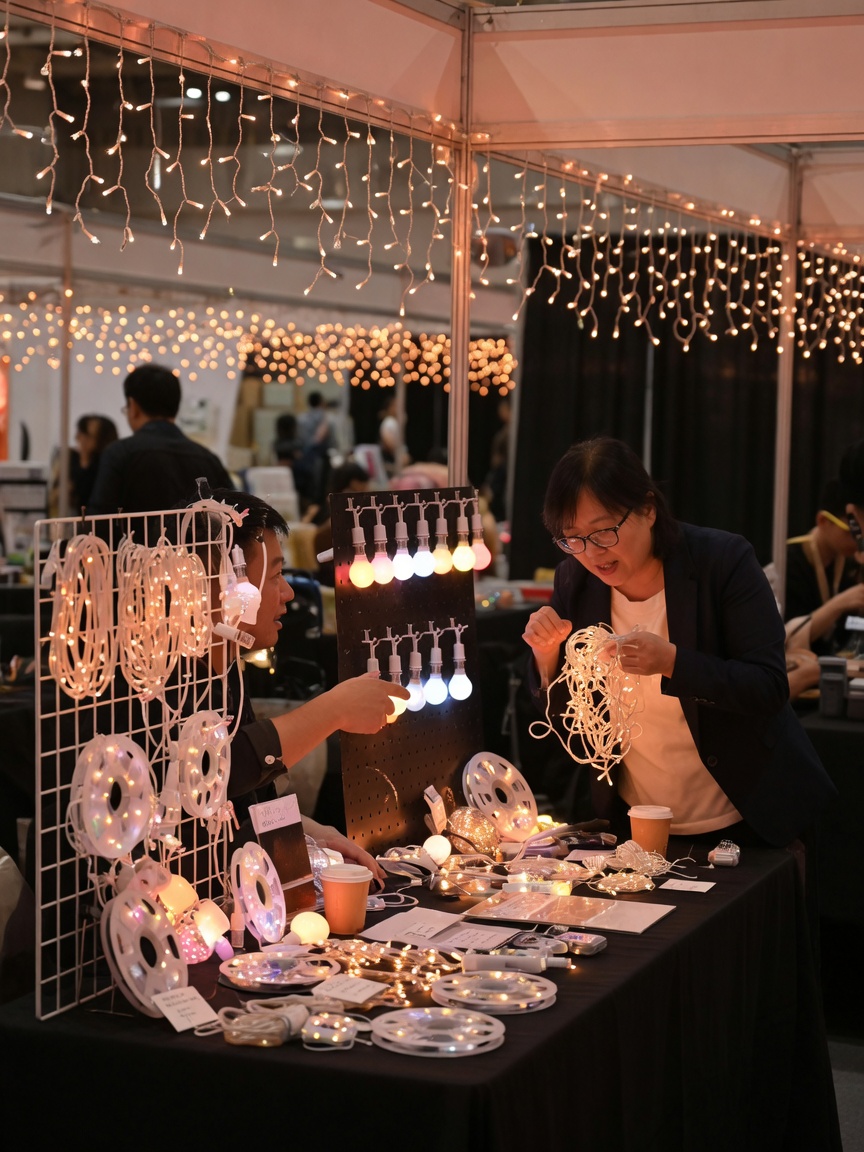
The Hong Kong International Lighting Fair (Autumn Edition), organized by the Hong Kong Trade Development Council (HKTDC), is held around October each year at the Hong Kong Convention and Exhibition Centre and is one of the largest lighting fairs in Asia[1]. It is positioned toward international buyers and brand sourcing, with a high international ratio of exhibitors and buyers, suited to finding finished products, brand partnerships, and design-led products.
The China Import and Export Fair (Canton Fair), held in Guangzhou, runs in phases around April in spring and October in autumn each year, with lighting and lighting equipment concentrated in Phase 1[2]. It is vast in scale and dense with suppliers, covering the full chain from components to finished goods, and oriented toward connecting directly with the manufacturing end.
(Actual dates shift slightly each year, so before you travel, always check the organizers’ official announcements.)
The positioning of the two fairs shapes your strategy
The Hong Kong fair and the Canton Fair are not an either/or but complementary. Understanding the difference in positioning lets you plan an efficient itinerary:
- Hong Kong International Lighting Fair: international, brand-oriented. Suited to seeing trends, finding design-strong finished products, and negotiating brand partnerships
- Canton Fair: large in scale, dense with suppliers, complete in chain. Suited to connecting directly with the manufacturing end, comparing many suppliers, and negotiating mass production and price
A common strategy is: see trends and brands in Hong Kong first to grasp this year’s direction and design language, then lock in capacity and price at the Canton Fair, connecting the direction you like to a supplier that can mass-produce it. Stringing the two hubs together does more for both “picking the right direction” and “negotiating the right price” than working just one of them.
Ten questions to ask a solution provider at the booth
At the booth, don’t rush to ask about price. What really sees through a provider’s capability are the following ten questions—their answers are more honest than any quote.
- Is the protocol open or proprietary? A proprietary protocol may be stronger on interference immunity and optimization, but ask clearly about the ecosystem and supply risk
- Which station on the line writes the address? Is writing automated? The consistency and yield of manual writing usually lag automated in-line writing
- What is the mass-production PPM (defect rate)? Ask for a specific number and its statistical basis, not “the quality is great”
- Does a single-point failure spread? Whether one dead light drags down the whole segment behind it is key to outdoor reliability
- Can beads be replaced for repair? Whether a dead bead can be swapped individually or the whole string is scrapped directly affects maintenance cost
- What is the address depth (number of addressable units)? It decides how many independently controllable lights one line can carry
- How do surge protection and weathering hold up? A must for outdoor—ask down to the specific protection design and testing
- Are there relevant patents? Clarify IP ownership to avoid sourcing a solution with infringement risk
- Which certification support can you offer? Cooperation on safety and EMC certification determines whether you can enter the target market
- How far does high-voltage application support go? If you need AC110/220V direct drive, confirm the solution’s voltage capability
Ask these ten questions and a provider’s engineering maturity becomes very clear. The ones who can answer, and answer specifically, are the ones worth taking further.
Post-fair samples: turning impressions into data
Samples at a fair look great and the atmosphere is nice, which makes it easy to judge too fast. The real evaluation waits until the sample comes home and is run through a standardized process:
- Consistency check: does the sample spec match the booth’s claims
- Power-on and addressing test: any flicker, address clashes, or drift
- Stress test: temperature-humidity cycling, repeated power cycling, simulated surge
- Outdoor items: additional waterproof and weathering tests
- Destructive test: deliberately break one light to see whether the failure spreads and whether the bead can be replaced
The key is to record every step as a comparable table. When you hold the same set of data for three or four suppliers’ samples, the choice shifts from “which one feels better” to “which one is better on the data”—the decision basis a professional buyer should have.
PowerMOS: turning “the questions to ask” into deliverable answers
Those ten questions are exactly the ones PowerMOS hopes buyers will ask—because each has a solid answer.
On writing and yield, PowerMOS uses automated in-line address writing and dual-layer addressing (laser metal fuse plus in-line rewritable silicon fuse); on reliability, it offers non-spreading single-point failure and bead-replaceable repair; on capability limits, it has 512-code address depth, surge protection, and high-voltage AC110/220V application capability. These are not marketing lines but engineering facts that can be pressed on and verified at the booth. Technical communication and certification cooperation for the procurement onboarding stage can be discussed as well. The main models cover the RGB, RGBW, and copper-wire light series; see the product center for the full list.
Further reading: for the market overview, see A Sourcing Guide to the Decorative-Lighting Market; for solution technical routes, see A Comparison of Technical Routes for Addressable LED Pixel-Control ICs.
Reference standards and literature
- HKTDC Hong Kong International Lighting Fair (Autumn Edition), organized by the Hong Kong Trade Development Council. Official page: hktdc.com.
- China Import and Export Fair (Canton Fair), organized by the China Import and Export Fair. Official page: cantonfair.org.cn.
This article is an educational piece on lighting sourcing. The fair information cited can be verified on the official websites of the HKTDC and the Canton Fair, with actual dates following the organizers’ announcements. PowerMOS pixel-control ICs use a proprietary carrier protocol optimized for LED pixel control.
FAQ
What are the important lighting-sourcing hubs in Asia?
Two frequently cited hubs are Hong Kong and Guangzhou. The Hong Kong International Lighting Fair (Autumn Edition), organized by the Hong Kong Trade Development Council (HKTDC), is held around October each year and is one of the largest lighting fairs in Asia, positioned toward international buyers and brand sourcing. The China Import and Export Fair (Canton Fair) is held in phases around April in spring and October in autumn each year, with lighting and lighting equipment concentrated in Phase 1—vast in scale, dense with suppliers, and oriented toward connecting directly with the manufacturing end. Actual dates follow the organizers' official announcements.
How do the Hong Kong Lighting Fair and the Canton Fair differ in positioning?
Broadly, the Hong Kong International Lighting Fair is positioned toward internationalization and brand sourcing, with a high international ratio of exhibitors and buyers, suited to finding finished products, brand partnerships, and design-led products. The Canton Fair is larger in scale and denser with suppliers, covering the full chain from components to finished goods, suited to connecting directly with the manufacturing end, comparing many suppliers, and negotiating mass production. The two are complementary: seeing trends and brands in Hong Kong first, then locking in capacity and price at the Canton Fair, is a common strategy.
What key questions should you ask a solution provider at the booth?
Beyond spec and price, ask the questions that see through capability: which station on the line writes the address, whether writing is automated, the mass-production PPM (defect rate), whether a single-point failure spreads, whether beads can be replaced for repair, the address depth, how surge protection and weathering hold up, whether there are relevant patents, which certification support can be offered, and whether the protocol is open or proprietary. The answers to these questions reflect a provider's engineering maturity far better than a quote does.
How should you evaluate the samples you get after the fair?
Build a standardized process: first confirm the sample matches the booth's claims, then run power-on and addressing tests, watching for flicker, address clashes, or drift; next run stress tests such as temperature-humidity cycling, repeated power cycling, and simulated surge; add waterproof and weathering tests for outdoor samples. Finally, deliberately break one light to see whether the failure spreads and whether the bead can be replaced. Record every step as a comparable table, and you can compare multiple samples objectively.
What support can PowerMOS offer in sourcing and fair scenarios?
As a pixel-control IC solution provider, PowerMOS can give solid answers to the key questions above: automated in-line address writing, dual-layer addressing (laser metal fuse plus in-line rewritable silicon fuse), non-spreading single-point failure, bead-replaceable repair, 512-code address depth, surge protection, and high-voltage AC110/220V application capability, plus technical communication for certification and mass-production onboarding. Buyers can use these dimensions to assess a solution's maturity. See the product center for the full model list.
Upgrading your string lights to full pixel control?
Power MOS Electronics delivers the complete stack — driver ICs, addressing equipment, controllers and apps. Tell us about your product and our engineering team will spec it with you.
Contact PowerMOS Browse products