However beautiful a smart-light is, if it cannot clear compliance it never reaches the shelf. The retail channels of the EU and North America impose a full set of mandatory and quasi-mandatory requirements on electrical and electronic products—CE's several attestations, North America's safety certifications, the spectrum rules for wireless, and California's chemical warnings. The names read like a pile of acronyms, but behind each one is an allocation of 'who is responsible for what.' This article lists, item by item, the compliance a smart-light must clear to reach Western shelves, and shows which part a brand owner can hand to a solution partner.
- The EU: CE is a declaration, not a certificate
- The CE four-pack: LVD, EMC, RoHS, and (if wireless) RED
- North America: UL 588 / ETL for safety, FCC for spectrum
- California Proposition 65: the most easily overlooked hurdle
- The responsibility split: which part the brand owner carries, which the partner takes
- Preparing to reach Western shelves? Let’s work through the compliance path together
- References and Standards Cited
- FAQ
However beautiful a smart-light is, if it cannot clear compliance it never reaches the shelf.
The retail channels of the EU and North America impose a full set of mandatory and quasi-mandatory requirements on electrical and electronic products—CE’s several attestations, North America’s safety certifications, the spectrum rules for wireless, and California’s chemical warnings. The names read like a pile of acronyms, but behind each one is an allocation of “who is responsible for what.” This article lists, item by item, the compliance a smart-light must clear to reach Western shelves, and shows which part a brand owner can hand to a solution partner.
The EU: CE is a declaration, not a certificate
There is no getting into the EU without the CE mark. But first, dispel a common misunderstanding: CE is not a certificate some government agency issues to you—it is the manufacturer’s own declaration of conformity. You declare that the product meets all applicable EU directives, and you keep the technical documentation and test reports ready to produce if a question arises.
For a smart-light that has a power supply, pixel control and possibly wireless, you usually have to meet the following “four-pack” at once.
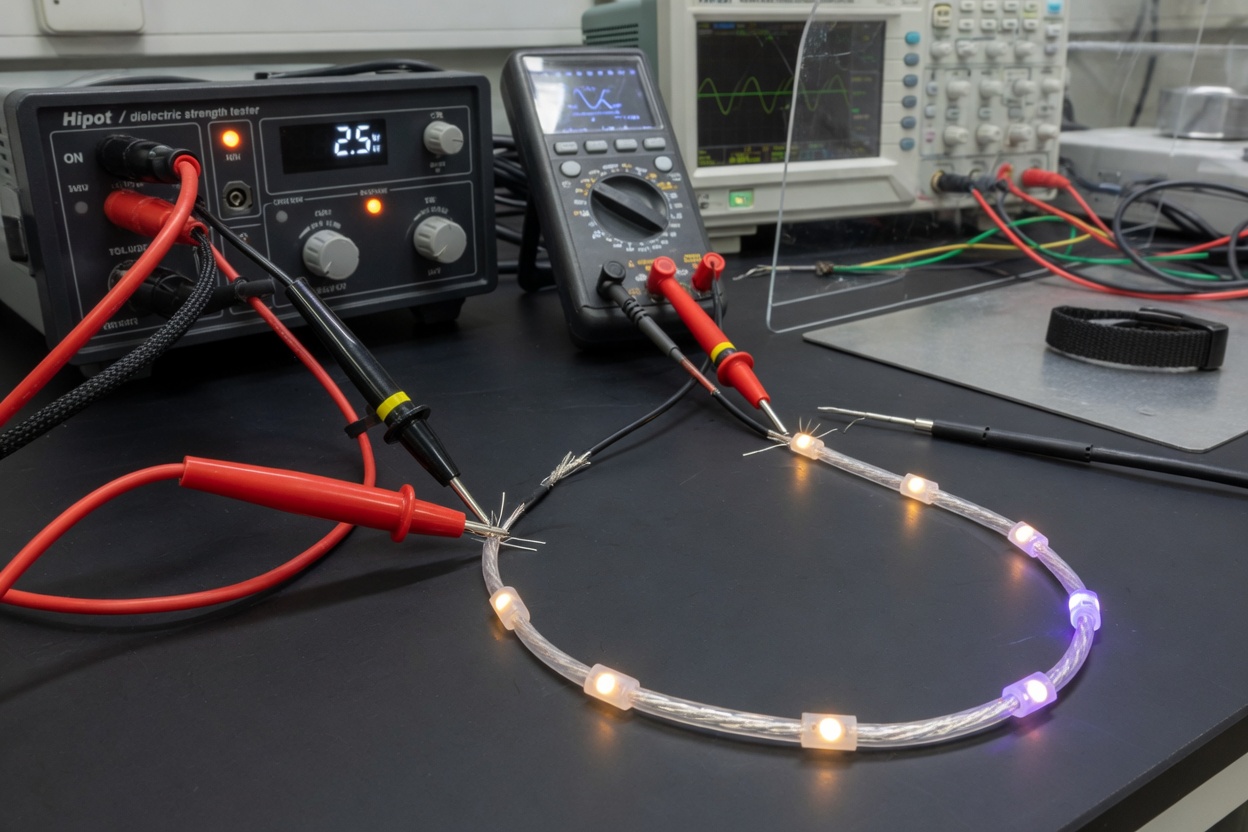
The CE four-pack: LVD, EMC, RoHS, and (if wireless) RED
LVD—the Low Voltage Directive (Directive 2014/35/EU)[1]: governs electrical safety. Any electrical equipment used within certain voltage limits must be sure not to cause hazards such as electric shock or fire. Mains-connected string power supplies and high-voltage applications lean especially on this one.
EMC—the Electromagnetic Compatibility Directive (Directive 2014/30/EU)[2]: governs mutual non-interference. The product must neither emit excessive electromagnetic disturbance nor fail to operate under a reasonable level of incoming interference. A pixel-control string carries fast-switching control signals, which makes this item a focal point.
RoHS—the Restriction of Hazardous Substances Directive (Directive 2011/65/EU)[3]: governs materials. It limits the content of lead, cadmium, mercury, certain plasticizers and other hazardous substances in electrical and electronic products, from the solder to the outer jacket of the wire.
RED—the Radio Equipment Directive (Directive 2014/53/EU)[4]: applies only when the product has wireless functions (Bluetooth or Wi-Fi control), and governs the efficient use of the radio spectrum and harmless coexistence. A purely wired string with no wireless need not touch this one.
The logic of the four-pack is clear: safety, interference, materials, spectrum—each governs one dimension, and miss a corner and the declaration is incomplete.
North America: UL 588 / ETL for safety, FCC for spectrum
Across the Atlantic the certification logic changes, but the dimensions of concern carry over.
Safety certification—UL 588 / ETL: The North American safety standard for seasonal and decorative lighting is UL 588, the Standard for Safety for Seasonal and Holiday Decorative Products[5], which sets minimum wire gauge, strain relief, overcurrent protection and more to reduce the risk of shock and fire. Against the same standard, a product that passes testing may carry the UL mark (issued by UL Solutions) or the ETL mark (issued by Intertek)—both accredited NRTLs, and retail channels generally accept either.
Electromagnetics and spectrum—FCC 47 CFR Part 15: The U.S. Federal Communications Commission’s 47 CFR Part 15, “Radio Frequency Devices”[6] governs electronic devices that generate radio-frequency energy. Pixel-control ICs and controllers contain digital logic and are unintentional radiators that must meet the interference limits of Part 15 Subpart B; if a wireless module is included, it must additionally meet the authorization requirements for intentional radiators. In both cases the aim is to keep the product from interfering with other radio services.
California Proposition 65: the most easily overlooked hurdle
Enter California and there is one more hurdle foreign brands especially tend to miss—California Proposition 65, formally the Safe Drinking Water and Toxic Enforcement Act of 1986[7].
It requires that products sold in California that may expose people to listed carcinogens or reproductive toxicants carry a clear and reasonable warning. The list is administered by California’s Office of Environmental Health Hazard Assessment (OEHHA) and currently covers several hundred substances. The plasticizers, lead and similar materials common in light strings are all on the watch list.
What makes it tricky is that the enforcement threshold is low—any individual can sue in the public interest. Many foreign brands first encounter it by receiving a lawyer’s letter. Rather than fixing it after the fact, factor it in at the material-selection stage.
The responsibility split: which part the brand owner carries, which the partner takes
Once you have gone through the list, the real question is: with so many items, who does them? Compliance goes smoothly not by adding tests after the fact, but when the underlying design is built to pass certification in the first place—electromagnetic compatibility, surge protection, material selection. If the IC and controller are designed from the outset around Western requirements, the later certification stage stops getting stuck again and again.
PowerMOS pixel-control ICs and controllers are designed on exactly this premise: EMC and surge protection are built into the architecture, material selection is aligned with the substances of concern under RoHS and Prop 65, and with nearly two decades of Western-market experience the company provides certification support that helps brand owners shorten the trial-and-error on CE, UL/ETL and FCC. The brand owner is still the party responsible for the product’s compliance, but can start from a point where “the foundation is already aligned” and spend its energy on channel and marketing. See the flagship models and solution scope at the product center.
Further reading: for the technical detail of safety certification, see Safety Certification for LED Light Strings; for electromagnetic compatibility and surge, see EMC, ESD and Surge Reliability in LED Systems.
Preparing to reach Western shelves? Let’s work through the compliance path together
If you are pushing a smart-light into Western retail, write to sales-02@powermos.com and the PowerMOS engineering and commercial teams will engage with you directly to work out the CE, UL/ETL and FCC compliance path alongside your product plan. You are also welcome to start with About PowerMOS and our competitive advantages.
References and Standards Cited
- Directive 2014/35/EU of the European Parliament and of the Council, on the harmonisation of the laws of the Member States relating to the making available on the market of electrical equipment designed for use within certain voltage limits (Low Voltage Directive). Official Journal of the European Union.
- Directive 2014/30/EU of the European Parliament and of the Council, on the harmonisation of the laws of the Member States relating to electromagnetic compatibility (recast) (EMC Directive). Official Journal of the European Union.
- Directive 2011/65/EU of the European Parliament and of the Council, on the restriction of the use of certain hazardous substances in electrical and electronic equipment (recast) (RoHS 2). Official Journal of the European Union.
- Directive 2014/53/EU of the European Parliament and of the Council, on the harmonisation of the laws of the Member States relating to the making available on the market of radio equipment and repealing Directive 1999/5/EC (Radio Equipment Directive). Official Journal of the European Union.
- UL 588, Standard for Safety for Seasonal and Holiday Decorative Products. UL Standards & Engagement / UL Solutions.
- 47 CFR Part 15, Radio Frequency Devices. U.S. Federal Communications Commission (FCC), Code of Federal Regulations, Title 47.
- California Proposition 65, Safe Drinking Water and Toxic Enforcement Act of 1986. Office of Environmental Health Hazard Assessment (OEHHA), California Environmental Protection Agency.
This article is an educational piece on compliance. The names of the EU directives, U.S. federal regulations, UL standard and California act cited can be verified in the official catalogs of EUR-Lex, the eCFR, UL Standards and OEHHA. PowerMOS pixel-control ICs use a proprietary carrier protocol optimized for LED pixel control and are not an implementation of any of the above standards.
FAQ
Is the CE mark a certificate?
No. CE is the manufacturer's self-declaration mark, signifying that the product meets all applicable EU directives. For a smart-light with a power supply, that usually means meeting the Low Voltage Directive (LVD, 2014/35/EU), the Electromagnetic Compatibility Directive (EMC, 2014/30/EU) and the Restriction of Hazardous Substances Directive (RoHS, 2011/65/EU) at once; if it has wireless functions, add the Radio Equipment Directive (RED, 2014/53/EU). CE is not a certificate issued by a government body, but a declaration of conformity the manufacturer makes on the basis of testing and technical documentation.
What is the difference between UL and ETL?
Both are common North American safety marks, and the testing can be against the same standard (UL 588 for seasonal and decorative lighting). The difference is the issuing body: the UL mark is issued by UL Solutions and the ETL mark by Intertek, both accredited NRTLs (Nationally Recognized Testing Laboratories). Retail channels generally accept either; what matters is that the product has genuinely passed testing to the standard.
Why does a smart-light have to deal with the FCC?
Any product containing digital logic or generating radio-frequency energy falls under the U.S. FCC's 47 CFR Part 15 'Radio Frequency Devices.' Pixel-control ICs and controllers are RF-generating electronic devices—unintentional radiators—that must meet Part 15's interference limits; if a wireless communication module is included, it must also meet the authorization requirements for intentional radiators. The goal is to ensure the product does not cause harmful interference to other radio services.
What is California Proposition 65, and why the special attention?
California Proposition 65, formally the Safe Drinking Water and Toxic Enforcement Act of 1986, requires a clear warning on products sold in California that may expose people to listed carcinogens or reproductive toxicants. It is administered by California's Office of Environmental Health Hazard Assessment (OEHHA), the enforcement threshold is low, private parties can sue, and substances common in light strings—plasticizers, lead—are on the watch list. It is the most easily overlooked hurdle when entering the California channel.
How does the PowerMOS solution help clear this compliance?
For compliance to go smoothly, the underlying design has to be 'built to pass certification.' PowerMOS pixel-control ICs and controllers are designed from the outset around Western-market requirements for electromagnetic compatibility, surge protection and material selection, and with nearly two decades of Western-market experience the company provides certification support that helps brand owners shorten the trial-and-error on CE, UL/ETL and FCC. See the product center for the full model range and solution scope.
Upgrading your string lights to full pixel control?
Power MOS Electronics delivers the complete stack — driver ICs, addressing equipment, controllers and apps. Tell us about your product and our engineering team will spec it with you.
Contact PowerMOS Browse products